

The serenity prayer is one of the most repeated prayers of the modern age. You see it on wall art, key rings, recovery coins, bracelets, and journal covers. Millions of people know the idea behind it, yet far fewer can say who wrote it, what each part asks for, or whether it appears in the Bible.
This guide answers all of those questions in plain language. You will learn the serenity prayer meaning, its history, the difference between the short and full versions, and the Bible verses that carry a similar message. You will also get practical tools you can use today.
If you typed “serinity prayer,” “serentiy prayer,” or “serenity orayer” into Google, you are in the right place. Those are common misspellings of the same prayer.
What Is the Serenity Prayer?
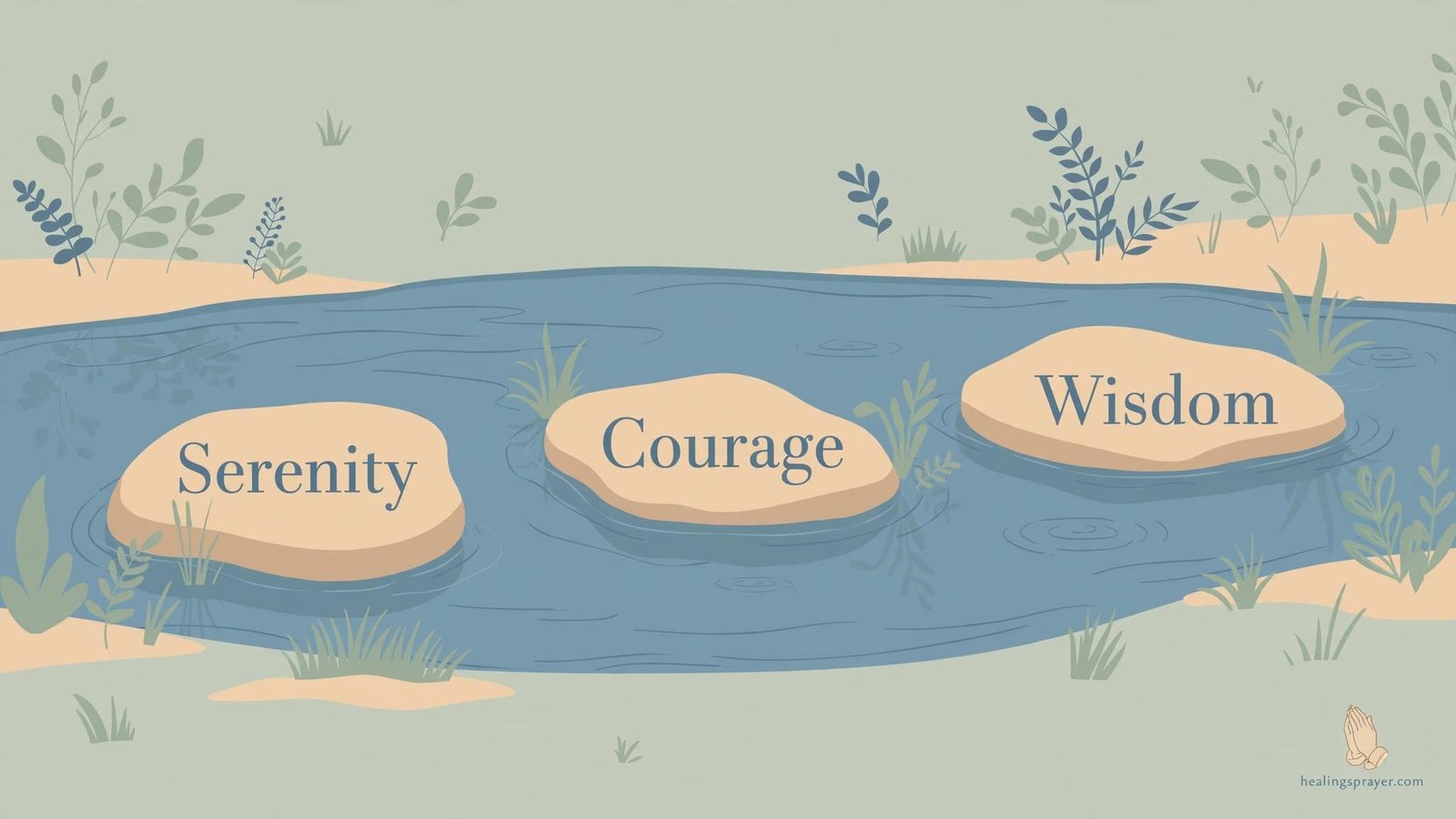
The serenity prayer is a short prayer that asks for peace to accept what you cannot change, courage to change what you can, and wisdom to know the difference. It is most often linked to the American theologian Reinhold Niebuhr, and it became world famous through Alcoholics Anonymous and other recovery programs.
That one sentence holds the entire idea. The rest of this guide shows how those three requests work in real life.
The Three Requests Behind the Serenity Prayer
The prayer is built on three asks. Each covers a different part of handling a hard situation:
- Serenity: the calm to accept what lies outside your control.
- Courage: the strength to act on what lies within your control.
- Wisdom: the judgment to tell the two apart.
This structure explains why the serenity prayer helps people of many faiths and people with no faith at all. It describes a mental skill, not only a religious ritual. You can practice the skill the same way you practice any other habit: slowly, repeatedly, and with honest feedback.
Serenity Prayer Short Version vs. Full Version
Most people know the serenity prayer short version. It is only a few lines long, and it is the form used in recovery meetings, on printed cards, and on coins. It contains the three requests and nothing more.
The serenity prayer full version is longer. It adds themes of living one day at a time, enjoying each moment as it comes, accepting hardship as a path toward peace, and trusting that things will be set right. It also closes with a hope for happiness in this life and the next.
Here is a fast way to tell them apart:
- Short version: three requests about acceptance, courage, and wisdom.
- Full version: the same three requests plus a longer reflection on patience, daily living, and trust.
The exact wording of the prayer is still protected or disputed in some forms, so this article explains both versions in its own words. For the complete traditional text, use a licensed source such as an official recovery program publication.
Is the Serenity Prayer in the Bible?

This is the most searched question about the prayer, so it gets a direct answer first.
The Direct Answer
No, the serenity prayer is not in the Bible. You will not find it in any book, chapter, or verse of Scripture. It is a twentieth-century prayer, written long after the Bible was completed.
So if you have been asking “is the serenity prayer in the Bible,” the accurate answer is no. The prayer is Christian-inspired and rooted in biblical themes, but it is not scripture.
Why the Serenity Prayer Feels Like Scripture
The confusion is understandable. The prayer speaks directly to God, uses language of surrender and trust, and matches themes found throughout the Psalms and the New Testament.
Several things strengthen that impression:
- It is common in churches, Bible studies, and Christian recovery groups.
- It often appears on devotional gifts next to Bible verses.
- Its calm, formal tone sounds like ancient prayer language.
- Many people first heard it from a parent, grandparent, or faith-based event, so it feels timeless.
- Some versions of the longer prayer mention a “sinful world,” which echoes biblical vocabulary.
These signals make the prayer seem ancient, even though its wording is modern.
10 Bible Verses That Match the Serenity Prayer
The prayer is not scripture, but these passages carry the same spirit. Each is paraphrased, so check your preferred translation for the exact wording.
- Philippians 4:6-7: Do not be anxious; bring your needs to God, and His peace will guard your heart and mind. Use it when: worry is loud and you need to hand a problem over.
- Psalm 46:10: Be still and know that God is God. Use it when: you are forcing an outcome that will not move.
- Proverbs 3:5-6: Trust God fully instead of relying only on your own understanding. Use it when: you cannot see the next step.
- Matthew 6:34: Do not worry about tomorrow, because each day has enough trouble of its own. Use it when: your mind races ahead.
- 1 Peter 5:7: Place your anxieties on God because He cares for you. Use it when: you carry more than you should alone.
- James 1:5: If you lack wisdom, ask God, who gives generously. Use it when: you cannot tell what is yours to change.
- Ecclesiastes 3:1: There is a season and a time for every matter under heaven. Use it when: a slow process tests your patience.
- 2 Corinthians 12:9: God’s grace is enough, and His power shows up in weakness. Use it when: you have reached the limit of your own strength.
- Isaiah 41:10: Do not fear, because God is with you and will strengthen you. Use it when: courage feels out of reach.
- Joshua 1:9: Be strong and courageous, because God is with you wherever you go. Use it when: the next step requires bravery.
You can match these verses to the three requests. Verses 1, 4, 5, and 7 line up with the serenity request. Verses 8, 9, and 10 line up with the courage request. Verses 3 and 6 line up with the wisdom request, while verse 2 supports all three.
Reading these passages beside the serenity prayer gives you a Bible-based companion to it. Many people read one verse, say the prayer slowly, and then sit quietly for a minute.
Who Wrote the Serenity Prayer?

Reinhold Niebuhr’s Account
The serenity prayer is most often credited to Reinhold Niebuhr, an American theologian who taught at Union Theological Seminary in New York. He said he wrote it in the early 1940s, and it spread widely during World War II. Families and service members were searching for short words of comfort, and the prayer fit that need.
His daughter, Elisabeth Sifton, later wrote a book about the prayer and its history. It supports the family’s account of where the prayer came from.
Earlier Wording Found in Print
The history is not completely settled. Fred Shapiro, editor of the Yale Book of Quotations, reported finding similar wording in print from the 1930s. That discovery raised the question of whether Niebuhr was the first to use it.
Historians weigh this evidence differently. Some treat it as proof of an earlier source. Others think the wording circulated informally before Niebuhr shaped the version people know today.
Ancient Roots of the Idea
The idea behind the prayer is far older than its wording. The Stoic philosopher Epictetus taught that some things are up to us and some are not. Writers in several religious traditions have also encouraged peace in the face of what cannot be changed, and similar thoughts are often linked to older Christian, Jewish, and Buddhist texts.
Here is the fair summary: Niebuhr is the person most closely tied to the serenity prayer, while its exact earliest wording is still debated. Verify dates and attributions with a trusted history source before quoting them in your own work.
Also Read : 80+ Powerful Words for Strength, Healing, and Peace
How the Serenity Prayer Spread Through AA and the 12 Steps
Alcoholics Anonymous (AA) is the main reason the serenity prayer is known worldwide. In the early 1940s, AA members came across the prayer, and it quickly became part of the fellowship. It was printed on small cards and passed around the movement.
From there it reached Narcotics Anonymous, Al-Anon, Overeaters Anonymous, and nearly every 12-step program. Today the serenity prayer is almost a symbol of recovery culture, and many meetings open or close with it.
The prayer fits recovery for a practical reason. People in recovery face cravings, memories, and relationships they cannot control, alongside choices they can control. The prayer gives them a simple sorting tool for each moment of the day.
The link to the 12 steps runs deeper than the meetings. Step 1 asks people to admit powerlessness over certain things, which matches the “accept” request. Later steps ask for honest action and personal responsibility, which matches the “courage” request. The prayer sits between them as a daily reminder.
It is just as useful outside recovery. Anyone dealing with stress, grief, burnout, or uncertainty can apply the same three-part idea.
Serenity Prayer Meaning, Line by Line
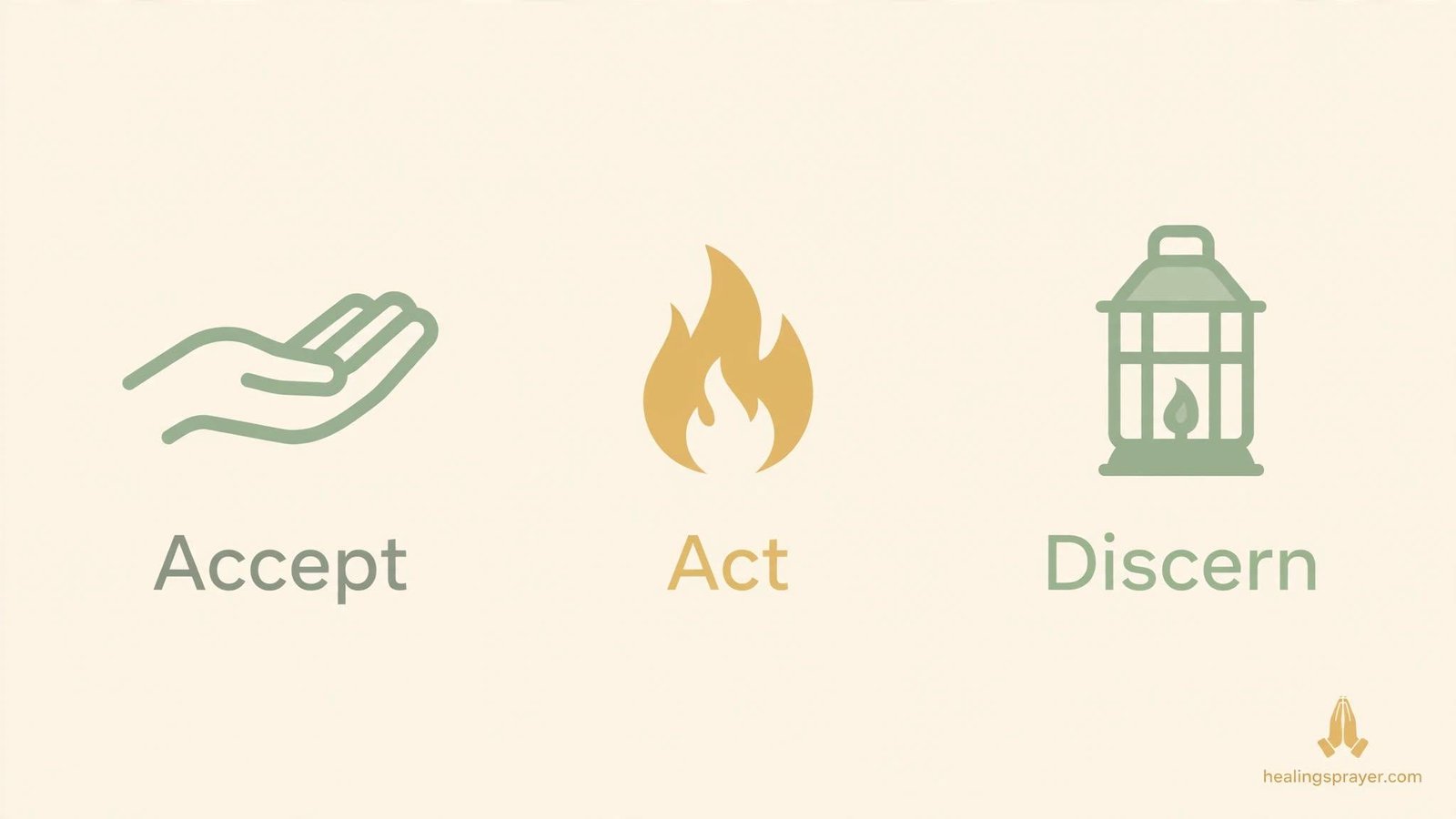
The serenity prayer works because it splits stress into three jobs. Each job needs its own skill, and each skill can be practiced.
Serenity: Accepting What You Cannot Change
What it asks: peace with limits. Much suffering comes from fighting reality, such as the past, other people’s choices, illness, or loss. When the prayer asks you to accept the things you cannot change, it does not mean approval or giving up. It means you stop spending energy on what will not move.
Acceptance also does not require you to feel happy about a situation. You can accept a loss and still grieve it. You can accept a diagnosis and still dislike it. The goal is to end the argument with reality so your energy is free for something useful.
Signs you need this part:
- You replay the same event repeatedly.
- You argue in your head with people who are not present.
- You feel worn out by something you cannot affect.
- You wake at night rehearsing conversations that already happened.
Try this:
- Say it out loud: “This is outside my control.”
- Breathe out slowly while you say it.
- Write down one feeling you are allowed to have about it.
- Redirect your attention to the next small task.
Courage: Changing What You Can
What it asks: action. Peace is not passivity. Some things are yours to change, including your habits, your responses, your boundaries, and your choices. The prayer’s request for courage to change the things I can admits that change is uncomfortable.
Courage here is usually quiet. It looks like making the phone call, saying the honest sentence, or leaving the habit that harms you. Small actions repeated daily count as much as large dramatic ones.
Signs you need this part:
- You keep putting off a decision you already know you must make.
- You complain about a situation but have not tried one step.
- You wait for others to change first.
- You say “someday” about something that needs a date.
Try this:
- Pick the smallest action you can take today.
- Set a time for it, not just an intention.
- Tell one trusted person what you plan to do.
- Review the result tonight without judging yourself.
Wisdom: Knowing the Difference
What it asks: discernment. This is the heart of the serenity prayer and its hardest part. Most people struggle less with acceptance or courage than with deciding which situation they are facing.
Wisdom grows from honest information. Ask what the facts are, what you have already tried, and what other people who know the situation say. The more accurate your picture, the less you mislabel things.
Signs you need this part:
- You cannot tell whether to keep trying or let go.
- You flip between “I must fix this” and “nothing helps.”
- Others give you opposite advice and you feel stuck.
- You feel guilty when you rest and anxious when you act.
Try this:
- Ask: “What part of this depends on me?”
- Ask: “What happens if I do nothing for a week?”
- Ask someone you trust to check your thinking.
- Pause and reflect quietly before deciding, not after.
Why the Serenity Prayer Works
The serenity prayer has lasted for decades because it matches well-known ideas in psychology and philosophy.
- Focus on control. The Stoic idea of separating what is up to you from what is not shows up again in modern coping research. Psychologists Richard Lazarus and Susan Folkman described coping as, in part, judging whether a stressful situation can be changed.
- Acceptance lowers distress. Acceptance and Commitment Therapy (ACT), developed by Steven Hayes and colleagues, teaches people to accept what they cannot control while acting on their values.
- Locus of control matters. Julian Rotter’s research on locus of control shows that how much control you believe you have shapes how you cope.
- Action gives worry somewhere to go. Picking one controllable step turns vague anxiety into a clear task.
- Ritual calms the body. Repeating a short, familiar phrase slowly pairs well with deep breathing, which can help settle the stress response.
- Simple tools get used. A three-part prayer is easy to remember during a crisis, when complex advice is hard to recall.
You do not need to be religious to use this framework. If you live with persistent anxiety, depression, or addiction, the serenity prayer works best alongside professional support, not instead of it.
Also Read : How to Start a Prayer Journal (That Actually Sticks)
How to Use the Serenity Prayer in Daily Life
10 Situations With Ready-to-Use Control Sorts
For each situation, copy the lines into your notes and replace them with your own details.
- Work stress. Can change: how you plan your day, what you ask for, and when you log off. Cannot change: your manager’s mood or company decisions.
- Anxiety. Can change: your breathing, sleep routine, and news intake. Cannot change: the first thought that arrives.
- Relationships. Can change: how you speak and the boundaries you set. Cannot change: what the other person chooses to do.
- Grief and loss. Can change: how you care for yourself and honor the memory. Cannot change: the loss itself.
- Health concerns. Can change: following medical advice, resting, and asking questions. Cannot change: a diagnosis or test result already given.
- Money pressure. Can change: your budget, spending, and next steps. Cannot change: prices, interest rates, or market swings.
- Recovery and cravings. Can change: where you go, who you call, and what you do in the next hour. Cannot change: that the urge shows up.
- Parenting. Can change: your tone, routines, and example. Cannot change: your child’s personality or every choice they make.
- Family conflict. Can change: how long you stay and how calmly you answer. Cannot change: old patterns in other people.
- Waiting on results. Can change: how you spend the waiting time. Cannot change: when the answer arrives or what it says.
A 5-Minute Serenity Prayer Routine
- Pause and take three slow breaths.
- Say the serenity prayer slowly, one line per breath, silently or aloud.
- Write the problem in one sentence.
- Sort it into “can change” and “cannot change.”
- Choose one action from the first list and schedule it.
Do this once in the morning and once when stress spikes. After two weeks, most people sort problems faster and react less sharply.
Serenity Prayer for Anxiety, Grief, Healing, and Recovery
Many readers search for the serenity prayer for anxiety or the serenity prayer for healing. The prayer adapts well to both, because both involve things you cannot control and things you can.
For anxiety: Say the prayer when a worry loop starts. Then name the one thing within your control, such as a phone call, a walk, or an early night. Let the rest wait.
For grief: The “serenity” line gives you permission to stop fighting the loss. The “courage” line points toward small acts of care: eating, resting, and reaching out to people who understand.
For healing from illness or hard seasons: The prayer separates the diagnosis, which you cannot change, from your habits, questions, and support network, which you can. This protects your energy for the places where it makes a difference.
For emotional healing after conflict: The prayer helps you release the need to control how others respond, while you decide what you will say, set, or stop.
For addiction recovery: The prayer works as an in-the-moment pause. Say it when a craving rises, then use the “courage” line to contact a sponsor, leave the environment, or start a replacement activity.
How to Personalize the Serenity Prayer
You do not have to change the traditional wording, but you can shape how you use it so it fits your life.
- Adjust the language. If addressing God does not fit your beliefs, read it as a reflective statement about acceptance, courage, and judgment.
- Attach it to a habit. Say it after brushing your teeth, before opening email, or when you start the car.
- Pair it with a physical cue. A bracelet, a card in your wallet, or a sticky note on your mirror reminds you to pause.
- Write your own closing line. After the prayer, add one sentence naming today’s priority, such as “Today I will make the call.”
- Keep a weekly review. Each Sunday, list which worries you let go of and which actions you completed.
- Match it to your faith practice. Pair the prayer with a Bible verse, a breathing exercise, or a few minutes of silence, depending on your tradition.
The Accept, Act, Ask Sort
Most articles stop at two columns. Add a third. Write one column for Accept, one for Act, and one for Ask for help.
The third column matters because some problems are neither fully yours nor fully out of reach. They need other people: a doctor, a counselor, a sponsor, a friend, or a faith leader. Moving an item into “Ask” is often the wise answer when “Accept” feels like surrender and “Act” feels impossible alone.
A 30-Day Serenity Prayer Practice Plan
A habit forms faster with a plan. Use this four-week schedule.
Week 1: Notice. Say the prayer once each morning. Each evening, write down one worry you spent time on and mark it “can change” or “cannot change.” Do not try to fix anything yet.
Week 2: Accept. Keep the morning prayer. Each day, choose one item from your “cannot change” list and practice the line “This is outside my control” with a slow exhale.
Week 3: Act. Keep the earlier steps. Each day, choose one item from your “can change” list and complete one small action before dinner.
Week 4: Ask and review. Add the Accept, Act, Ask sort. Contact one person for support on an item that feels too heavy alone. On day 30, read your notes and list three patterns you notice.
Keep the notes in one notebook so you can see your progress. Many people find the written record more convincing than memory.
10 Common Mistakes When Using the Serenity Prayer
- Treating acceptance as giving up. Acceptance ends the struggle with reality, not your effort to improve your situation.
- Using it to avoid hard actions. If everything lands in the “cannot change” column, check whether fear is making that choice.
- Forgetting the courage line. Many people repeat only the calm part and skip the action part.
- Rushing the wisdom part. Deciding in a panic leads to mislabeling. Pause first.
- Using it to excuse harm. Accepting a situation never means staying in abuse or danger. Seek safety and professional help.
- Reciting without thinking. Words repeated on autopilot lose their power. Slow down and mean them.
- Expecting instant calm. The prayer is a practice. Calm grows with repetition.
- Replacing professional care. For clinical anxiety, depression, or addiction, use the prayer alongside therapy, medical care, or support groups.
- Judging yourself for forgetting it. Missing a day does not cancel your progress. Return to it the next morning.
- Applying it to other people’s lives. Telling someone else to “just accept it” ignores their pain. Use the prayer as a tool for yourself first.
Serenity Prayer Summary Table
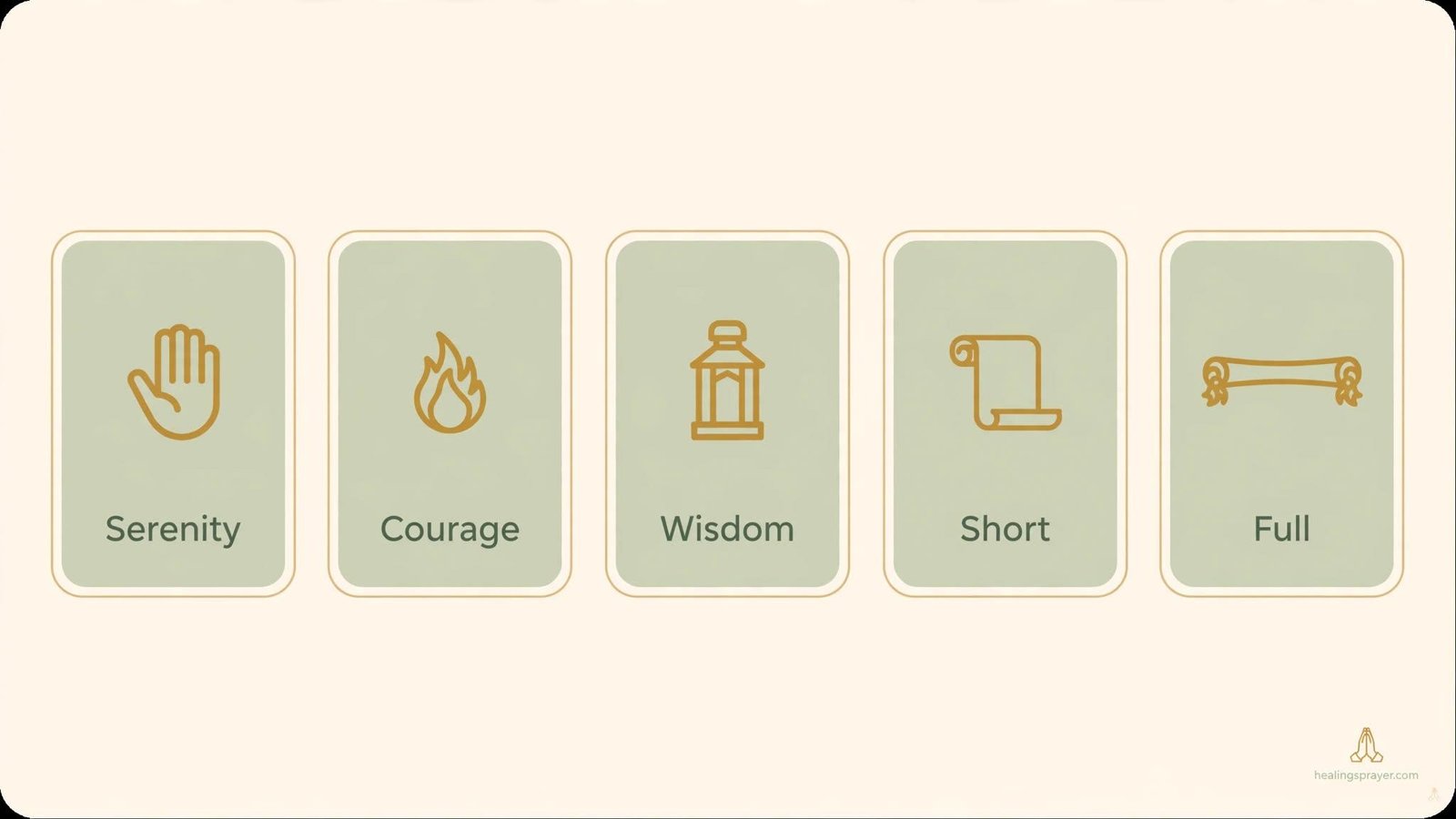
| Part of the Prayer | What It Asks For | When to Use It | Example Self-Prompt |
|---|---|---|---|
| Serenity | Peace with what you cannot change | When you replay the past or argue with reality | “I cannot change what happened. I can choose my next hour.” |
| Courage | Strength to act on what you can change | When you postpone a needed step | “What is the smallest action I can take today?” |
| Wisdom | Judgment to know which is which | When you feel stuck between fixing and letting go | “What part of this depends on me?” |
| Short version | The three requests only | Quick daily use, recovery meetings | Say it slowly, one line per breath |
| Full version | Three requests plus patience and trust | Longer reflection or devotional time | Read it once, then journal one takeaway |
Serenity Prayer FAQs
Is the serenity prayer in the Bible?
No, the serenity prayer is not in the Bible. It is a twentieth-century prayer, though many Bible verses express similar ideas about peace, courage, and wisdom.
Who wrote the serenity prayer?
It is most often credited to theologian Reinhold Niebuhr. Earlier similar wording has been found in print, so historians still discuss its exact origin.
What is the meaning of the serenity prayer?
The serenity prayer asks for peace to accept what cannot be changed, courage to change what can be, and wisdom to know the difference.
What is the serenity prayer short version?
The short version contains only the three requests: accept what you cannot change, change what you can, and know the difference.
Is there a serenity prayer full version?
Yes. The longer version adds themes of living one day at a time, accepting hardship as a path to peace, and trusting that things will be made right.
Why is the serenity prayer used in AA?
AA members adopted it in the early 1940s because it speaks to the daily struggle between what they can and cannot control in recovery.
Is the serenity prayer only for people in recovery?
No. It became famous through AA, but anyone can use it for stress, anxiety, grief, or difficult decisions.
Is the serenity prayer religious?
It addresses God, so it is rooted in a religious tradition. Many people adapt the language or use it as a reflective mindset exercise.
Can the serenity prayer help with anxiety?
It can help you sort worries into controllable and uncontrollable, which reduces mental overload. For ongoing anxiety, combine it with professional support.
Is the serenity prayer a Christian prayer?
It grew out of a Christian setting, but people of many faiths and none use it today. Its three-part idea does not depend on one belief system.
How often should I say the serenity prayer?
Once in the morning and again whenever stress rises works well for most people. Quality matters more than frequency, so say it slowly.
Final Thoughts on the Serenity Prayer
The serenity prayer is not found in the Bible, but its message of peace, courage, and wisdom speaks to Scripture and to human experience far beyond any one faith. Its history includes Reinhold Niebuhr, wartime comfort, and the growth of recovery programs, while its core idea reaches back to ancient philosophy.
What keeps the serenity prayer alive is its usefulness. You accept what you cannot change, act on what you can, and ask for the judgment to tell them apart. Use the routine, the control sorts, and the 30-day plan above, and return to the serenity prayer whenever life feels heavier than it should.

Welcome to Healings Prayer!
Healings Prayer is a faith-based platform created to offer comfort, hope, and encouragement through prayer and Scripture. Our mission is to help people find peace in difficult moments and draw closer to God through heartfelt prayers and Bible verses.