
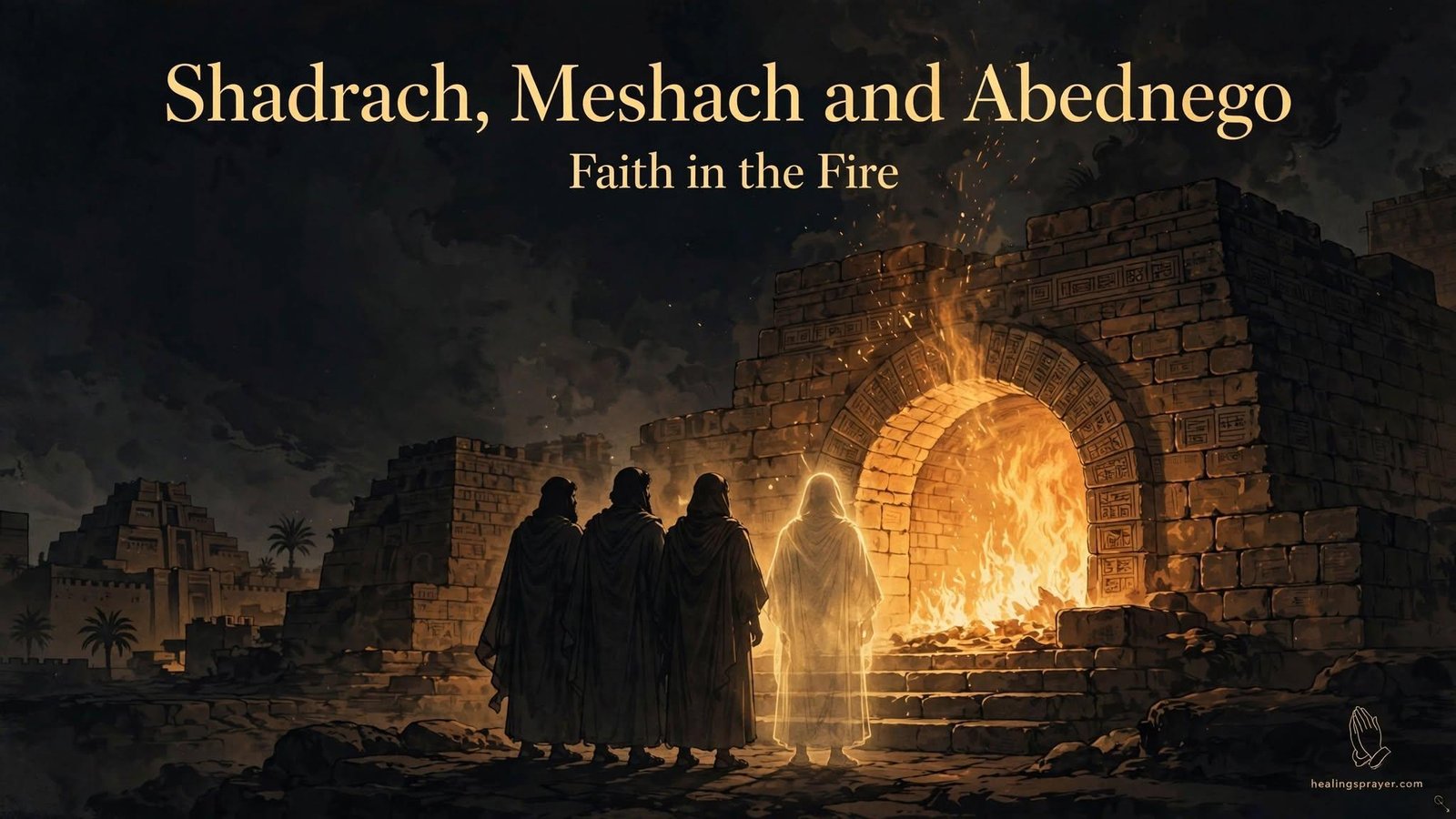
Shadrach, Meshach and Abednego are three young Hebrew men whose story appears in the third chapter of the Book of Daniel. They refused to bow to a golden statue, survived a blazing furnace, and became one of the Bible’s best-known examples of faith under pressure.
This complete guide to Shadrach, Meshach and Abednego is written for Bible readers, parents, teachers, and anyone looking for faith that holds under pressure. You will find the full story, the key Bible verses, the meaning of their names, and the debate about the fourth man in the fire.
You will also get ten practical lessons, short prayers, a 7-day reflection plan, and ideas for teaching the story to children. If you searched for “shadrack,” “meshack in the Bible,” “abednego bible,” or “sadrac mesac abednego,” you are in the right place. Those are common spellings of the same three names.
Who Were Shadrach, Meshach and Abednego?
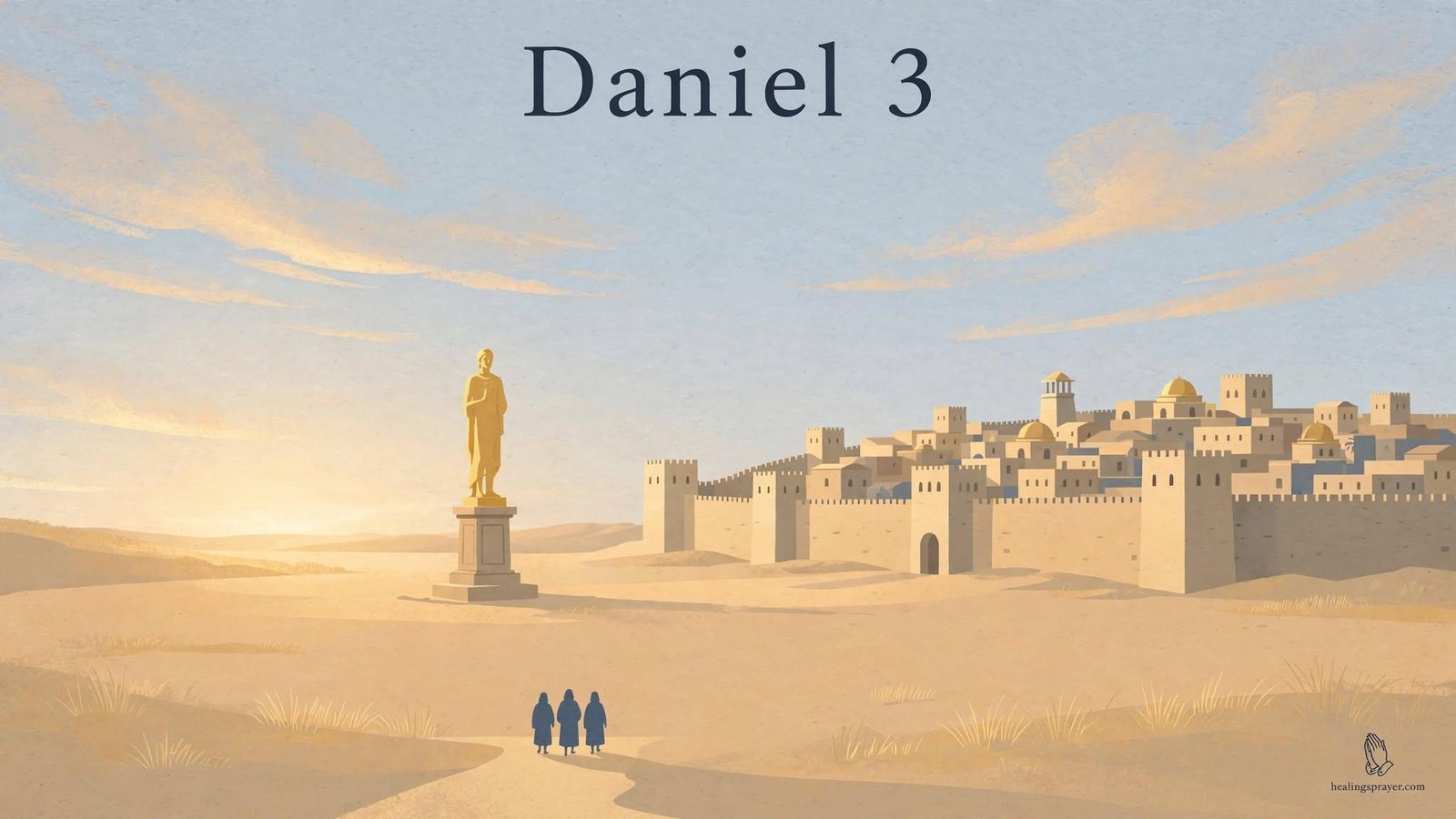
Shadrach, Meshach and Abednego were three Jewish young men from Judah who served in the royal court of Babylon under King Nebuchadnezzar and refused to worship his golden image. Their original Hebrew names were Hananiah, Mishael and Azariah.
They appear in Daniel chapters 1 and 3. They are often taught alongside Daniel, who was taken to Babylon in the same group.
Their Hebrew Names and Babylonian Names
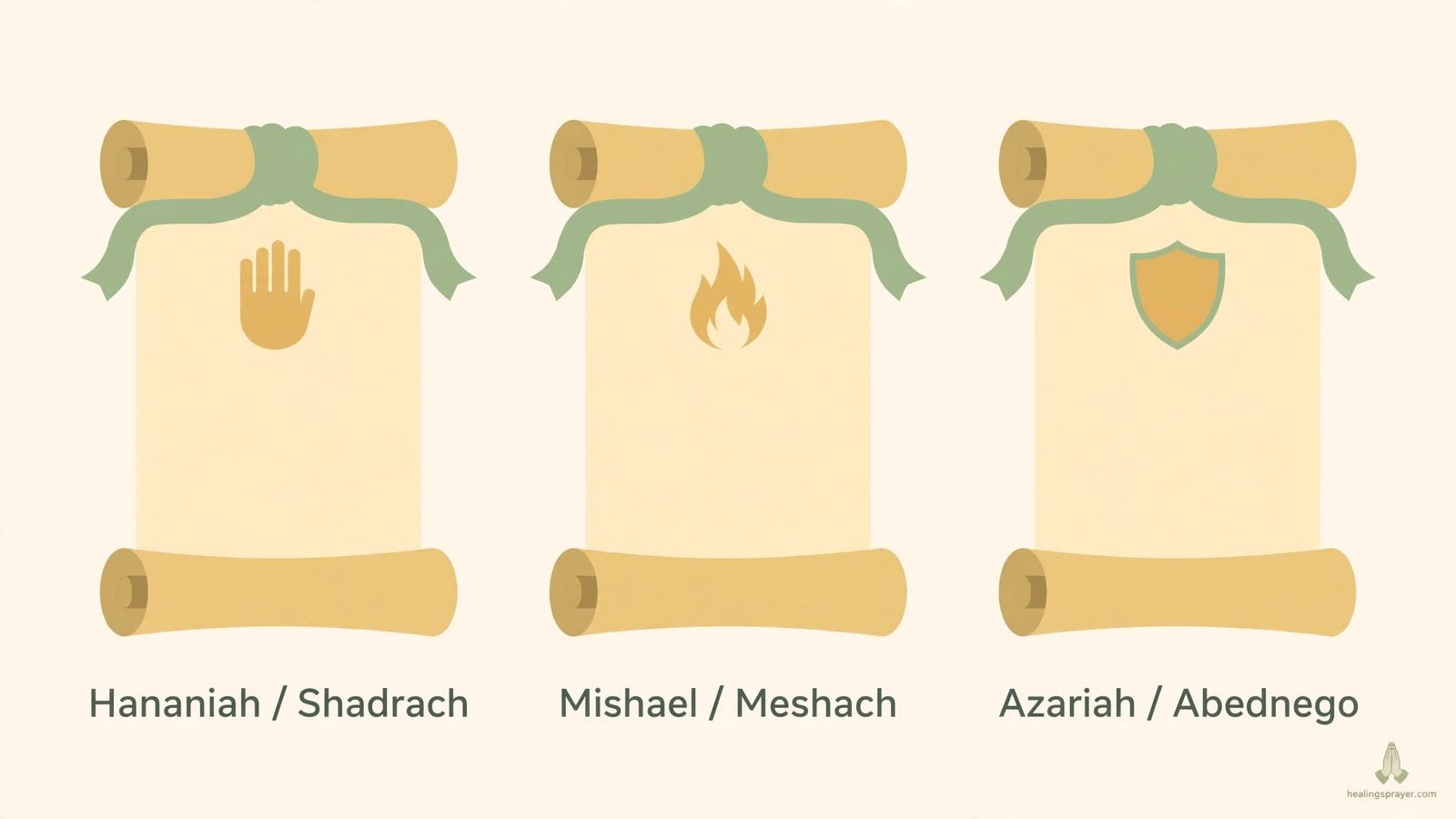
The three men were born with Hebrew names. After they were selected for royal training, the chief official in charge gave them new Babylonian names (Daniel 1:7).
- Hananiah became Shadrach.
- Mishael became Meshach.
- Azariah became Abednego.
- Daniel was renamed Belteshazzar.
The name change was part of a larger effort to reshape their identity. Babylon wanted them to think, eat, speak, and serve like Babylonians.
Why They Were in Babylon
Babylon conquered Judah in the late seventh and early sixth centuries BC and took a group of educated young men from noble families into exile. These young men were trained for three years in Babylonian language and literature before entering the king’s service.
The Bible presents this as a high-pressure setting. They held official positions, lived far from home, and faced constant pressure to blend in. The story of Shadrach, Meshach and Abednego did not begin at the furnace. It began years earlier with small decisions about food, loyalty, and daily habits.
The Early Test in Daniel 1
Daniel 1 describes the first test. The young men were offered food and wine from the king’s table, and Daniel asked for permission not to defile himself with it. The official in charge feared for his own safety if they looked weaker than the other trainees.
Daniel proposed a ten-day trial of simple food and water. At the end, the four looked healthier than those who ate the royal food, and they were allowed to continue. The text credits God with giving them knowledge and skill.
This early test matters for understanding Shadrach, Meshach and Abednego. Their courage in chapter 3 was not sudden. It grew from a habit of making faithful choices in small matters long before a large one arrived.
The Story of Shadrach, Meshach and Abednego in Daniel 3
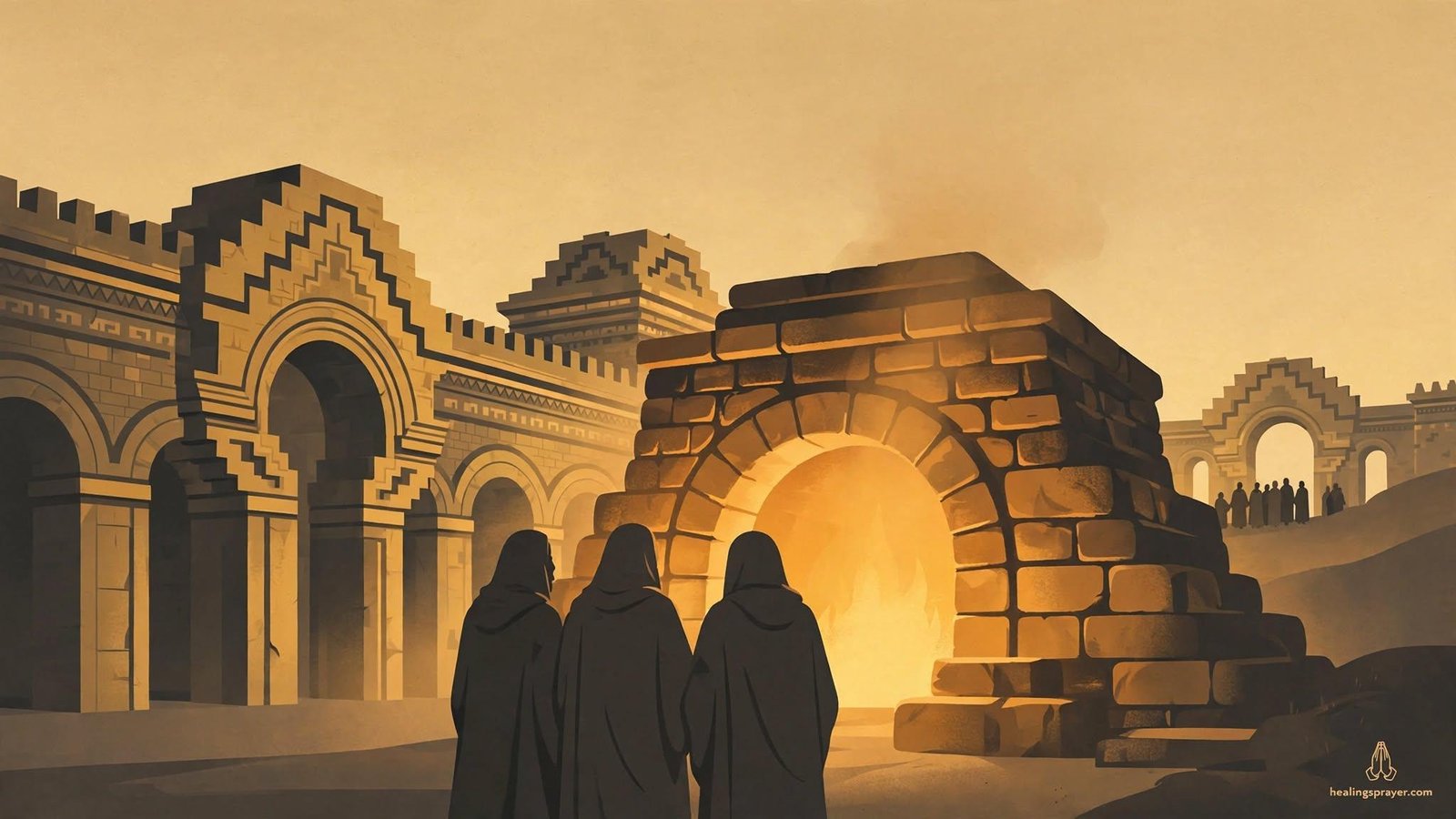
Here is the story of Shadrach, Meshach and Abednego in clear order. The wording is paraphrased, so read Daniel 3 in your preferred Bible translation alongside it.
The Golden Statue
King Nebuchadnezzar built a huge golden image on the plain of Dura. Daniel 3:1 gives its size as about sixty cubits high and six cubits wide, which is roughly ninety feet tall and nine feet wide.
He ordered all officials to gather for its dedication. When the music played, everyone was to bow and worship. The orchestra included horns, flutes, lyres, harps, and pipes (Daniel 3:5). Anyone who refused would be thrown into a blazing furnace.
The Refusal
Some astrologers (Chaldeans) reported to the king that three Jewish officials, Shadrach, Meshach and Abednego, were not worshiping the statue. Nebuchadnezzar was furious and summoned them.
He offered a second chance. If they bowed when the music played, all would be well. If not, the furnace awaited, and he asked who could rescue them from his hand.
Their answer in Daniel 3:16-18 is the heart of the chapter. They said they did not need to defend themselves. They believed the God they served was able to rescue them from the furnace and from the king. And even if God did not rescue them, they would not serve his gods or worship the golden image.
The Fiery Furnace
Nebuchadnezzar’s anger changed his expression. He ordered the furnace heated seven times hotter than usual and had his strongest soldiers bind the three men and throw them in (Daniel 3:19-20).
The fire was so intense that the soldiers who carried them died from the heat. Shadrach, Meshach and Abednego fell, bound, into the flames.
The Fourth Man
Then the king jumped up in alarm. He had seen three men thrown in bound, yet now he saw four men walking around freely in the fire, unharmed. He described the fourth as looking like a son of the gods (Daniel 3:24-25).
Nebuchadnezzar approached the furnace and called the three men out by name, calling them servants of the Most High God. They walked out.
The Aftermath
Officials gathered around them and saw the evidence. Their bodies were unharmed, their hair was not singed, their clothing was not damaged, and they did not smell of smoke (Daniel 3:27).
Nebuchadnezzar praised their God, who sent an angel to rescue servants who trusted him and defied the royal command (Daniel 3:28). He ordered that no one speak against their God, and he promoted Shadrach, Meshach and Abednego in the province of Babylon.
Also Read : 210+ Uplifting International Day of Light Quotes 2026: Inspiring Wishes, Messages, and Sayings
Shadrach, Meshach and Abednego Bible Verse: 8 Key Passages
Many readers search for the Shadrach, Meshach and Abednego Bible verse that best sums up the story. The core text is Daniel 3, and these eight passages matter most. Each is paraphrased, so check your preferred translation for the exact wording.
- Daniel 1:7. The chief official gave the four young men new Babylonian names. Use it when: you want to understand the identity pressure they faced.
- Daniel 3:12. The accusers pointed out that the three men did not serve the king’s gods. Use it when: you face criticism for a faith-based choice.
- Daniel 3:16. The three men said they did not need to defend themselves before the king. Use it when: you feel pressure to over-explain your convictions.
- Daniel 3:17. They said the God they served was able to deliver them. Use it when: you need confidence in God’s power.
- Daniel 3:18. They said that even if God did not rescue them, they would still not worship the image. Use it when: you need faith that does not depend on the outcome.
- Daniel 3:25. The king saw four men walking unharmed in the fire. Use it when: you need reassurance that God is present in hardship.
- Daniel 3:27. Their bodies, hair, and clothes showed no sign of fire. Use it when: you need a reminder of God’s protection.
- Daniel 3:28. The king blessed the God who sent an angel to rescue his servants. Use it when: you want to see how faith can change the people watching.
If you want the single most quoted section, it is Daniel 3:16-18. Many people memorize it as a statement of faith that stays steady whether the result is rescue or not. The Shadrach, Meshach and Abednego Bible verse list above works well as a study guide for a small group or personal devotion.
Meaning of the Names Shadrach, Meshach and Abednego
Names carry meaning in the Bible, so the names of Shadrach, Meshach and Abednego are worth a closer look.
Their Hebrew names point to God:
- Hananiah is commonly understood to mean “the Lord is gracious.”
- Mishael is commonly understood as a question meaning “who is what God is?” or “who is like God?”
- Azariah is commonly understood to mean “the Lord has helped.”
Each name carries the name of God inside it. Their parents gave them identities built around God’s grace, greatness, and help.
Their Babylonian names are less certain. Scholars connect the names with Babylonian gods or language, and the exact meaning of Shadrach and Meshach is still debated. Abednego is widely understood to mean “servant of Nego,” likely a form of Nabu, a Babylonian god. Because these meanings are debated, treat any single translation with caution.
The takeaway is clear. Babylon tried to replace names that honored the Lord with names tied to Babylonian gods. Yet the men themselves kept the faith that their Hebrew names declared.
Spelling variations you may see: Shadrack, Meshack, Abednigo, and the Spanish forms Sadrac, Mesac, and Abed-nego. All point to the same three men.
Who Was the Fourth Man in the Fiery Furnace?
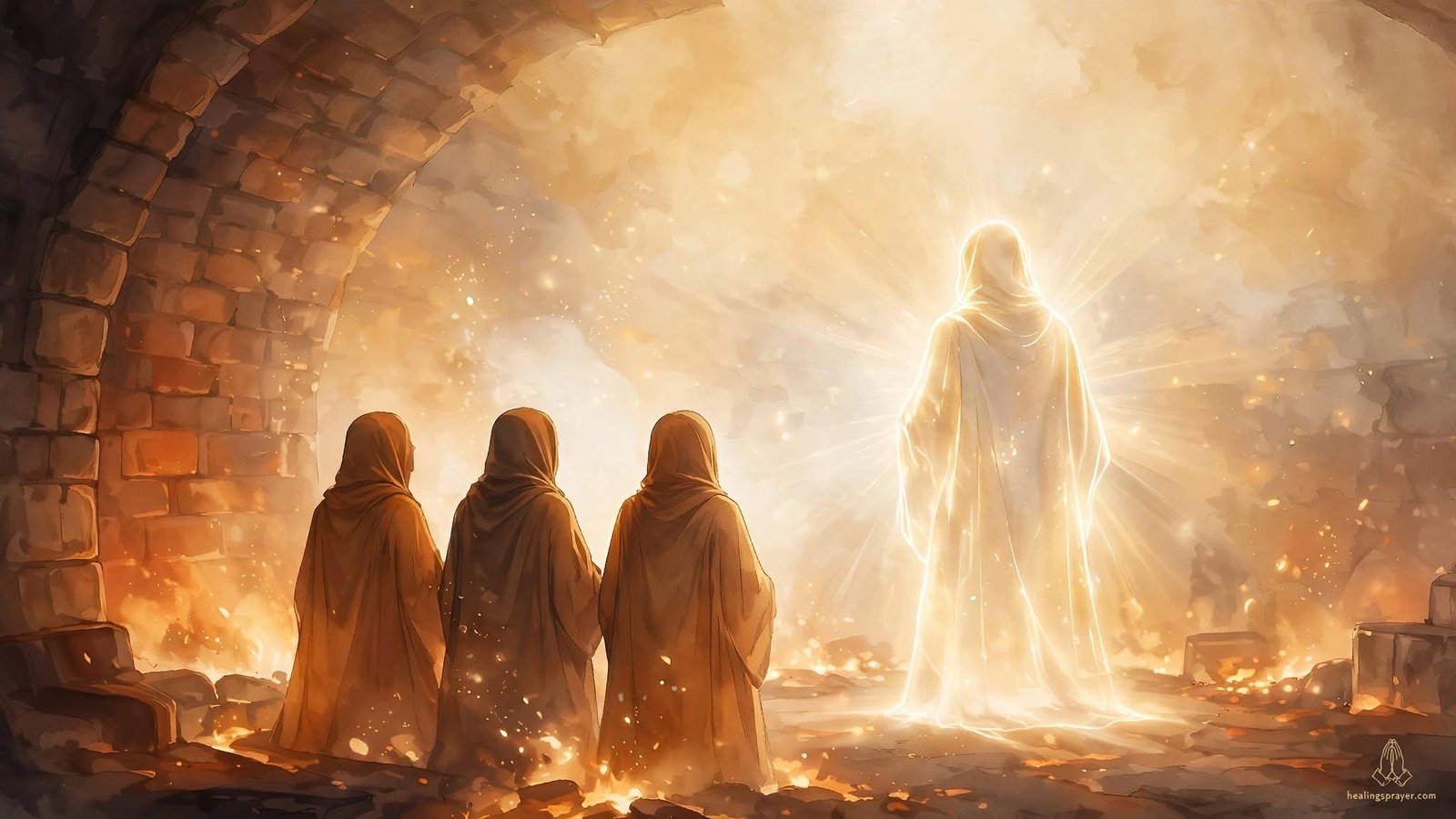
The fourth man in the fiery furnace is one of the most searched questions about this story. Daniel 3:25 says the king saw a fourth figure who looked like a son of the gods. Three main views exist.
- An angel. Daniel 3:28 says Nebuchadnezzar praised God who sent his angel to deliver the three men. Many readers take the fourth figure to be this angel.
- A pre-incarnate appearance of Christ. Many Christian readers see the fourth man as the Son of God appearing before the incarnation. They note that the Bible often shows God present with his people in suffering.
- A divine presence in general. Some scholars say the text only shows that a heavenly being was with them, without naming exactly who it was.
The text does not settle the debate. What it does state clearly is simple: Shadrach, Meshach and Abednego did not walk through the fire alone. That point is the same for all three views and is the part most readers carry with them.
Remember that Nebuchadnezzar was not a believer in Israel’s God when he spoke these words. He described what he saw with the language he had, which is why the phrase “son of the gods” should be read carefully.
10 Powerful Lessons From Shadrach, Meshach and Abednego

These lessons come directly from the text of Daniel 3, not from guesswork. Each one includes a practical step.
1. Faith Shows Up Before the Crisis
The three men did not invent courage in front of the furnace. Daniel 1 shows them making small, faithful choices years earlier. Practice: decide today how you will respond to a pressure you know is coming.
2. Stand for Your Convictions Respectfully
They answered the king calmly, without insulting him. They stated what they would not do and trusted God with the rest. Practice: when you disagree with someone in authority, state your position in one clear, polite sentence.
3. You Do Not Have to Win the Argument
They told the king they had no need to defend themselves. Some moments call for a clear answer, not a long debate. Practice: before replying under pressure, ask whether a short answer would be stronger.
4. Believe God Is Able
They said the God they served could deliver them. Their faith began with a clear belief about who God is. Practice: write down three ways God has helped you or your family and read them when fear rises.
5. Faith Holds Even If the Outcome Is Hard
The phrase “even if he does not” shows faith that does not depend on getting the result you want. Practice: finish the sentence “God, I trust you even if…” in your journal and pray over it.
6. Obedience Can Be Costly
The furnace was a real penalty. The Bible never pretends that faithfulness is always safe. Practice: count the cost before a hard decision, and ask a trusted person to pray with you.
7. There Is Strength in Standing Together
Shadrach, Meshach and Abednego answered the king together. Shared conviction gives each person courage. Practice: find one or two people who share your values and meet with them regularly.
8. God Is With You in the Fire
The fourth man shows that God’s presence is not limited to easy places. He did not only watch from outside. Practice: in hard moments, read Daniel 3:25 slowly and pray, “Be with me here.”
9. Your Faith Can Affect Those Watching
Nebuchadnezzar ended the chapter praising the God of the three men. Faithfulness under pressure often speaks louder than words. Practice: ask how your daily choices might show your faith to the people around you.
10. Do Not Let Pressure Redefine Your Identity
Babylon gave them new names, but they did not let go of the faith their old names carried. Practice: write your core values on a card and review them each morning.
Shadrach, Meshach and Abednego Quotes and Short Prayers
Many readers want short lines they can pray or write on a card. These are original lines based on the themes of Daniel 3, not quotations from any translation.
Short prayers inspired by the story:
- “Lord, give me courage to stand when everyone else bows.”
- “God, I trust you in the fire, and I trust you even if the outcome is hard.”
- “Father, be with me in the place where I feel alone.”
- “Lord, keep my identity rooted in you, not in what pressure tells me to be.”
- “God, give me calm words when I am questioned about my faith.”
- “Lord, help me remember that you are able.”
Short reflection lines:
- Faith is not the absence of fear. It is choosing loyalty to God in spite of it.
- The furnace did not decide who they were. Their God did.
- Courage is often a quiet answer, not a loud speech.
How to use them: Write one line on a sticky note, place it where you will see it daily, and repeat it slowly when pressure rises.
Also Read : 300+ Uplifting Loyal Love Quotes About Trust, Faithfulness, and Staying True
Where Was Daniel in the Story of Shadrach, Meshach and Abednego?
Many readers notice that Daniel is absent from Daniel 3. This is a common search and an angle many articles skip.
The Bible does not explain why. Readers have suggested several possibilities:
- Daniel may have been away on official business.
- The chapter may focus on the three men for the purposes of its message.
- Daniel’s position may have placed him outside the group summoned to the dedication.
The text does not say, so any explanation is a guess. What the absence shows is that faith sometimes has to stand without a familiar leader or friend beside you. Daniel’s own test comes later, in Daniel 6.
Historical Background of the Fiery Furnace in Babylon
The fiery furnace in Daniel 3 was not an invented punishment. Ancient Babylon used fire as a form of execution, and the Bible itself mentions this practice in Jeremiah 29:22, where two false prophets were roasted in fire by the king of Babylon. This helps you understand why Nebuchadnezzar’s threat sounded believable to everyone present.
What historians and Bible scholars generally agree on:
- Large brick kilns and furnaces were common in ancient Mesopotamia, used for baking bricks and smelting metals.
- Nebuchadnezzar II was known for his massive building projects, which required enormous quantities of baked brick.
- Public displays of loyalty, such as bowing to a royal image, were a normal way to prove allegiance to a ruler.
Because the furnace was a familiar tool in the city, the threat was real, practical, and immediate. That context makes the courage of Shadrach, Meshach and Abednego even clearer. They were not facing an imaginary danger.
Why this matters for you: Reading Daniel 3 with its historical setting in mind keeps you from treating it as a fairy tale. It was a real test with real consequences, and that is why the story still speaks to people facing real pressure today.
Related Bible Passages That Echo Daniel 3
Several other passages connect with the story of Shadrach, Meshach and Abednego. All are paraphrased.
- Isaiah 43:2. God promises to be with his people through water and fire. This closely matches the furnace.
- Hebrews 11:33-34. Among the heroes of faith, some are described as quenching the power of fire. Many readers link this to Daniel 3.
- Acts 5:29. The apostles say they must obey God rather than people. This matches the choice at the golden statue.
- 1 Peter 4:12-13. Believers are told not to be surprised by fiery trials. This connects to the idea of testing.
- Psalm 23:4. God is with the believer even in the darkest valley. This echoes the fourth man.
- Exodus 20:3-5. The commands against other gods and images explain why the three men refused to bow.
- Daniel 6. Daniel’s refusal to stop praying and his night in the lions’ den follows the same pattern of faith under royal pressure.
- Romans 8:38-39. Nothing can separate believers from God’s love, which fits the theme of divine presence in suffering.
Shadrach, Meshach and Abednego in Jewish and Christian Tradition
The story of Shadrach, Meshach and Abednego holds an important place in both Jewish and Christian teaching, though each tradition reads it with its own emphasis.
In Jewish tradition, the story is often read as an example of kiddush Hashem, the idea of honoring God’s name through faithful action under pressure. The three men are remembered as a model of refusing idolatry even when the cost is life itself.
In Christian tradition, the story is often used to teach faith in hardship, and many Christians connect the fourth figure in the furnace with God’s presence through Christ. Early Christian writers also used the story as an example of steadfast faith under persecution.
In some Christian traditions, an additional text called the Prayer of Azariah and the Song of the Three Holy Children is included with the Book of Daniel. It is found in Catholic and Orthodox Bibles but not in most Protestant Bibles. If you notice differences between Bibles, this is the reason.
What stays the same across traditions: All see the three men as examples of loyalty to God over loyalty to a ruler. That shared message is why the story crosses denominational lines so easily.
How to Apply the Faith of Shadrach, Meshach and Abednego Today
You are unlikely to face a literal furnace, but the pressure points are familiar: workplace compromise, peer pressure, public opinion, and fear of losing status or income. Use the story as a pattern, not as a demand for dramatic action.
- Know your lines in advance. Decide what you will and will not do before pressure arrives.
- Answer briefly and calmly. Respect people while staying clear about your position.
- Build a support circle. Faith is easier to keep with people who share it.
- Pray before you decide. Take time with God before reacting.
- Release the outcome. Do your part and trust God with the result, like the “even if” statement.
- Seek wisdom when needed. Talk with a pastor, counselor, or mature friend for complex situations.
Applying the example of Shadrach, Meshach and Abednego does not mean looking for conflict. It means being ready, calm, and clear when a real test finds you.
A 7-Day Reflection Plan
Spend ten minutes a day on this plan. Keep a notebook for your answers.
- Day 1: Read Daniel 3:1-12. Write down one pressure you face that is similar to the golden statue. Journal question: what would bowing look like in my life?
- Day 2: Read Daniel 3:13-18. Write your own “even if” sentence and pray over it. Journal question: where do I need faith that does not depend on results?
- Day 3: Read Daniel 3:19-23. Write down one fear about a hard outcome and give it to God in prayer. Journal question: what is the worst case, and who can support me?
- Day 4: Read Daniel 3:24-25. Write down a time you sensed God’s presence in a hard moment. Journal question: how did I know I was not alone?
- Day 5: Read Daniel 3:26-27. Thank God for one way he has protected you. Journal question: what has been brought through the fire in my life?
- Day 6: Read Daniel 3:28-30. Ask how your faith could influence one person around you. Journal question: who is watching how I handle pressure?
- Day 7: Review. Read your notes and choose one action to take this week.
Teaching Shadrach, Meshach and Abednego to Kids and Sunday School
The story of Shadrach, Meshach and Abednego is a favorite in children’s ministry because it has clear action and a clear message. Use these ideas for ages roughly 5 to 12.
Simple summary for children: Three friends loved God and would not bow to a statue. The king put them in a fire, but God was with them, and they came out safe.
Discussion questions:
- Why did the three friends say no to the king?
- How do you think they felt when they were thrown in?
- Who was the fourth person in the fire?
- What is something brave you can do for God this week?
- Who helps you stay strong when it is hard to do the right thing?
- Why do you think the three friends stayed together?
- How can you be kind and brave at the same time?
- What did the king learn about God at the end?
Activity ideas:
- Memory verse card. Write a short paraphrase of Daniel 3:17 and decorate it.
- Role-play the music cue. Let children practice saying “no, thank you” calmly when the music plays.
- Furnace craft. Make a paper furnace with orange and yellow tissue paper and add four paper figures.
- Name match. Match each Hebrew name to its Babylonian name on cards.
- Courage jar. Add a paper slip each time a child does something brave and kind.
Keep the tone gentle. Younger children can be frightened by the furnace, so focus on God’s presence and rescue.
8 Common Mistakes When Reading the Story
- Treating it as a promise that God always prevents suffering. The “even if” statement shows that faith includes the possibility of loss.
- Skipping Daniel 1. The courage in chapter 3 grows out of small choices in chapter 1.
- Stating the fourth man’s identity as settled fact. The text allows more than one reading.
- Using the story to shame others. The point is faithfulness, not judging people who struggle with fear.
- Ignoring the cost. The men were willing to die. Do not turn the story into a quick-fix lesson.
- Forgetting the supporting characters. The king, the soldiers, and the officials show how God’s work is seen by outsiders.
- Mixing up the names. Learn which Hebrew name goes with which Babylonian name.
- Applying it as a call to be reckless. Wisdom and courage go together, and the men answered calmly.
Shadrach, Meshach and Abednego Summary Table
| Story Stage | What Happens | Bible Reference | Example Lesson to Apply |
|---|---|---|---|
| The Statue | Nebuchadnezzar orders everyone to worship a golden image | Daniel 3:1-7 | Know your limits before pressure arrives |
| The Refusal | The three men decline and state their faith | Daniel 3:16-18 | Answer calmly: “God is able, even if he does not” |
| The Furnace | They are thrown into a furnace heated seven times hotter | Daniel 3:19-23 | Faithfulness can carry a real cost |
| The Fourth Man | The king sees four men walking unharmed | Daniel 3:24-25 | God is present in hard places |
| The Rescue | They walk out with no sign of fire | Daniel 3:26-27 | Trust God with the outcome |
| The Promotion | The king praises God and promotes them | Daniel 3:28-30 | Your faithfulness can influence others |
Shadrach, Meshach and Abednego FAQs
Who were Shadrach, Meshach and Abednego?
They were three Jewish young men taken to Babylon who served in the king’s court. Their Hebrew names were Hananiah, Mishael and Azariah.
Where is the story of Shadrach, Meshach and Abednego in the Bible?
It is in the Book of Daniel, mainly chapter 3, with their introduction in chapter 1.
What is the main Bible verse about Shadrach, Meshach and Abednego?
Daniel 3:16-18 is the best-known passage, where they state their faith in God before the king.
What do the names Shadrach, Meshach and Abednego mean?
Their Hebrew names mean “the Lord is gracious,” “who is like God,” and “the Lord has helped.” The Babylonian names are less certain, though Abednego is widely read as “servant of Nego.”
Who was the fourth man in the fiery furnace?
The Bible says the king saw a figure like a son of the gods. Readers identify him as an angel, a pre-incarnate Christ, or a divine presence.
Why did Shadrach, Meshach and Abednego refuse to bow?
They worshiped only the God of Israel, and bowing to the golden image would have broken that devotion.
What was the furnace temperature?
The Bible says it was heated seven times hotter than usual, but it does not give a specific temperature.
What happened to the soldiers who threw them in?
The heat of the furnace killed them, according to Daniel 3:22.
Where was Daniel during this story?
The Bible does not say. Daniel is not mentioned in chapter 3.
What happened after they were rescued?
Nebuchadnezzar praised their God, protected the worship of their God by decree, and promoted the three men.
Is “even if He does not” in the Bible?
The idea is in Daniel 3:18, where they say they will not worship the image even if God does not rescue them. The exact wording depends on the translation.
What can kids learn from Shadrach, Meshach and Abednego?
Children can learn to stay faithful, make brave choices, and trust that God is with them in hard moments.
How old were Shadrach, Meshach and Abednego?
The Bible does not give their exact ages. They are described as young men when they were taken to Babylon, and Daniel 3 happens years later when they held official positions.
What was the golden statue made of?
Daniel 3 describes it as a golden image, but many scholars think it may have been a statue overlaid with gold rather than solid gold, given its size.
Why did Nebuchadnezzar build the statue?
The Bible does not state a reason. Many scholars suggest it was meant to unify his empire and test loyalty among his officials.
Does Daniel 3 mention Daniel?
No. Daniel is not named anywhere in this chapter, which is one of the reasons readers ask where he was.
Which book of the Bible has the story of the fiery furnace?
The Book of Daniel, chapter 3.
Final Thoughts on Shadrach, Meshach and Abednego
The story of Shadrach, Meshach and Abednego teaches that real faith holds steady when the outcome is uncertain. They trusted that God was able to rescue them, and they trusted him still if he did not. That balance is the core of their witness.
The story also shows a God who enters the fire with his people. Whatever your own furnace looks like, the example of Shadrach, Meshach and Abednego gives you a clear pattern: decide early, answer calmly, stand with others, and leave the result with God. Return to Daniel 3 whenever you need courage.

Welcome to Healings Prayer!
Healings Prayer is a faith-based platform created to offer comfort, hope, and encouragement through prayer and Scripture. Our mission is to help people find peace in difficult moments and draw closer to God through heartfelt prayers and Bible verses.