
Childlike faith is the simple, trusting belief in God that Jesus held up as the model for everyone who wants to follow him. It shows up in humility, honesty, dependence, and a readiness to believe that God is good. Many people read about it in the Gospels, yet few can say what it looks like on an ordinary Tuesday.
This guide explains the meaning of childlike faith, the best Bible verses on it, and what Jesus meant when he said “unless you become like a child.” You will also find the difference between childlike and childish faith, eight clear characteristics, ten practical steps, and a short plan you can start today.
If you searched for “child like faith,” “faith like a child,” or “faith of a child verse,” you are in the right place. They all point to the same teaching.
What Is Childlike Faith?

Childlike faith is a humble, trusting, dependent belief in God, modeled on the way a young child trusts a loving parent. It is not about being young or uninformed. It is about the posture of the heart: open, honest, and ready to rely on God instead of on your own strength.
That definition answers the question “what is childlike faith,” but the idea has more depth. A child does not need to understand how the parent will provide. The child simply trusts that the parent will. Childlike faith carries that same confidence into your relationship with God.
Child Like Faith or Childlike Faith: Which Spelling Is Right?
Both spellings appear in search results, but “childlike” is the standard form in dictionaries and most Bible study writing. “Child like faith” and “child-like faith” are common variations and mean the same thing.
Pick one form and use it consistently if you write or teach on the topic. The meaning does not change.
Childlike Faith Meaning
The meaning of childlike faith comes from the way Jesus used children as a living example. He did not say children are perfect. He pointed to specific qualities that make a child ready to receive.
What Childlike Faith Means
Here is what the phrase childlike faith points to in practice:
- Trust without demanding every detail. You believe God’s character even when you cannot see the full plan.
- Humility. You know you need help and you are willing to say so.
- Dependence. You rely on God daily, not only in emergencies.
- Openness. You stay teachable and willing to hear.
- Honesty. You bring your real questions, fears, and wants to God without polishing them.
Put simply, the childlike faith meaning is this: faith that receives instead of earns. A child does not pay for dinner or qualify for love. A child receives, and that picture matches how the Bible describes grace.
What Childlike Faith Does Not Mean
Many people misread the idea, so it helps to name what it does not mean:
- It does not mean ignorance. You can study, ask hard questions, and grow in knowledge.
- It does not mean immaturity. Scripture calls believers to grow up in their understanding.
- It does not mean pretending to have no doubts. Honest doubt and trust can sit side by side.
- It does not mean avoiding responsibility. You still act, work, and make wise choices.
Childlike faith describes how you trust. It does not limit how deeply you think.
Childlike Faith Verse: 10 Powerful Bible Verses

Many readers search for a childlike faith verse to read, memorize, or write on a card. These ten passages cover the topic well. Each is paraphrased, so check your preferred translation for the exact wording.
- Matthew 18:3. Jesus says that unless you change and become like little children, you will not enter the kingdom of heaven. Use it when: you need the core teaching in one verse.
- Matthew 18:4. Whoever humbles themselves like a child is greatest in the kingdom. Use it when: pride or comparison is creeping in.
- Mark 10:14. Jesus tells his disciples to let the children come to him and not to hinder them, because the kingdom belongs to such as these. Use it when: you feel unworthy to come to God.
- Mark 10:15. Whoever does not receive the kingdom like a child will not enter it. Use it when: you are trying to earn what God offers freely.
- Luke 18:17. The same teaching appears in Luke: receive the kingdom like a child. Use it when: you want a second Gospel witness for the message.
- Matthew 11:25. Jesus thanks the Father for hiding certain things from the wise and revealing them to little children. Use it when: you feel pressure to have every answer.
- Psalm 131:2. The psalmist describes a calmed and quieted soul, like a weaned child resting with its mother. Use it when: anxiety is loud and you want to rest in God.
- Psalm 8:2. God has established praise from the mouths of children and infants. Use it when: you need a reminder that simple faith matters.
- 1 Peter 2:2. Believers are encouraged to crave pure spiritual milk like newborn babies so they can grow. Use it when: your hunger for God has faded.
- Romans 8:15. Believers receive a spirit of adoption and cry out to God as “Abba, Father.” Use it when: you need to remember you are a beloved child, not a stranger.
If you want a verse to memorize first, choose Matthew 18:3 for the teaching or Psalm 131:2 for the feeling of rest. Many people read one verse slowly, pray it back to God, and sit in silence for a minute. That small habit is already a form of childlike faith.
Also Read : 15 Powerful Prayers for Strength for Every Hard Season of Life
“Unless You Become Like a Child”: Matthew 18:3 Explained
The phrase “unless you become like a child” is the most searched part of this topic. It comes from one of the sharpest teachings in the Gospels, so the context matters.
The Setting
In Matthew 18:1, the disciples ask Jesus who is the greatest in the kingdom of heaven. They are thinking about rank, status, and position. It is a very human question.
Jesus answers by calling a small child to stand among them. He does not give a speech about leadership. He gives a living picture.
What Jesus Was Teaching
Jesus tells them that unless they change and become like little children, they will never enter the kingdom of heaven. Then he adds that the one who humbles themselves like this child is the greatest (Matthew 18:3-4).
Notice what he does not say. He does not praise the child’s innocence, intelligence, or purity. In that culture, a child had little status and no power. The child stood for humility and dependence, not achievement.
So the point of “unless you become like a child” is this: you enter God’s kingdom by receiving, not by climbing. The disciples were asking how to rise. Jesus told them to come down.
The Same Message in Mark 10 and Luke 18
The teaching appears again in Mark 10:13-16 and Luke 18:15-17. People brought children to Jesus so he could bless them, and the disciples tried to send them away. Mark records that Jesus was indignant. He welcomed the children, took them in his arms, and blessed them.
In both Gospels, he says that whoever does not receive the kingdom like a child will not enter it. The repetition across the Gospels shows how central the idea is. Matthew 19:14 repeats the welcome as well, telling the disciples not to stop the children from coming.
This is also the answer to anyone searching for a faith of a child verse. The best-known passages are Matthew 18:3, Mark 10:15, and Luke 18:17.
Faith Like a Child: Why Jesus Used Children as the Example
Why did Jesus choose a child as the picture of faith like a child? Several reasons stand out from the text and from how children actually live.
- Children know they are dependent. They do not pretend to be self-sufficient. They ask for help without shame.
- Children trust their caregivers. They expect to be fed, protected, and guided.
- Children receive gifts easily. They do not argue about whether they deserve a present.
- Children have little status. In the ancient world, they had no standing, which is exactly why Jesus’ choice was so striking.
- Children are open to learning. They ask questions and listen.
Psychologists who study attachment, such as John Bowlby, describe how children use a trusted caregiver as a secure base from which to explore the world. That idea fits the biblical picture well. A person with childlike faith treats God as a secure base, and that security makes bravery and curiosity possible.
Jesus was not asking adults to act younger. He was asking them to return to a posture of trust that pride tends to erase.
Childlike Faith vs. Childish Faith
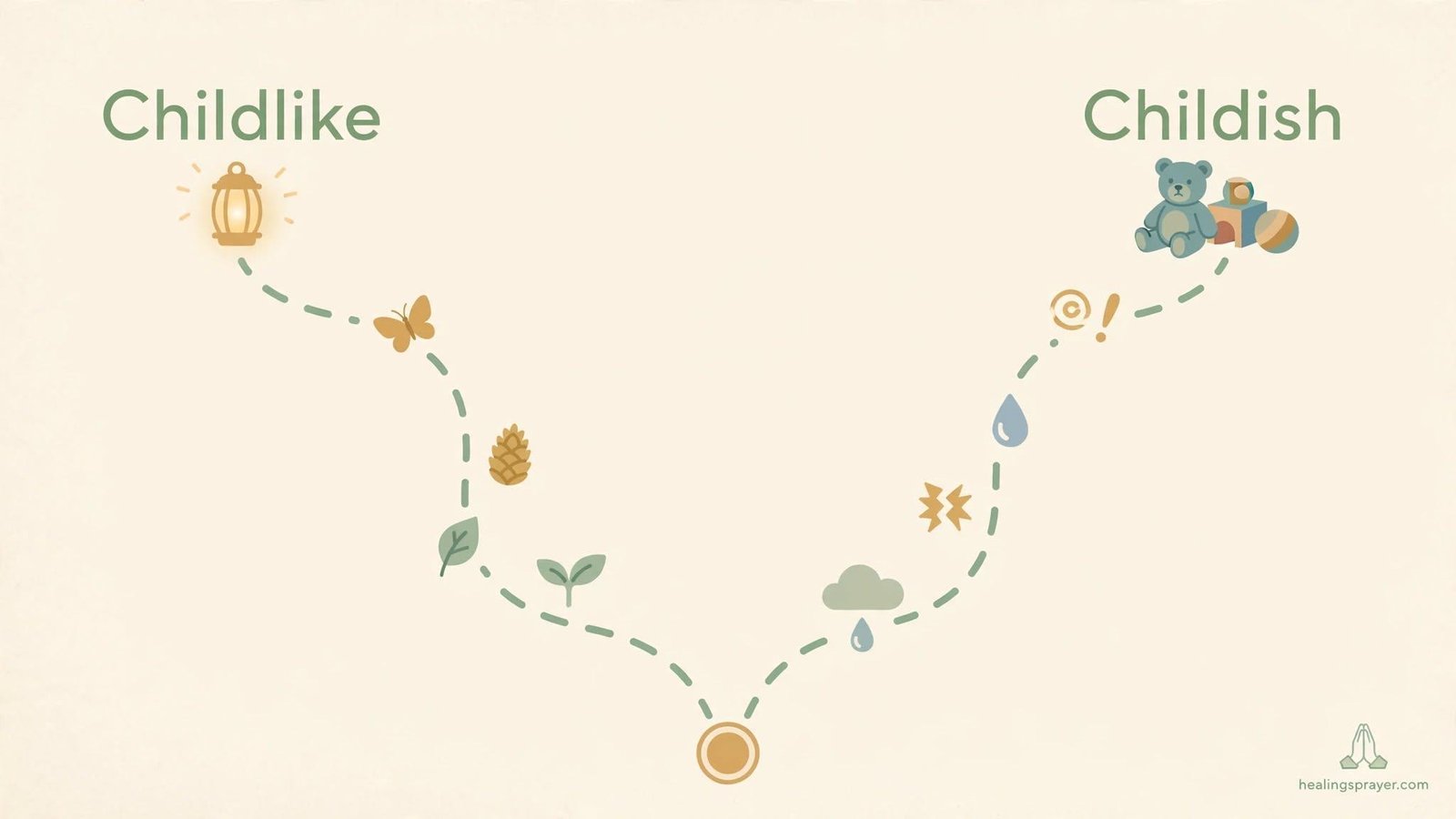
This is the distinction many articles skip, and it clears up a lot of confusion. Childlike faith and childish faith sound similar, but they point in opposite directions.
Childlike faith:
- Trusts God and stays willing to grow.
- Asks honest questions and listens.
- Accepts correction.
- Depends on God while taking responsibility.
- Stays humble and curious.
Childish faith:
- Demands that God act on request, like a vending machine.
- Refuses to learn or face hard truths.
- Blames others and avoids responsibility.
- Throws a tantrum when prayers are not answered the way it wanted.
- Stays stuck on the basics and avoids growth.
The Bible draws the same line. Paul writes that when he was a child he thought like a child, but when he became an adult he put away childish ways (1 Corinthians 13:11). He also tells believers to be infants in evil but adults in their thinking (1 Corinthians 14:20). Hebrews 5:12-14 warns about staying on milk when you are ready for solid food, and Ephesians 4:14 speaks of no longer being tossed around like spiritual infants.
So the Bible asks for both. Be childlike in trust and humility, and mature in understanding and action. A quick test: if your faith makes you more humble, teachable, and loving, it is likely childlike. If it makes you demanding, closed, and self-centered, it has drifted toward childish.
8 Characteristics of Childlike Faith
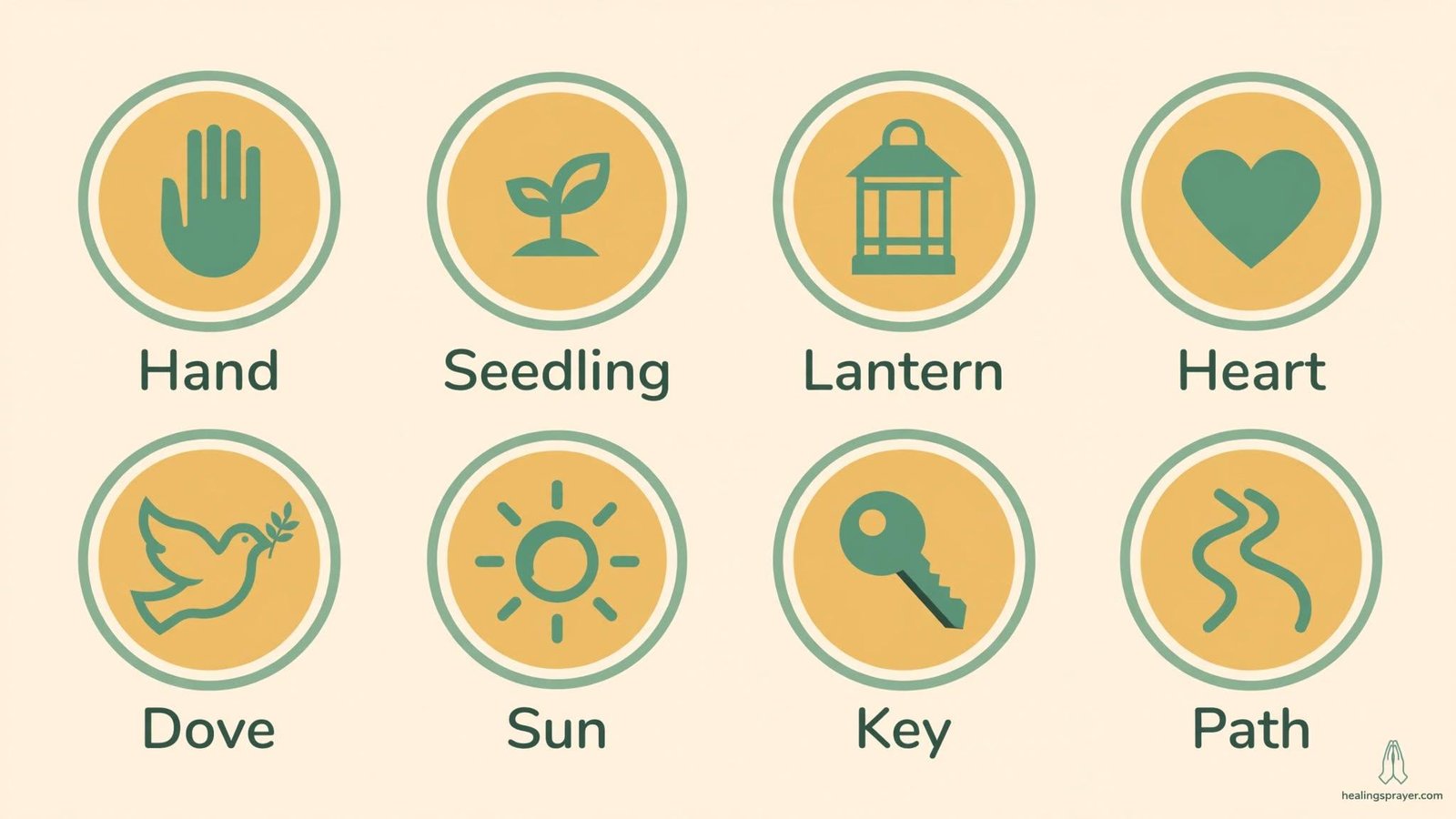
If you are searching for the characteristics of childlike faith, these eight traits come straight from how Jesus described children and how the Bible describes trust. Each includes a practical step.
1. Trust
A child trusts a loving parent without needing a full explanation. In the same way, childlike faith believes God’s character even when the details are unclear. Practice: when you face an unknown, say, “I do not see the plan, but I trust the One who does.”
2. Humility
Jesus linked humility directly to the child in Matthew 18:4. Childlike faith does not rely on status, achievement, or being right. Practice: once a day, admit a limit out loud in prayer and ask for help.
3. Dependence
A child does not try to run the household. Childlike faith relies on God daily, not only in a crisis. Practice: begin your morning by handing God the day’s top three concerns.
4. Openness and Curiosity
Children ask questions and listen. A person with childlike faith stays teachable and willing to be surprised by God. Practice: read one passage slowly and ask, “What is new here for me today?”
5. Honesty
Children say what they feel. Childlike faith brings real fears, wants, and questions to God without polishing them first. Practice: write an unedited prayer and do not fix the wording.
6. Quick Forgiveness
Children often forgive and move on quickly. Childlike faith releases grudges rather than carrying them for years. Practice: name one person you are holding something against and pray for their good.
7. Wonder and Joy
A child can be amazed by small things. Childlike faith notices God’s goodness in ordinary moments such as a meal, a sunrise, or a kind word. Practice: write three small things you are thankful for each evening.
8. Simple Obedience
When a trusted parent says “come,” a child comes. Childlike faith responds to God’s guidance without endless bargaining. Practice: act on one clear prompting today, even a small one, within the hour.
Childlike Faith Examples in the Bible
The Bible shows childlike faith in real people, not only in Jesus’ words. These examples show how the trait works.
- The children brought to Jesus (Mark 10). They came with no argument and no résumé, and Jesus welcomed them.
- Samuel (1 Samuel 3). As a boy serving in the temple, Samuel answered God’s call with a simple willingness to listen.
- The boy with the loaves and fish (John 6:9). A young boy offered what little he had, and Jesus used it to feed a crowd.
- The servant girl in Naaman’s house (2 Kings 5). A young girl trusted that God’s prophet could heal her master and spoke up plainly.
- The children praising in the temple (Matthew 21:15-16). They cheered for Jesus when adults objected, and Jesus affirmed their praise.
- David as a young shepherd (1 Samuel 17). He faced Goliath trusting that God would act, and he did not lean on armor or status.
- The father who said “I believe; help my unbelief” (Mark 9:24). His honesty is a good example of the open, honest side of childlike faith.
- Mary’s reply to Gabriel (Luke 1:38). She answered with simple trust, calling herself the Lord’s servant, even though she did not understand everything.
Most of these people were young or had little power. Their faith was not impressive by human standards, but God honored it.
How to Have Childlike Faith: 10 Practical Steps

Many readers ask how to have childlike faith as an adult. You cannot force it, but you can build habits that make it grow. Here are ten steps.
- Start with a simple prayer. Talk to God in plain words, like speaking to a trusted parent. Skip the formal language.
- Name your dependence. Write a short list of what you cannot control and hand each item to God.
- Ask questions without fear. Bring your real questions to God and to trusted believers. Honest questions are not the opposite of faith.
- Read the Gospels slowly. Watch how Jesus treats children, outsiders, and the humble, and notice what he praises.
- Practice gratitude daily. Wonder returns when you notice small gifts. Record three each evening.
- Release the need to look impressive. Stop performing for people. Faith grows when you stop pretending.
- Forgive quickly. Carrying resentment is heavy. Give it to God in prayer and let it go as often as needed.
- Obey in small things. When you sense a clear next step, take it. Small obedience builds trust.
- Spend time with children. Children are good teachers. Listen to how they pray, ask, and wonder.
- Rest. Psalm 131 pictures a quiet, calmed soul. Schedule ten minutes of silence each day without a to-do list.
A 7-Day Childlike Faith Plan
Spend ten minutes a day on this plan. Keep a notebook for your answers.
- Day 1: Read Matthew 18:1-4. Write one way you try to earn God’s approval. Journal question: where am I climbing instead of receiving?
- Day 2: Read Mark 10:13-16. Imagine being welcomed by Jesus. Journal question: what makes me feel unworthy to come?
- Day 3: Read Psalm 131. Sit in silence for five minutes. Journal question: what worry can I set down today?
- Day 4: Read Matthew 11:25-30. Write what you do not understand and give it to God. Journal question: what do I need to stop pretending to know?
- Day 5: Read Romans 8:14-17. Pray the word “Father” slowly. Journal question: how would I live differently if I truly believed I was God’s child?
- Day 6: Read Mark 9:20-27. Write your own “I believe; help my unbelief” prayer. Journal question: where do my faith and doubt meet?
- Day 7: Review. Read your notes and choose one habit to keep for the next month.
Can You Have Childlike Faith and Still Have Doubts?
Yes. This is a question many people feel guilty asking, and it is a gap in a lot of articles. Childlike faith is not the same as having zero doubts.
Children ask “why” all day long. They question because they trust the person they are asking. In the same way, honest questions can be a sign of trust rather than rejection. Mark 9:24 records a father saying to Jesus, “I believe; help my unbelief.” Jesus did not rebuke him. He helped.
Here is how to hold faith and doubt together:
- Name the doubt. Say it plainly to God instead of hiding it.
- Ask it in the right place. Bring hard questions to a pastor, mentor, or study group.
- Keep walking. Continue prayer, reading, and community while you search for answers.
- Accept some mystery. Some questions will stay open, and that is part of trust.
If your doubts come with deep sadness, anxiety, or loss of hope, it is wise to talk to a counselor or pastor as well. Spiritual care and mental health care can work together.
Childlike Faith Prayers and Short Reflections
Many readers want short lines they can pray or write on a card. These are original lines based on the themes above, not quotations from any translation.
6 short prayers for childlike faith:
- “Father, help me trust you the way a child trusts a loving parent.”
- “Lord, teach me to come to you without pretending.”
- “God, quiet my heart like a child resting in its mother’s arms.”
- “Jesus, keep me humble enough to receive what you give.”
- “Father, give me the courage to ask my honest questions.”
- “Lord, help me see small things with wonder again.”
3 short reflection lines:
- Faith is not climbing higher. It is trusting the hand that holds you.
- A child’s question is often a child’s trust in disguise.
- Becoming like a child begins with admitting you need help.
How to use them: Write one line on a sticky note, place it where you will see it, and repeat it slowly when you feel pressure to perform or control.
Also Read : How to Start a Prayer Journal (That Actually Sticks)
Passing On Childlike Faith to Your Children
If you are a parent, grandparent, or teacher, you may wonder how to protect childlike faith in a child. The most reliable method is to model it and make space for it.
- Pray simply and out loud. Children learn to pray by hearing real, short prayers.
- Welcome their questions. If you do not know an answer, say so and look for it together.
- Share your own dependence. Let them hear you say, “I need God’s help with this.”
- Tell Bible stories in a warm, calm way. Focus on God’s care rather than fear.
- Build small routines. A bedtime prayer or a mealtime thank-you gives faith a steady place in daily life.
- Avoid shaming doubt. A child who feels safe asking questions keeps trusting.
The aim is not to make children act religious. It is to help them feel secure with God, so their faith can grow with their understanding.
8 Common Mistakes About Childlike Faith
- Confusing it with ignorance. Childlike faith does not require you to stop learning or thinking.
- Mixing it up with childish faith. Trust and humility are childlike. Demanding and self-centered attitudes are childish.
- Pretending to have no doubts. Honest doubt is not the enemy of trust.
- Using it to avoid responsibility. Trusting God does not replace wise action.
- Treating it as a feeling. Childlike faith is a posture of trust that you choose, not a mood that comes and goes.
- Believing it is only for children. Jesus addressed adults when he taught this. It is for everyone.
- Ignoring humility. Without humility, faith drifts toward performance.
- Expecting instant results. Trust grows through small, repeated choices over time.
Childlike Faith Summary Table
| Characteristic | What It Looks Like | Bible Reference | Example Practice |
|---|---|---|---|
| Trust | Believing God’s character without every detail | Proverbs 3:5-6 | Say, “I do not see the plan, but I trust you” |
| Humility | Admitting limits and needing help | Matthew 18:4 | Name one limit out loud in prayer each day |
| Dependence | Relying on God daily, not only in crisis | Psalm 131:2 | Hand God your top three concerns each morning |
| Openness | Staying teachable and curious | Matthew 11:25 | Read a passage and ask, “What is new here?” |
| Honesty | Bringing real fears and questions to God | Mark 9:24 | Write an unedited prayer |
| Forgiveness | Letting go of grudges quickly | Matthew 18:21-22 | Pray for the good of one person you resent |
| Wonder | Noticing God’s goodness in small things | Psalm 8:2 | List three small gratitudes each evening |
| Simple obedience | Responding to God’s guidance without bargaining | Romans 8:15 | Act on one clear prompting within the hour |
Childlike Faith FAQs
What is childlike faith?
Childlike faith is a humble, trusting, dependent belief in God, like a child trusting a loving parent. It is about the posture of your heart, not your age or knowledge.
What does childlike faith mean in the Bible?
In the Bible, childlike faith means receiving God’s kingdom with humility and trust instead of trying to earn it. Jesus teaches this in Matthew 18:3, Mark 10:15, and Luke 18:17.
What is the best childlike faith verse?
Matthew 18:3 is the best-known childlike faith verse, where Jesus says you must become like little children to enter the kingdom of heaven. Mark 10:15 and Psalm 131:2 are also widely used.
What does “unless you become like a child” mean?
It means entering God’s kingdom requires humility and dependence, not status or achievement. Jesus used a child to show that you receive the kingdom rather than climb to it.
What is the difference between childlike faith and childish faith?
Childlike faith trusts God while staying humble and teachable. Childish faith demands, resists growth, and avoids responsibility.
What are the characteristics of childlike faith?
Key characteristics include trust, humility, dependence, openness, honesty, forgiveness, wonder, and simple obedience.
How can adults have childlike faith?
Adults can build it through simple prayer, honest questions, gratitude, quick forgiveness, small acts of obedience, and regular rest. It grows through repeated habits.
Is childlike faith the same as blind faith?
No. Childlike faith trusts God’s character while still asking questions and seeking understanding. It is relational trust, not a refusal to think.
Can you have childlike faith and doubt at the same time?
Yes. Mark 9:24 shows a father saying he believes and asking for help with his unbelief, and Jesus responded with help.
Where is faith like a child in the Bible?
The main passages are Matthew 18:1-4, Mark 10:13-16, and Luke 18:15-17. Psalm 131 and Matthew 11:25 add related pictures.
Why did Jesus say to become like little children?
He wanted his followers to drop pride and status-seeking and come with humble trust. Children in that culture had little standing, which made the example striking.
Is “child like faith” spelled correctly?
“Childlike faith” is the standard spelling. “Child like faith” and “child-like faith” appear often and mean the same thing.
How do I teach childlike faith to my kids?
Pray simply, welcome their questions, share your own dependence on God, and build small daily routines. A safe environment helps their trust grow.
Final Thoughts on Childlike Faith
Childlike faith is not a step backward. It is the humble, trusting posture Jesus held up when he said you must receive the kingdom like a child. It combines honest dependence with an open heart, and it grows alongside mature thinking, not against it.
Start small. Pray in plain words, name what you cannot control, ask your real questions, and thank God for small gifts. Over time, childlike faith turns from an idea into a way of living, steady enough to hold you through hard days and simple enough to begin today.

Welcome to Healings Prayer!
Healings Prayer is a faith-based platform created to offer comfort, hope, and encouragement through prayer and Scripture. Our mission is to help people find peace in difficult moments and draw closer to God through heartfelt prayers and Bible verses.