
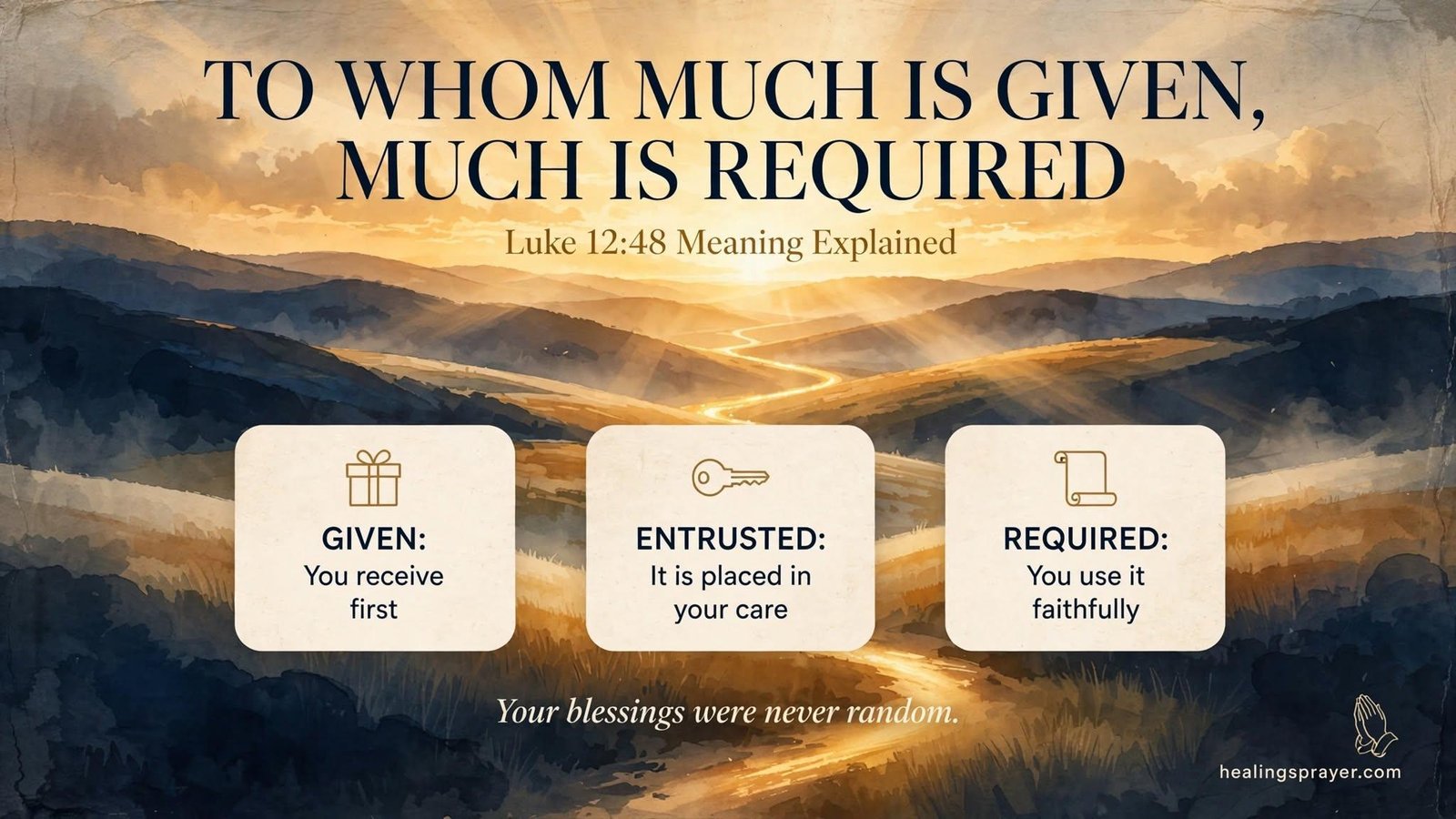
To whom much is given much is required is one of the most quoted lines in the Bible, and one of the most misunderstood. It comes from Luke 12:48, and people use it in sermons, graduation speeches, and personal mission statements.
If you searched for its meaning, you probably want three things: where it comes from, what it actually says, and how to live it without feeling crushed by it. This guide covers all three. You will read the verse in the KJV, see its place in Luke 12, learn what each key word means, and then apply the principle in seven areas of daily life.
What Does “To Whom Much Is Given Much Is Required” Mean?
To whom much is given much is required means that people who receive greater blessings, knowledge, or opportunities are held to a higher standard of responsibility for how they use them. The saying comes from Luke 12:48, where Jesus teaches that every gift carries a duty to use it faithfully.
In plain terms, the verse is about stewardship, not ownership. What you hold was placed in your care: money, skills, understanding, time, influence. The more you hold, the more you are expected to use it well. That is the heart of to whom much is given much is required.
Three ideas sit inside the phrase:
- Much is given: you receive something valuable first.
- Much is required: responsibility follows the gift.
- Accountability grows with the gift: a bigger blessing means a bigger expectation.
Luke 12:48 in the KJV
Verse 48 makes more sense when you read it together with verse 47. Here are both in the King James Version:
Luke 12:47: “And that servant, which knew his lord’s will, and prepared not himself, neither did according to his will, shall be beaten with many stripes.”
Luke 12:48: “But he that knew not, and did commit things worthy of stripes, shall be beaten with few stripes. For unto whomsoever much is given, of him shall be much required: and to whom men have committed much, of him they will ask the more.”
The second half of verse 48 is the part people remember. It has two matching lines. One is about what is given, and the other is about what is committed. Both end with a higher request.
Why the Popular Wording Differs From the KJV
Look closely at the KJV: “unto whomsoever much is given, of him shall be much required.” The short form to whom much is given much is required is a compressed version of that sentence. It keeps the meaning and drops the older grammar.
Many modern translations, including the Luke 12:48 NIV wording, replace “required” with “demanded,” and others use “expected.” That is why people also search for “much is given much is expected.” The idea is the same in every version.
Use the KJV wording when you study the verse. Use the short form to whom much is given much is required for quotes, captions, and conversation.
[INTERNAL LINK SUGGESTION: stewardship in the Bible → article on what biblical stewardship means]
“To Much” or “Too Much”? Clearing Up the Common Typo
Many people type “to much is given much is required” or “too much is given much is required.” Both are spelling mistakes. The correct phrase is to whom much is given much is required.
The word is “to whom,” meaning “unto the person to whom.” It has nothing to do with “too much,” which means excessive. The typo is common because “to much” and “too much” sound the same when spoken.
A quick test: replace “to” with “unto.” If the sentence still works, you have the right word.
Where Is “To Whom Much Is Given Much Is Required” in the Bible?

The verse sits in Luke chapter 12, at the end of a long teaching about readiness. Luke 12:48 is not a stand-alone proverb. It closes a short parable, and reading to whom much is given much is required in context changes how you apply it.
The Setting: Jesus, the Disciples, and Peter’s Question
Jesus is teaching His disciples how to live while He is away. In Luke 12:35 He tells them to keep their “loins girded about” and their “lights burning” (KJV). That is the picture of a servant who is dressed and ready.
In verse 41, Peter asks whether the parable is meant only for the disciples or for everyone. Jesus answers by describing a “faithful and wise steward,” a manager who does his work whether or not the master is watching.
He then gives two outcomes (Luke 12:43-46). One steward is found doing his duty when the master returns. The other treats the delay as permission to neglect his work and mistreat others. Verses 47 and 48 then explain how accountability is measured.
Luke 12:47: The Servant Who Knew
Verse 47 describes a servant who knew what his master wanted and still did not prepare or act. This servant receives the heavier consequence, “many stripes.”
The lesson is direct: knowing what is right creates a duty to act on it. Here, to whom much is given much is required applies to understanding. The more clearly you see the right thing to do, the less room there is to delay.
Luke 12:48: The Servant Who Did Not Know
Verse 48 begins with a servant who did not know his master’s will, yet still did wrong. He faces “few stripes.” His consequence is lighter, but it is not zero.
Then Jesus widens the lens. The second half of the verse moves from servants to a general rule for everyone. Whoever receives much, whether knowledge, wealth, ability, or opportunity, will be asked for more. This is the moment to whom much is given much is required becomes a principle for all people, not only for one servant in one parable.
What “Few Stripes” and “Many Stripes” Teach
- Responsibility grows with knowledge. The servant who knew is held to a higher standard.
- Ignorance lowers the weight, but does not erase it. The servant who did not know still answers for what he did.
- Accountability is proportional. It is not the same for everyone, because the gifts are not the same for everyone.
- The rule applies to everyone. The phrase “unto whomsoever” means any person, not a select group.
What Does “Required” Really Mean in Luke 12:48?
Most confusion about to whom much is given much is required comes from one word: “required.” Many readers hear it as a threat. The verse itself points to something different, and the Greek words help show why.
Required Does Not Mean Earned
Look at the order of the sentence. “Given” comes first, and “required” comes second. The gift arrives before any demand is made.
That means you are not paying off a debt. You are managing a trust. The verse does not rank people by how much they have. It asks what each person does with what they have been handed.
This is why to whom much is given much is required can be read as a calling, not a punishment. Someone who has received a lot has also been trusted with a lot.
Given, Committed, Asked: The Three Verbs of the Verse
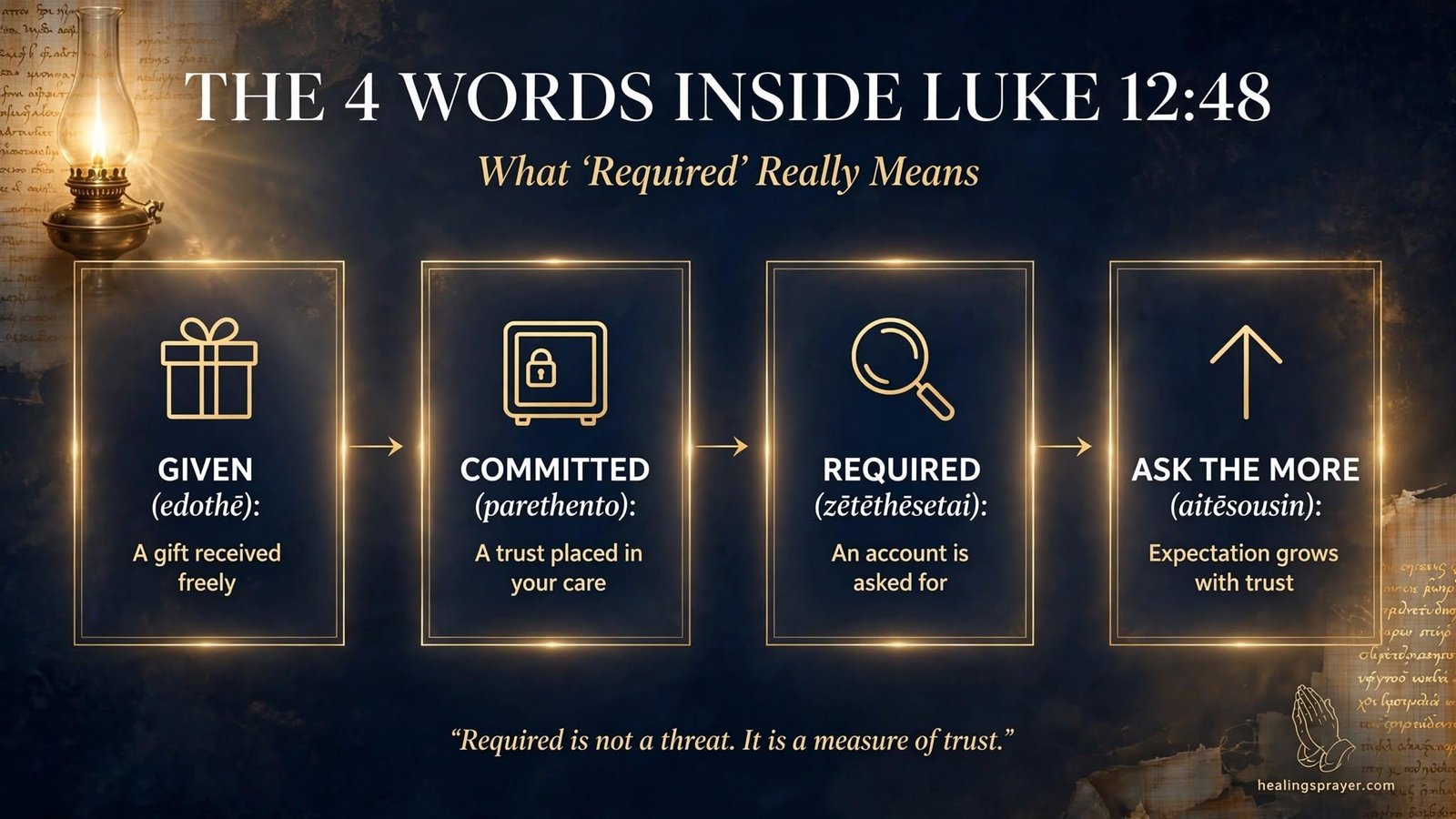
The Greek text of Luke 12:48 uses four key verbs. Each one adds a layer to to whom much is given much is required:
- Given (edothē): a gift received freely, with nothing earned.
- Committed (parethento): placed beside you for safekeeping, like a deposit or a trust. This is the language of stewardship.
- Required (zētēthēsetai): sought out, meaning someone will come asking for an account.
- Ask the more (aitēsousin): a further request, showing that the expectation increases as the trust increases.
Put together, the sentence describes a simple pattern: something is given, something is entrusted, and an account is later asked for. Once you see that pattern, to whom much is given much is required stops sounding like a burden and starts sounding like a measure of trust.
Why “To Whom Much Is Given Much Is Required” Still Matters Today
To whom much is given much is required matters today because most people hold more than they realize: education, skills, income, a platform, a stable home, or simply good health. The verse asks you to notice what you have been given and to treat it as something to use, not something to hoard.
Here are three reasons the principle still works:
- It ends the comparison trap. The verse measures what you do with your gift, not how your gift compares to someone else’s.
- It gives your blessings a purpose. Money, talent, and knowledge become tools for serving others instead of trophies.
- It builds a habit of honest self-review. You learn to ask, “What was placed in my hands, and what am I doing with it?”
This is the practical Luke 12:48 meaning for daily life. The verse does not demand perfection. It asks for faithful use, and to whom much is given much is required gives you a simple lens for every decision about your time, money, and abilities.
Also Read : 80+ Powerful Holy Week Prayers with Scriptures to Prepare Your Heart for Easter
“Much Is Given Much Is Expected”: Same Verse, Different Wording
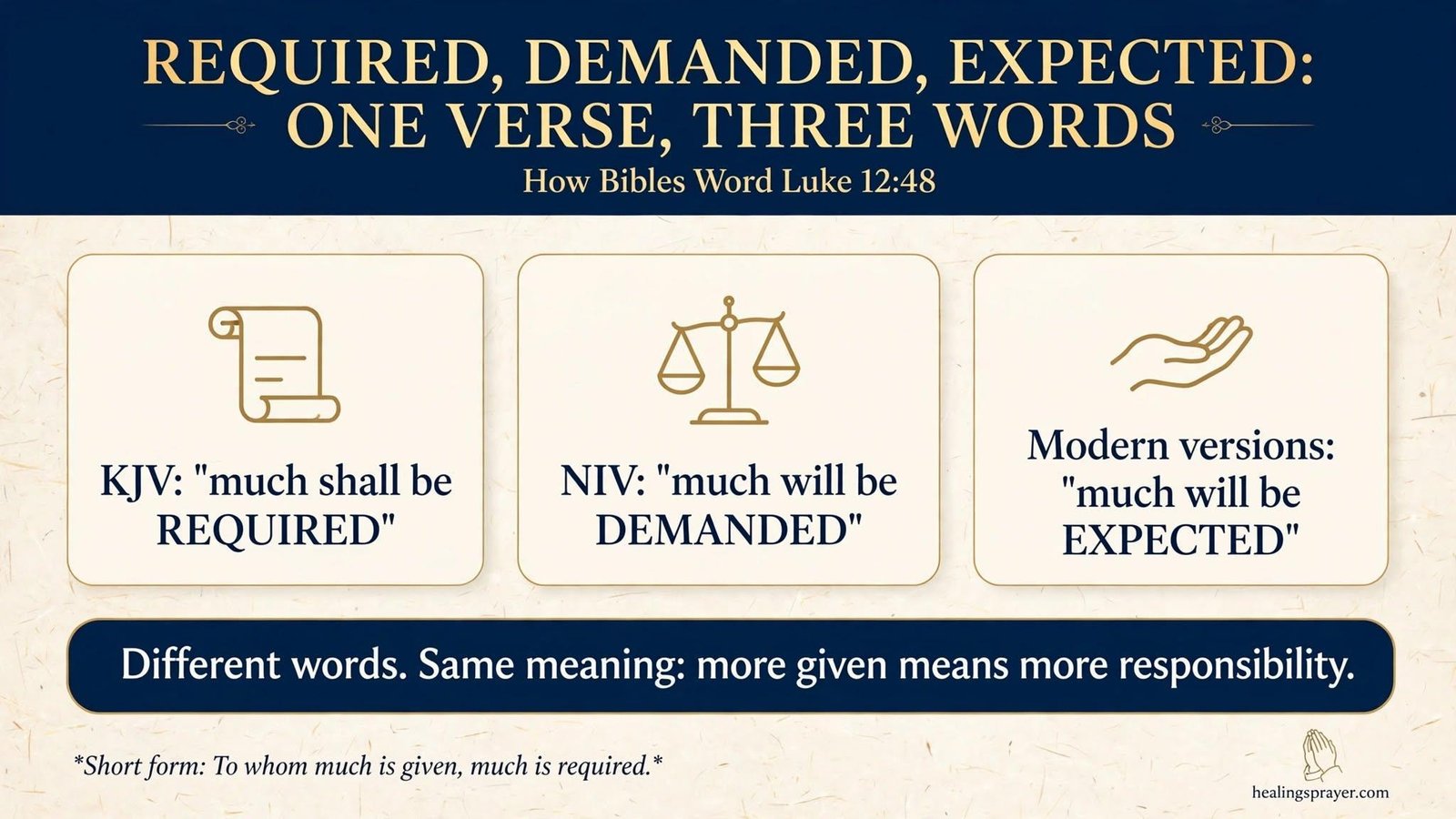
Many people search for “much is given much is expected” instead of the KJV wording. They are looking for the same verse. The words differ because translators choose different English words for the same Greek idea.
Here is how the main wordings compare:
- KJV: “of him shall be much required”
- NIV: “much will be demanded”
- Other modern versions: “much will be expected”
The meaning does not change. “Required” stresses obligation, “demanded” stresses accountability, and “expected” stresses anticipation. All three describe the same truth behind to whom much is given much is required.
You may also hear a similar modern saying: “With great power comes great responsibility.” It carries a related idea, but it is a modern saying, not a Bible verse. When you want the biblical source, always point to to whom much is given much is required and Luke 12:48.
7 Areas Where Much Is Given (and What Is Required)

Luke 12:48 does not name one kind of gift. It says “much is given,” and that can mean many things. These seven areas cover where most people hold “much.” Each one shows what the gift looks like, what is required, and three ways to respond.
Read each section and ask where to whom much is given much is required applies to you.
1. Money and Resources
Signs You Have Been Given Much Here
- You have income beyond your basic needs, or savings you can access.
- You own or control assets such as property, a business, or valuable tools.
What Is Required
Money is a trust, not a trophy. Scripture speaks about being “rich in good works, ready to distribute” (1 Timothy 6:18, KJV). In this area, to whom much is given much is required means giving, saving wisely, and avoiding waste.
3 Ways to Respond
- Set a fixed percentage for giving and keep it consistent.
- Pay debts and plan ahead so your resources serve others, not stress.
- Spend on people and causes, not only on yourself.
2. Talents and Skills
Signs You Have Been Given Much Here
- People often ask you for help with a specific skill.
- You learn certain things faster or more naturally than others.
What Is Required
Talents are given to be used. First Peter 4:10 teaches that each person should serve others with the gift they have received. Hiding a skill out of fear or comparison is the opposite of faithful use.
3 Ways to Respond
- Name your top two strengths in writing.
- Offer them where they are needed, such as at church, work, or in your community.
- Keep improving them so the gift grows instead of fading.
3. Knowledge and Education
Signs You Have Been Given Much Here
- You have formal education, training, or specialized understanding.
- You understand how something works that many others do not.
What Is Required
Knowledge carries a duty to act. James 4:17 says that whoever knows the right thing to do and does not do it commits sin. The servant in Luke 12:47 shows the same principle: to whom much is given much is required, and knowledge is one of the heaviest gifts.
3 Ways to Respond
- Share what you know through teaching, mentoring, or writing.
- Put your knowledge into action instead of only collecting more.
- Stay humble and keep learning.
4. Faith and Spiritual Understanding
Signs You Have Been Given Much Here
- You have access to Scripture, teaching, and a believing community.
- You understand God’s Word more clearly than you once did.
What Is Required
Spiritual understanding is meant to change how you live, not only how you speak. In this area, to whom much is given much is required means practicing what you read, praying consistently, and treating others with grace.
3 Ways to Respond
- Turn one verse a week into one specific action.
- Pray for the people God places in your path.
- Encourage someone who is newer or weaker in faith.
5. Time and Opportunity
Signs You Have Been Given Much Here
- You have open hours, flexible work, or doors that others lack.
- You are presented with chances to serve, learn, or lead.
What Is Required
Time is the one gift everyone receives in equal daily amounts, and it cannot be stored. Luke 16:10 says that faithfulness in small things leads to faithfulness in much. Use your opportunities before they pass.
3 Ways to Respond
- Block time each week for something that serves others.
- Say yes to opportunities that match your gifts and say no to distractions.
- Review how you spend your hours once a month.
6. Influence and Leadership
Signs You Have Been Given Much Here
- Others listen to your opinion or follow your example.
- You manage people, a platform, a household, or a team.
What Is Required
Influence raises the standard. James 3:1 warns that teachers face stricter judgment because their words shape others. If your voice carries weight, to whom much is given much is required means honesty, fairness, and humility.
3 Ways to Respond
- Check that your words and actions match.
- Use your platform to lift others, not only yourself.
- Welcome correction and admit mistakes quickly.
7. Relationships and Family
Signs You Have Been Given Much Here
- You have people who love, trust, and depend on you.
- You belong to a family, friendship group, or community that supports you.
What Is Required
Relationships are gifts that need care. Galatians 6:2 tells believers to carry one another’s burdens. Being loved means being asked to love back through time, patience, and presence.
3 Ways to Respond
- Give your full attention when someone speaks to you.
- Show up in practical ways during hard seasons.
- Forgive quickly and speak kindly.
[INTERNAL LINK SUGGESTION: Bible verses about generosity → article on generosity and giving in Scripture]
How to Live “To Whom Much Is Given Much Is Required” Without Guilt
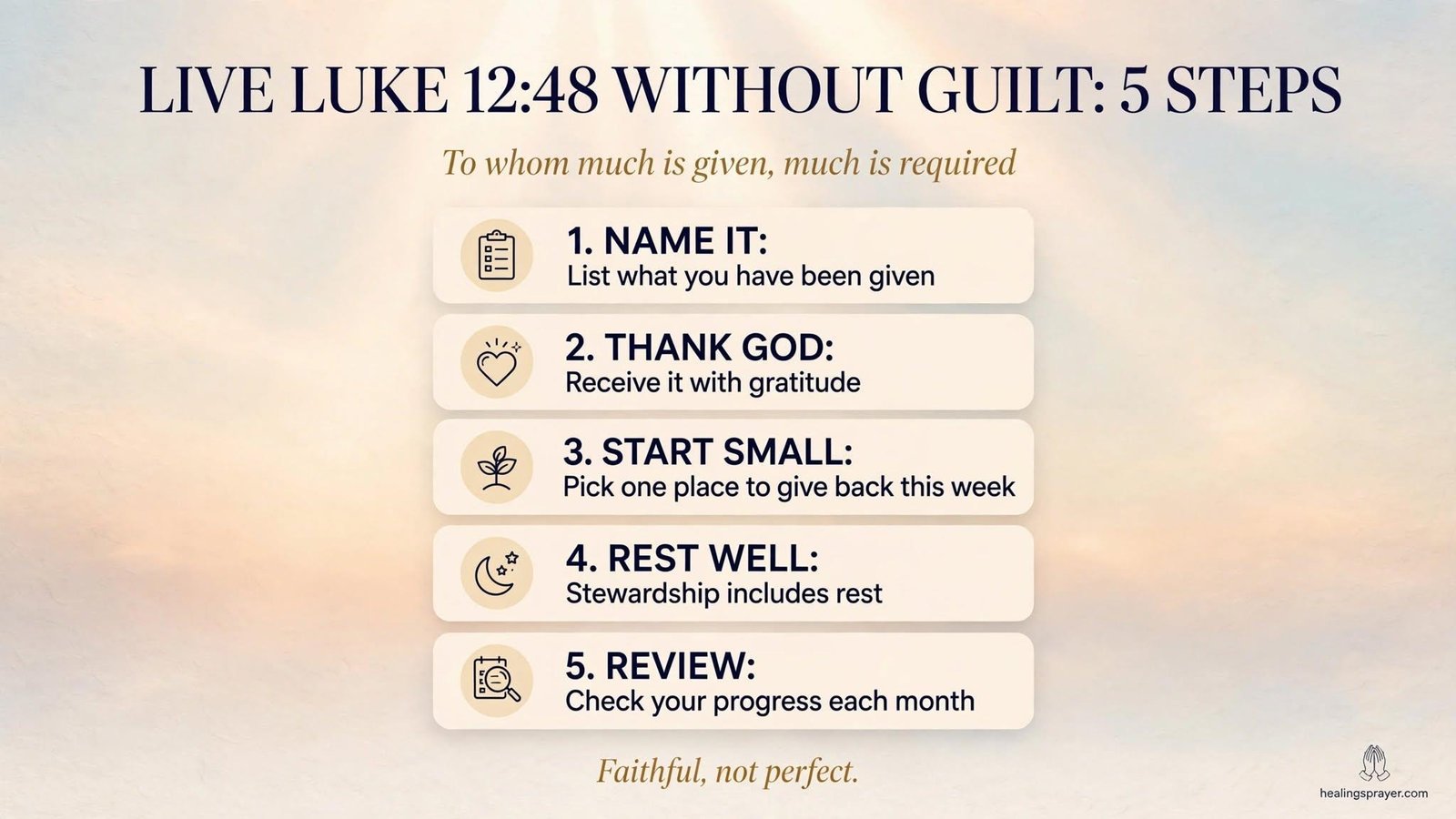
Some people read to whom much is given much is required and feel pressure instead of purpose. That reaction is common, and it can be fixed. The verse is meant to guide you, not to weigh you down.
Use these five steps to live it with a clear mind.
Step 1: Name What You Have Been Given
Write a short list of your resources, skills, knowledge, time, and relationships. You cannot use faithfully what you have not noticed.
Step 2: Receive It With Gratitude
Start with thanks, not obligation. The verse puts “given” before “required,” so gratitude comes first. This keeps to whom much is given much is required from turning into guilt.
Step 3: Start Small and Specific
Choose one clear action this week. One act of giving, teaching, or serving is better than a big plan you never begin.
Step 4: Protect Rest and Limits
Stewardship does not mean exhaustion. A tired steward cannot serve well, so plan rest as part of faithful use.
Step 5: Review Regularly
Once a month, ask three questions: What was I given? How did I use it? What will I change? This keeps to whom much is given much is required practical, not abstract.
The goal is not to be perfect. The goal is to be faithful with what you have, and that is something every person can do.
Related Bible Verses That Echo Luke 12:48
Luke 12:48 does not stand alone. Several other passages teach the same idea from different angles. Reading them together makes to whom much is given much is required clearer and gives you more Scripture to study.
- Matthew 25:14-30 (the parable of the talents): Each servant receives a different amount, and each is judged on faithful use, not on the size of the gift. The reward in verse 21, “Well done, thou good and faithful servant,” goes to the one who used what he had.
- Luke 19:11-27 (the parable of the minas): This parable repeats the same principle with a different setting. Faithful use leads to greater trust.
- Luke 16:10: “He that is faithful in that which is least is faithful also in much” (KJV). Faithfulness starts small and grows.
- 1 Peter 4:10: Every person who has received a gift should use it to serve others, “as good stewards of the manifold grace of God” (KJV).
- Matthew 10:8: “Freely ye have received, freely give” (KJV). This is the same pattern as to whom much is given much is required: receive first, then give back.
- James 3:1: Those who teach face a stricter standard. This links directly to the influence area from Part 2.
- Romans 14:12: Each person will give an account for themselves. It matches the “ask the more” idea in Luke 12:48.
Together these verses show that to whom much is given much is required is a consistent biblical theme, not a single isolated line.
Also Read : 490+ Hello June Quotes to Welcome Summer, Sunshine, and New Beginnings
Common Mistakes When Applying Luke 12:48
Even sincere readers misuse this verse. Avoid these six mistakes so that to whom much is given much is required works as encouragement, not pressure.
- Reading “required” as a threat. The verse describes responsibility that follows trust. It is not a warning designed to scare you.
- Comparing your “much” to someone else’s. Your gift is measured against your own situation. Another person’s income, platform, or talent is not your standard.
- Thinking it only applies to money. As the seven areas showed, “much” includes knowledge, time, faith, influence, and relationships.
- Waiting until you have more. Faithfulness is expected with what you hold now. Luke 16:10 says small things come first.
- Using the verse to shame other people. The verse is for self-examination. Quoting it to pressure someone else misses its purpose.
- Confusing it with earning salvation. Ephesians 2:8-9 teaches that salvation is by grace. Faithful use of your gifts is a response to grace, not payment for it.
A seventh habit worth avoiding is skipping rest. A steward who burns out cannot serve for long, so build limits into your plan.
Using the Verse as a Quote, Caption, or Tattoo
Many people want to use to whom much is given much is required as a social media caption, a graduation message, a journal heading, or even a tattoo. Because the phrase is short and meaningful, it works well in all of these places.
Here are practical tips so your wording stays correct:
- Check the spelling. Use “to whom,” never “to much” or “too much.” This is the most common error, and it is especially costly on a tattoo.
- Decide on a wording and keep it. Use the KJV style, “unto whomsoever much is given, of him shall be much required,” or the short form, to whom much is given much is required. Both are accurate.
- Add the reference. Including “Luke 12:48” tells readers where the words come from and prevents confusion with modern sayings.
- Choose a clear font. Long phrases need readable lettering, especially in small sizes.
If you are considering a tattoo, write out the exact wording and ask a trusted person to proofread it before you commit. A short check now saves a permanent mistake later.
Quick Summary Table: Areas, Requirement, and Example Action
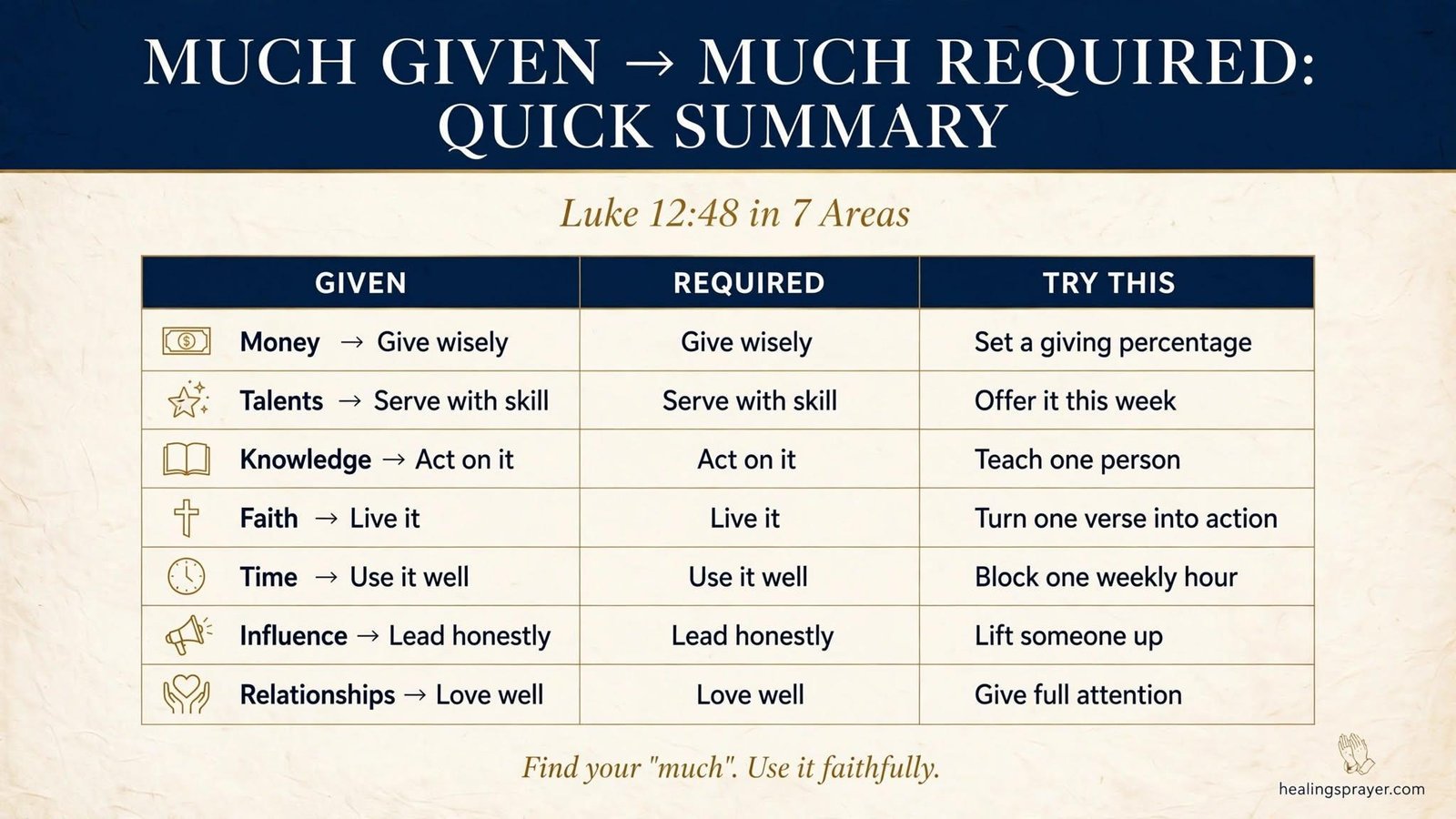
Use this table as a quick reference. It shows how to whom much is given much is required applies in each area, with one action you can take today.
| Area | What Is Given | What Is Required | Example Action |
|---|---|---|---|
| Money | Income, savings, assets | Generosity and wise use | Set a fixed giving percentage this month |
| Talents | Skills and abilities | Faithful service | Offer your best skill to one person this week |
| Knowledge | Education and understanding | Acting on what you know | Teach or mentor one person |
| Faith | Scripture and spiritual insight | Living it out | Turn one verse into one action |
| Time | Hours and opportunities | Wise, intentional use | Block one weekly hour for serving |
| Influence | Voice, platform, leadership | Honesty and humility | Use your platform to lift someone else |
| Relationships | People who love you | Love, presence, forgiveness | Give someone your full attention today |
FAQ: To Whom Much Is Given Much Is Required
What does “to whom much is given much is required” mean?
It means that people who receive more blessings, knowledge, or opportunities carry more responsibility to use them well. The phrase comes from Luke 12:48 and teaches stewardship, not ownership.
Where is “to whom much is given much is required” in the Bible?
It is in Luke 12:48, near the end of Jesus’ teaching about being ready and faithful. The verse follows verse 47 and closes the parable of the faithful steward.
What is the KJV text of Luke 12:48?
The KJV reads: “But he that knew not, and did commit things worthy of stripes, shall be beaten with few stripes. For unto whomsoever much is given, of him shall be much required: and to whom men have committed much, of him they will ask the more.”
What does Luke 12:47 mean?
Luke 12:47 teaches that a servant who knew his master’s will and did not act receives a heavier consequence. It shows that knowing what is right creates a duty to do it.
Is it “to much” or “too much” is given?
The correct phrase is “to whom much is given.” “To much” and “too much” are common spelling mistakes. Replace “to” with “unto” to check: if it still works, the wording is right.
What is the difference between “required” and “expected”?
There is no difference in meaning. “Required” is the KJV word, “demanded” appears in the NIV, and “expected” appears in many modern versions. All describe the same principle.
Does the verse mean God punishes people who have more?
No. The verse describes accountability that grows with trust. The gift comes first, and the responsibility is a response to it, not a penalty for having more.
What does “12+48” mean in searches?
“12+48” is a common shorthand people type when they are looking for Luke 12:48. It refers to the same verse and the same saying.
Who said “to whom much is given much is required”?
According to the Gospel of Luke, Jesus said it while teaching His disciples about readiness and faithful service.
How can I apply the verse if I feel I have very little?
Start with what you do have. The verse says faithfulness is measured against what was given to you, and Luke 16:10 shows that faithfulness with small things matters.
Final Thoughts on To Whom Much Is Given Much Is Required
To whom much is given much is required is not a burden meant to make you anxious. It is a reminder that every gift you hold, whether money, skill, knowledge, time, influence, or love, was placed in your hands for a purpose.
Remember the pattern in Luke 12:48: something is given, something is entrusted, and an account is later asked for. The gift always comes first. Your part is to respond with gratitude, start small, and stay faithful.
Take one step today. Name one thing you have been given, choose one way to use it for someone else, and begin. That is how to whom much is given much is required moves from a quoted verse to a lived habit.

Welcome to Healings Prayer!
Healings Prayer is a faith-based platform created to offer comfort, hope, and encouragement through prayer and Scripture. Our mission is to help people find peace in difficult moments and draw closer to God through heartfelt prayers and Bible verses.