
One tiny seed. One huge lesson. The parable of the mustard seed shows that your smallest act of faith is never wasted.
The parable of the mustard seed is one of the shortest teachings Jesus ever gave, yet it answers a question many believers carry quietly: does small faith really count? Three Gospels record it, and all three point to the same truth. Something tiny, planted with trust, can grow far beyond what anyone expects.
This guide gives you the full story, the verse-by-verse meaning, the Old Testament background most articles skip, seven practical faith lessons, a simple daily practice, and nine ready-to-use prayers. By the end, you will understand the parable of the mustard seed clearly and know exactly how to live it out this week.
[INTERNAL LINK SUGGESTION: faith like a mustard seed → your article on Bible verses about faith]
What Is the Parable of the Mustard Seed?
The parable of the mustard seed is a short teaching of Jesus that compares the kingdom of God to a tiny mustard seed that grows into a large plant, showing that great things can grow from very small beginnings.
That one sentence holds the whole message. The sections below explain what it means, where it comes from, and how it applies to your life today.
The Short Answer
In plain terms, the parable of the mustard seed teaches three things:
- God’s work often starts small and can look unimpressive at first.
- Growth takes time. The seed does not become a plant overnight.
- The result is far bigger than the beginning, large enough to shelter others.
A parable is a short, simple story that uses familiar things to explain a spiritual truth. Jesus drew on farming, bread, coins, and sheep because his listeners knew them well. The parable of the mustard seed uses a garden seed so common that every person in the crowd had handled one.
Bible teachers often point out that a parable usually carries one central point. For the parable of the mustard seed, that point is the contrast between a tiny beginning and a large, sheltering result. Every detail in the story supports that contrast.
Where the Parable of the Mustard Seed Appears in the Bible
You will find the parable of the mustard seed in three Gospels:
- Matthew 13:31-32, part of a chapter containing seven kingdom parables, including the sower, the weeds, the yeast, the hidden treasure, and the pearl.
- Mark 4:30-32, placed alongside other parables about seeds and growth, directly after the parable of the growing seed.
- Luke 13:18-19, which follows Jesus healing a woman on the Sabbath and is followed by the parable of the yeast.
Its presence in all three of these Gospels, often called the Synoptic Gospels, shows how widely this teaching was remembered and repeated.
Do not confuse these passages with the separate saying about “faith as a grain of mustard seed” in Matthew 17:20 and Luke 17:6. That is a different teaching with a different point, and it gets its own section later in this guide.
Who Jesus Was Speaking To
In Matthew and Mark, Jesus tells the parable of the mustard seed to large crowds gathered beside the Sea of Galilee. Many listeners were farmers, fishermen, and villagers living under Roman rule. They hoped God’s kingdom would arrive with visible power, a decisive turning point, and a clear break from the empire above them.
Jesus described it as a seed instead. That contrast is the heart of the teaching: the kingdom does not look impressive at the start, and that does not make it weak. Listeners who expected a sudden display of strength were being invited to see God’s work in a different way, one that begins quietly and grows with certainty.
The Parable of the Mustard Seed Story, Verse by Verse
Here is each account of the parable of the mustard seed in the King James Version, followed by plain-language notes on what stands out in each one.
Matthew 13:31-32
“Another parable put he forth unto them, saying, The kingdom of heaven is like to a grain of mustard seed, which a man took, and sowed in his field: Which indeed is the least of all seeds: but when it is grown, it is the greatest among herbs, and becometh a tree, so that the birds of the air come and lodge in the branches thereof.”
What to notice: Matthew places the seed in “his field,” which means cultivated farmland. He also calls the full-grown plant a “tree,” which shows how dramatic the growth is meant to feel. In Matthew’s telling of the parable of the mustard seed, the focus is the size gap between seed and plant, and the sheltering birds at the end complete the picture.
Mark 4:30-32
“And he said, Whereunto shall we liken the kingdom of God? or with what comparison shall we compare it? It is like a grain of mustard seed, which, when it is sown in the earth, is less than all the seeds that be in the earth: But when it is sown, it groweth up, and becometh greater than all herbs, and shooteth out great branches; so that the fowls of the air may lodge under the shadow of it.”
What to notice: Mark opens with a question that invites the listeners to think before Jesus answers. He also uses the words “great branches” and “shadow,” which are shelter words. In this version of the parable of the mustard seed, the plant exists to give protection, and the growth happens steadily after the seed is sown.
Luke 13:18-19
“Then said he, Unto what is the kingdom of God like? and whereunto shall I resemble it? It is like a grain of mustard seed, which a man took, and cast into his garden; and it grew, and waxed a great tree; and the fowls of the air lodged in the branches of it.”
What to notice: Luke says “garden” instead of “field” and uses the word “cast,” as if the seed were planted with ease. Luke’s placement also matters. The parable of the mustard seed comes right after a Sabbath healing, which connects the kingdom’s growth with what Jesus was already doing among the people.
What Changes Between the Three Accounts
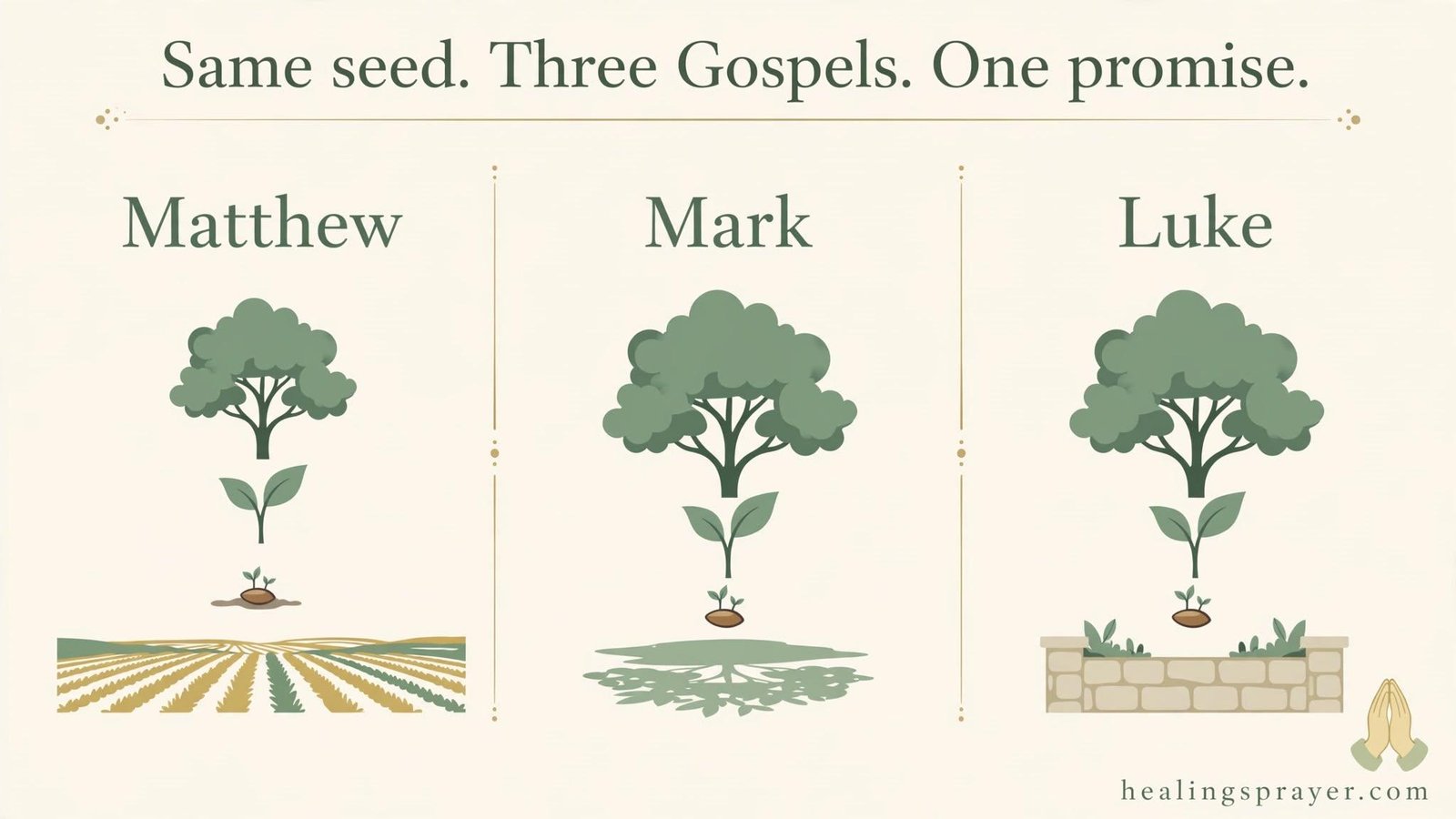
The core stays identical across all three versions of the parable of the mustard seed. Only the details shift:
- Setting: a field (Matthew), the earth (Mark), a garden (Luke).
- Plant: a tree (Matthew and Luke), or the greatest of herbs with great branches (Mark).
- Opening: Matthew calls it “another parable,” while Mark and Luke begin with a question.
- Shared message: a small start, a huge result, and shelter for others.
These differences do not change the meaning. Each Gospel writer shapes the retelling for his readers while keeping the central picture intact. When you read all three side by side, the repeated details stand out most clearly: a tiny seed, a deliberate planting, certain growth, and a place of shelter at the end.
Parable of the Mustard Seed Meaning: What Jesus Was Really Teaching
The Kingdom of God Begins Small
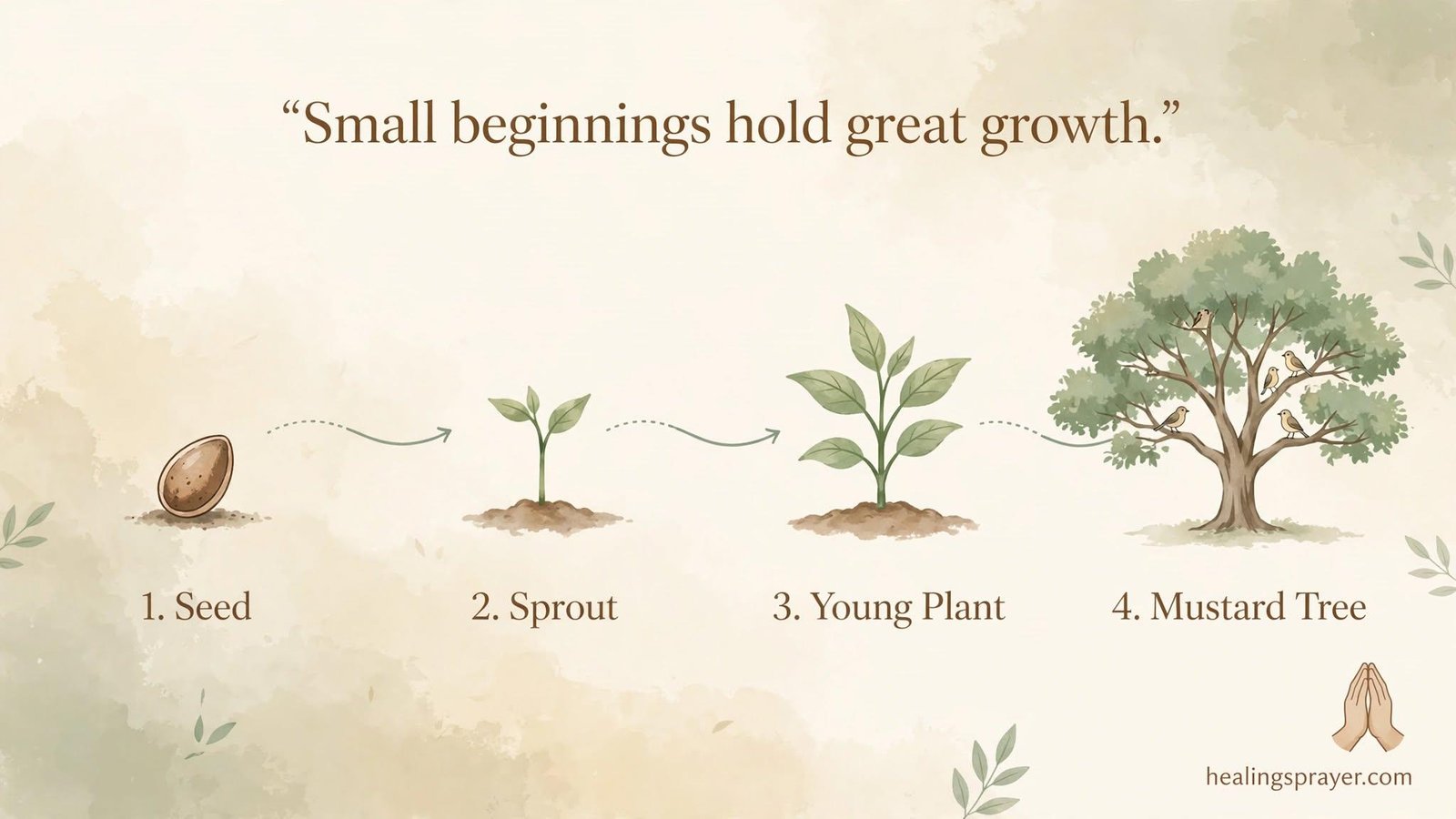
The central meaning of the parable of the mustard seed is the contrast between how something begins and how it ends. Jesus’ own ministry fits the pattern: a teacher from Nazareth and a small group of followers started a movement that later spread across the world.
Three ideas sit inside this meaning:
- Hidden beginnings. God often works quietly before anyone notices.
- Certain growth. The seed grows because of what it is, not because a crowd is watching.
- Wide shelter. The finished plant gives rest to others.
The parable also shows a kingdom that is already planted but not yet fully grown. The seed is in the ground, and growth has started, yet the full tree is still ahead. That is why the parable of the mustard seed speaks so well to anyone living in the middle of a process, when the beginning is behind you and the result is not visible yet.
Why “Smallest Seed” Is a Figure of Speech
The Gospels call the mustard seed the smallest of all seeds. Botanically, that is not strictly true, since orchid seeds are much smaller. But Jesus was speaking the language of his audience. In Jewish teaching of that era, the mustard seed often stood for something extremely small, much like “a drop in the ocean” does today.
Mustard was also a familiar crop in the ancient Mediterranean world, so listeners could picture it at once. A mustard seed measures roughly 1 to 2 millimeters across, yet the black mustard plant (Brassica nigra) can grow taller than a person, often reaching around 6 to 9 feet in good conditions.
Reading the verse as a botany claim misses the point. The parable of the mustard seed is about contrast, not seed science. The wider the gap between the seed and the plant, the stronger the message.
The Tree and the Birds: Old Testament Echoes
The birds nesting in the branches are not decoration. Old Testament writers used a great tree sheltering birds as a picture of a mighty kingdom protecting many nations. You can see this image in Ezekiel 17:22-24, Ezekiel 31:6, and Daniel 4:12.
By borrowing that image for a humble garden plant, the parable of the mustard seed tells listeners that God’s kingdom will shelter people from every background, and that it will start small. Many Bible scholars read the birds as a sign that the kingdom welcomes the nations.
This background gives the parable extra weight. Jesus was not only talking about plants. He was connecting a simple garden scene to a long biblical hope: that God’s rule would one day become a place of safety for people everywhere.
Why Jesus Chose Mustard and Not a Cedar
The cedar of Lebanon was a familiar symbol of grandeur in Scripture, and Ezekiel 17 itself uses a cedar. Jesus chose a garden plant instead. Some scholars point out that mustard spreads easily and is hard to remove once it takes hold, and the Roman writer Pliny the Elder described mustard as growing wild and being difficult to clear from a field once sown. That detail fits the idea that the kingdom, once planted, keeps spreading.
Choosing mustard over a cedar also keeps the focus on the process of growth. A cedar is admired for what it is. A mustard plant is remarkable for where it started. The parable of the mustard seed is about the journey from start to finish, and that journey is something every reader can relate to.
Key Takeaways So Far
- The parable of the mustard seed appears in Matthew 13, Mark 4, and Luke 13.
- Its meaning is the contrast between a tiny start and a large, sheltering result.
- “Smallest seed” is a figure of speech, not a botany lesson.
- The birds in the branches echo Old Testament pictures of a kingdom that shelters the nations.
- The parable of the mustard seed describes a kingdom that is already planted and still growing.
Mustard Seed in the Bible: 8 Verses to Read and Pray
The parable of the mustard seed is not the only place where Scripture uses this tiny seed or the idea of small beginnings. The passages below connect with the parable of the mustard seed and deepen its message.
Faith Like a Mustard Seed (Matthew 17:20)
Jesus gives a separate teaching about the same seed after his disciples were unable to help a boy in need (Matthew 17:14-20).
“…for verily I say unto you, If ye have faith as a grain of mustard seed, ye shall say unto this mountain, Remove hence to yonder place; and it shall remove; and nothing shall be impossible unto you.”
Here the mustard seed describes the size of faith, not the size of the kingdom. This is the key difference from the parable of the mustard seed, where the seed pictures the kingdom of God growing over time. Matthew 17:20 is about faith that acts. The parable of the mustard seed is about growth that unfolds.
Also Read : 120 Missing You Quotes for Him to Melt His Heart
“And the Lord said, If ye had faith as a grain of mustard seed, ye might say unto this sycamine tree, Be thou plucked up by the root, and be thou planted in the sea; and it should obey you.”
Luke repeats the idea with a tree instead of a mountain. The apostles had just asked Jesus to increase their faith (Luke 17:5), and his answer points to quality over quantity. Even a very small amount, placed in God, carries real power. This sits beside the parable of the mustard seed as a second angle on how little it takes to begin.
The Yeast Parable Next Door (Matthew 13:33)
Matthew and Luke both place a second short parable right after the parable of the mustard seed: a woman hides leaven in three measures of meal until the whole batch is leavened (Matthew 13:33; Luke 13:20-21).
Read together, the two form a pair. The mustard seed shows the kingdom growing outward and becoming visible. The yeast shows it working inward, quietly, through everything it touches. Studying both gives you the complete picture of how the kingdom grows: in public and in secret.
8 Mustard Seed Verses at a Glance
Use this list for Bible study, journaling, or captions:
- Matthew 13:31-32: the original parable of the mustard seed in Matthew, where a tiny seed becomes a tree.
- Mark 4:30-32: Mark’s version of the parable of the mustard seed, with the “shadow” of shelter for the birds.
- Luke 13:18-19: the parable of the mustard seed in a garden setting, placed after a Sabbath healing.
- Matthew 17:20: faith as small as a mustard seed can speak to a mountain.
- Luke 17:6: faith as small as a mustard seed can uproot a sycamine tree.
- Mark 4:28: “first the blade, then the ear, after that the full corn in the ear,” which shows growth in stages.
- Zechariah 4:10: “For who hath despised the day of small things?” This was spoken about the modest start of the rebuilt temple, and it warns against dismissing small beginnings.
- Job 8:7: “Though thy beginning was small, yet thy latter end should greatly increase.” These words come from Bildad, one of Job’s friends, whose advice is not always right, so read this verse as a general principle that agrees with the wider teaching of Scripture.
7 Faith Lessons From the Parable of the Mustard Seed
These seven lessons come directly from the details of the parable of the mustard seed. Each one ends with a simple action you can take today.
Lesson 1: Small Faith Still Counts
The parable of the mustard seed begins with the smallest thing in the garden, and Jesus uses it to describe God’s kingdom. Size is not the measure. A faith that feels quiet, uncertain, or new is still real faith, and it still has growth inside it.
Matthew 17:20 supports this. Jesus says faith as small as a grain of mustard seed is enough to be effective. What matters most is where your faith is placed, not how large it feels.
Try This Today
Write down one thing you trust God with right now, however small, and pray over that one thing.
Lesson 2: Begin Before You Feel Ready
In the parable, a man “took” the seed and “sowed” it. He acts first. The parable of the mustard seed does not describe a seed waiting for perfect conditions. Many people wait for full certainty before they act, but the seed teaches the opposite order: plant first, then trust God with the growth.
Waiting for a perfect moment often means never starting at all. A small action taken today gives God something to grow.
Try This Today
Take one small step on something you have delayed, such as sending the message, opening your Bible, or making the call.
Lesson 3: Growth Often Happens Out of Sight
A seed does its first work underground. In the same way, the parable of the mustard seed reminds you that no visible progress does not mean no progress. Mark 4:27 describes seed that grows while the sower sleeps, “he knoweth not how.”
That means some of the most important growth in your life may be happening where you cannot measure it yet. Roots form long before leaves appear.
Try This Today
Name one area where you see no change yet, and thank God for what he may be doing beneath the surface.
Lesson 4: Patience Is Part of the Process
The seed does not become a tree in a day. The parable of the mustard seed covers a full season of growth in a single sentence, which can make it sound faster than it is. Mark 4:28 lays out the stages: first the blade, then the ear, then the full grain. Each stage has its own timing, and none can be skipped.
Patience is not passive. It means continuing to pray, act, and trust while the growth takes shape.
Try This Today
Pick one long-term goal or prayer and write down only the next small stage, not the final result.
Lesson 5: Do Not Despise Small Beginnings
Zechariah 4:10 asks, “who hath despised the day of small things?” The parable of the mustard seed answers that question by showing what small things become. A short prayer, a five-minute reading, and a single act of kindness all count as seeds.
Comparing your starting point to someone else’s finished work only creates discouragement. Every large thing you admire began as something small.
Try This Today
Choose one small spiritual habit and keep it for five minutes today, such as reading one verse and praying one sentence.
Lesson 6: Your Growth Is Meant to Shelter Others
The finished plant gives shelter to birds. The parable of the mustard seed ends with others being sheltered, not with the plant being admired. Your growth in faith is not only for you. It is meant to become a place of rest, encouragement, and strength for the people around you.
This changes how you look at your own progress. Each step you take in faith can make you more able to help someone else.
Try This Today
Encourage one person today with a verse, a kind message, or a short prayer.
Lesson 7: Trust the One Who Finishes the Work
The parable of the mustard seed assumes that the seed will become what it was made to be. Philippians 1:6 carries the same confidence: “Being confident of this very thing, that he which hath begun a good work in you will perform it until the day of Jesus Christ.”
Your part is to plant and tend. The growth belongs to God. Remembering that takes the pressure off and keeps you steady when results come slowly.
Try This Today
Pray Philippians 1:6 over one area of your life that feels unfinished.
How to Apply the Parable of the Mustard Seed in Daily Life
Understanding the parable of the mustard seed matters most when it changes how you live. This weekly practice and prayer method help you put it to work.
A 7-Day Mustard Seed Practice
- Day 1: Plant. Read Matthew 13:31-32 and write one sentence about your own small beginning.
- Day 2: Water. Pray for five minutes about that one beginning.
- Day 3: Wait. Read Mark 4:26-29 and thank God for growth you cannot see yet.
- Day 4: Notice. Write down one small sign of progress, even if it feels minor.
- Day 5: Share. Send one encouraging message or verse to someone.
- Day 6: Release. Hand one worry to God, using Matthew 17:20 as your prayer.
- Day 7: Review. Look back over the week and write what you learned from the parable of the mustard seed.
Repeat the cycle each week. Small repeated steps are exactly how the parable of the mustard seed works, and a simple routine kept over time shapes faith more than occasional bursts of effort.
How to Pray With the Parable
- Read Matthew 13:31-32 slowly, twice.
- Name one small thing you want God to grow in your life.
- Ask him to grow it in his timing, using the parable of the mustard seed as your reminder that small things grow.
- Thank him before you see results.
- Close with “Amen” and write one line you can look back on later.
9 Mustard Seed Prayers for Faith, Hope, and New Beginnings
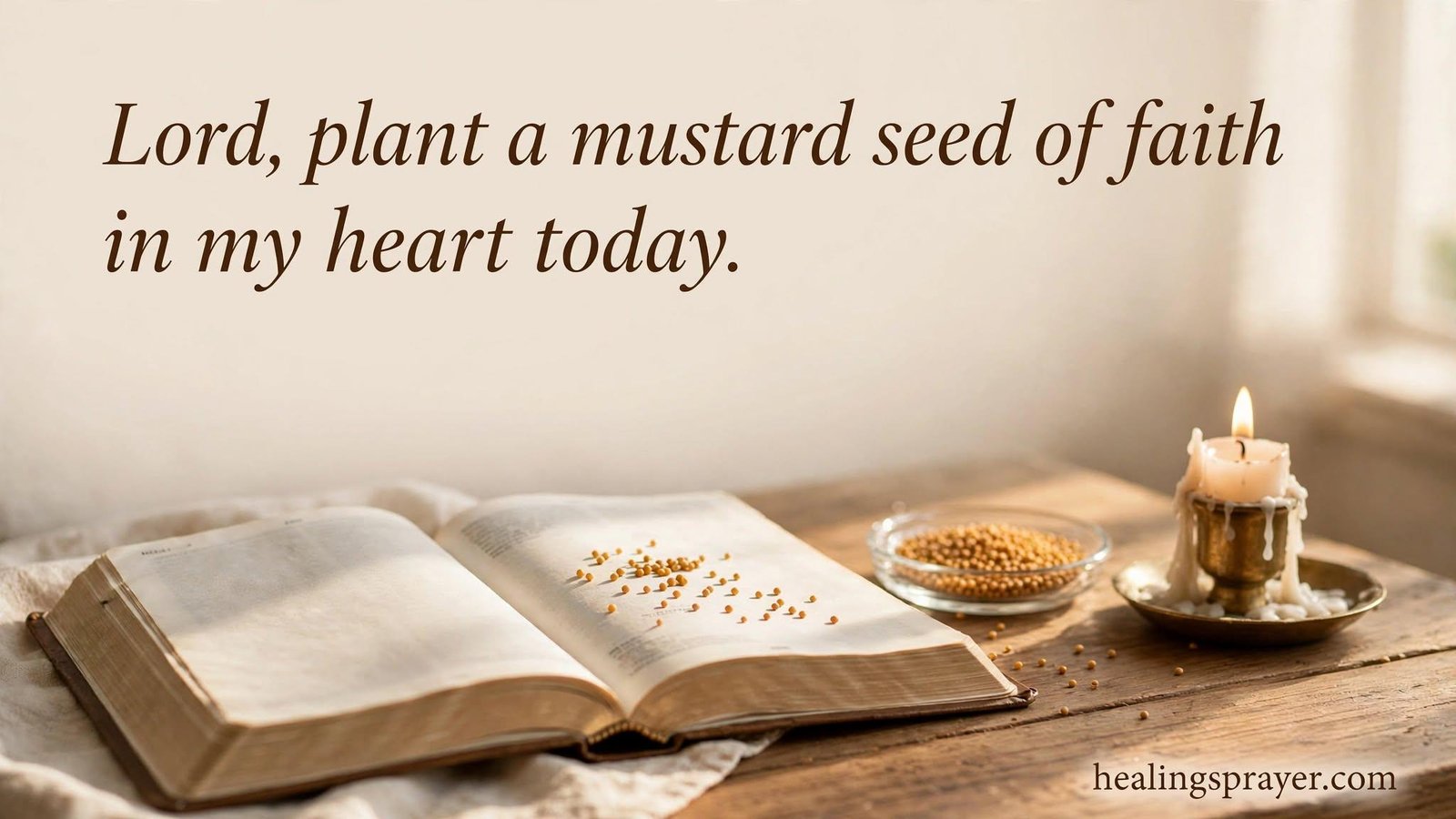
Here are nine prayers inspired by the parable of the mustard seed, grouped by need. Copy them, adapt them, or pray them as written.
Prayers for Faith
- “Lord, plant a mustard seed of faith in my heart today. Help it grow even when I cannot see it, and help me trust you with what I cannot yet understand. Amen.”
- “Father, my faith feels small, but I place it in your hands. You said even a grain is enough, so I bring you what I have. Amen.”
- “God, teach me to trust like a sower who plants and waits. Strengthen what you have started in me. Amen.”
Prayers for Small Beginnings
- “Lord, bless this small beginning. I will not despise the day of small things, and I ask you to give it growth in your time. Amen.”
- “Father, help me take the first step even when I do not feel ready. I will plant, and I trust you with the harvest. Amen.”
- “God, let what I start in faith grow into something that shelters and helps others. Make my small effort count for your purpose. Amen.”
Prayers for Doubt and Waiting
- “Lord, when I see no progress, remind me that seeds grow underground first. Give me patience while you work where I cannot see. Amen.”
- “Father, I admit my doubts. Meet me in them, and keep a mustard seed of trust alive in me through every season. Amen.”
- “God, you began a good work in me, and I trust you to complete it. Keep me steady while I wait. Amen.”
Pray any of these alongside Matthew 13:31-32 to keep the parable of the mustard seed at the center of your prayer time.
Also Read : 15 Powerful Prayers for Strength for Every Hard Season of Life
Common Mistakes When Reading the Parable of the Mustard Seed
Many readers miss the point of the parable of the mustard seed because of a few common errors. Here is what to avoid and what to do instead.
- Mixing it up with Matthew 17:20. The parable describes the kingdom growing. The other saying describes the size of faith. Keep them separate first, then connect them, as the comparison table below does.
- Reading it as a botany lesson. The parable of the mustard seed is not measuring seeds. The “smallest” language is a figure of speech about contrast, so focus on the message instead of the biology.
- Expecting instant results. Seeds grow in stages. Give your prayers and goals the time the process needs, and look for small signs of progress along the way.
- Ignoring the birds. The shelter is part of the meaning. If you skip it, you lose the point that growth is meant to bless others.
- Treating it as a promise of worldly success. The parable of the mustard seed describes the kingdom of God, not guaranteed fame, wealth, or a bigger platform.
- Measuring faith by feelings. A seed grows whether or not you feel it. Your faith is real even on days when it feels quiet.
Avoiding these errors keeps your reading of the parable of the mustard seed accurate and your faith grounded.
Parable of the Mustard Seed at a Glance (Comparison Table)
This table summarizes the key passages tied to the parable of the mustard seed and the related faith teachings, with a ready-to-use takeaway line for each.
| Passage | Key Image | Main Emphasis | Ready-to-Use Takeaway |
|---|---|---|---|
| Matthew 13:31-32 | Seed in a field becomes a tree | Dramatic growth | “What starts small in God’s hands never stays small.” |
| Mark 4:30-32 | Seed becomes the greatest of herbs with shade | Protection and shelter | “Grow where you can shelter others.” |
| Luke 13:18-19 | Seed in a garden becomes a great tree | Kingdom growth among the people | “Plant today and trust God with the tree.” |
| Matthew 17:20 | Faith like a mustard seed moves a mountain | The power of small faith | “Small faith, placed in God, still moves mountains.” |
| Luke 17:6 | Faith like a mustard seed uproots a sycamine tree | Response to “increase our faith” | “Faith placed in God, even a little, is enough to act.” |
| Matthew 13:33 | Leaven hidden in three measures of meal | Quiet, inward growth | “Some growth works quietly from the inside out.” |
Use this table as a quick study guide, or as a caption bank the next time you share the parable of the mustard seed.
Parable of the Mustard Seed FAQs
What is the parable of the mustard seed about?
The parable of the mustard seed is about the kingdom of God starting small and growing into something large enough to shelter others. It teaches that humble, unnoticed beginnings can lead to results far greater than anyone expects, and that God is faithful to finish what he starts.
Where is the parable of the mustard seed in the Bible?
The parable of the mustard seed appears in three places: Matthew 13:31-32, Mark 4:30-32, and Luke 13:18-19. A related saying about faith like a mustard seed appears separately in Matthew 17:20 and Luke 17:6.
What does the mustard seed represent?
The mustard seed represents the humble beginning of God’s kingdom in the parable, and the size of faith needed to act in Matthew 17:20. In both cases, the point is that very little, placed in God’s hands, can grow or accomplish a great deal.
Why did Jesus compare the kingdom of God to a mustard seed?
Jesus chose the mustard seed because it was a familiar picture of something very small. In the parable of the mustard seed, he used it to show that the kingdom would not begin with visible power, yet would grow into something large and sheltering.
Is the mustard seed really the smallest seed?
No, not botanically, since orchid seeds are smaller. The Gospels use “smallest” as a figure of speech common in that era, meaning extremely small, so the phrase highlights contrast rather than making a scientific claim.
What do the birds in the mustard tree mean?
The birds represent people finding shelter in God’s kingdom. The image echoes Old Testament passages such as Ezekiel 17:22-24, Ezekiel 31:6, and Daniel 4:12, where a great tree shelters birds as a sign of a kingdom protecting many nations.
What is the difference between the parable of the mustard seed and faith like a mustard seed?
The parable of the mustard seed describes how the kingdom of God grows, while “faith like a mustard seed” describes how little faith is needed to act. One is about growth over time, and the other is about the power of small faith placed in God.
What is the moral lesson of the parable of the mustard seed?
The moral lesson of the parable of the mustard seed is that small beginnings matter and that God can grow them into something that blesses many people. It encourages patience, trust, and faithful action over waiting for perfect conditions.
How can I apply the parable of the mustard seed today?
You can apply the parable of the mustard seed by taking one small step of faith today, praying over one specific need, and trusting God with the growth. The 7-day practice in this guide gives you a simple way to begin and keep going.
Final Thoughts on the Parable of the Mustard Seed
The parable of the mustard seed tells you that small is not the same as insignificant. A quiet prayer, a first step, or a short moment of trust can hold more growth than it appears to hold today.
Here is what to carry with you:
- The meaning: a tiny beginning, certain growth, and a result that shelters others.
- The background: the tree and birds echo Old Testament pictures of a kingdom that welcomes the nations.
- The difference: the parable describes the kingdom’s growth, while Matthew 17:20 and Luke 17:6 describe the power of small faith.
- The practice: plant, pray, wait, notice, share, release, and review.
Across Matthew, Mark, and Luke, the message stays the same: plant faithfully, wait patiently, and trust God with what grows. Take what you learned from the parable of the mustard seed and plant one small seed this week. Then let God do what only he can do.

Welcome to Healings Prayer!
Healings Prayer is a faith-based platform created to offer comfort, hope, and encouragement through prayer and Scripture. Our mission is to help people find peace in difficult moments and draw closer to God through heartfelt prayers and Bible verses.