

Have you ever gone through the motions of faith and felt almost nothing? If so, you may be asking whether you are a lukewarm Christian. The phrase comes straight from the words of Jesus in the book of Revelation.
This guide explains the meaning, the exact Bible verse, the history behind it, 17 clear signs, the causes, and a practical path back to a living faith. You will also get a 30-day reset plan, a list of mistakes to avoid, and a comparison table.
What Is a Lukewarm Christian?
A lukewarm Christian is a person who claims to follow Jesus but lives with little passion, commitment, or obedience. They are not openly against God, yet God is no longer the center of their daily choices.
Think of it as having the label of faith without the fire of faith. A lukewarm Christian may attend church, say the right words, and agree with the right doctrine. The problem is that faith has become a habit, not a relationship.
Here is what usually marks a lukewarm Christian:
- Belief without urgency. You agree with the Bible but rarely act on it.
- Faith without cost. You follow God only when it is easy and convenient.
- Religion without relationship. You do spiritual things but feel distant from God.
- Comfort without conviction. Sin no longer bothers you the way it once did.
Lukewarm Christian vs. Struggling Believer
A struggling believer and a lukewarm Christian can look similar from the outside, but the heart is different. A struggling believer feels pain over their weakness and keeps reaching for God. Doubt, grief, and exhaustion are real, but the desire is still alive.
A lukewarm Christian feels very little. The warning sign is not weakness. It is indifference. If you are troubled by your distance from God, that concern is evidence of a living conscience.
Lukewarm Christian vs. Backslider
A backslider has usually turned away from faith in a visible, deliberate way. A lukewarm Christian often stays inside church life while the heart quietly cools. That is why this condition is easy to miss. Nobody sees it, including the person living it.
What Does Lukewarm Mean?
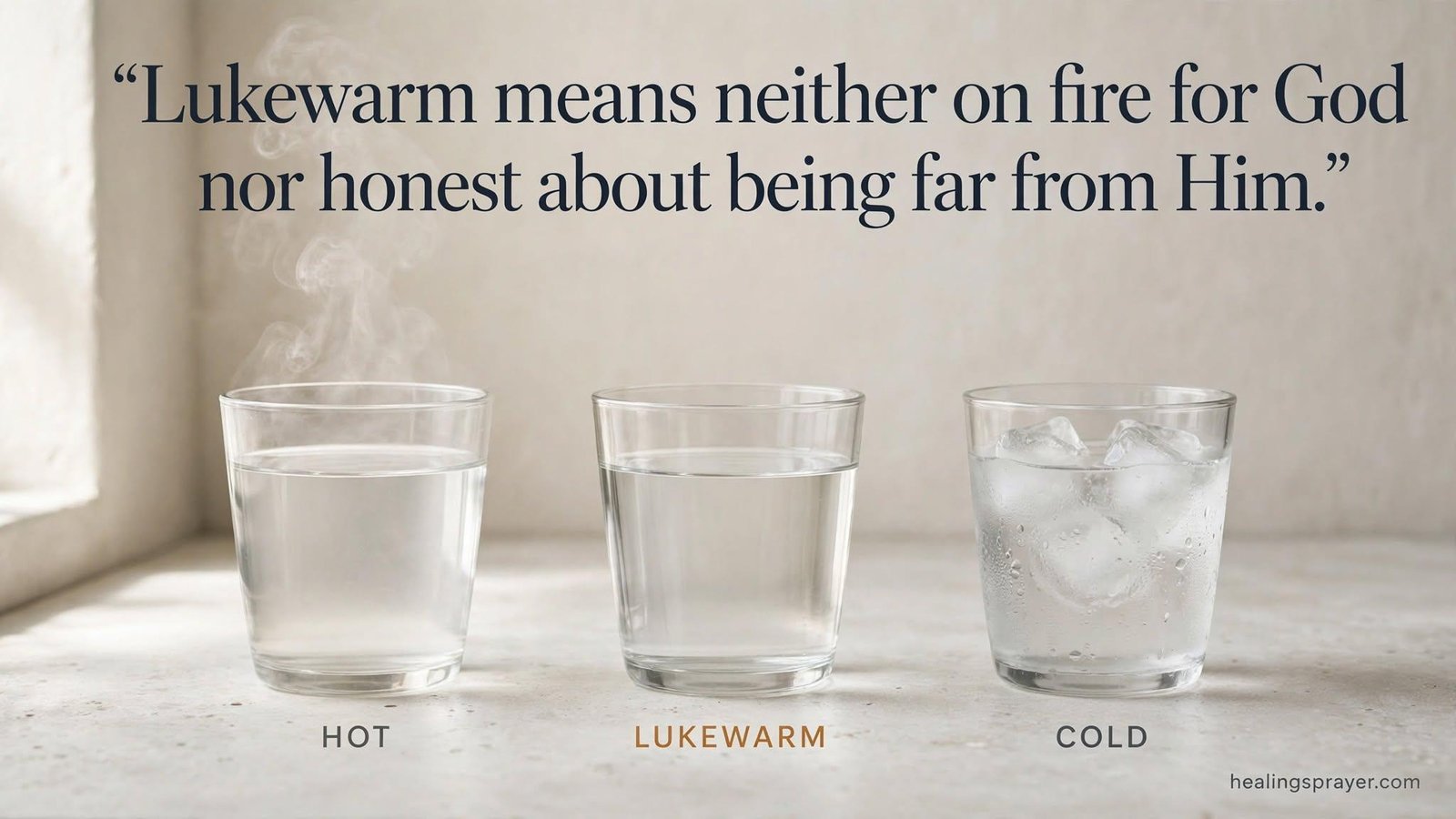
In plain English, lukewarm means slightly warm, neither hot nor cold. Hot water soothes and cleans. Cold water refreshes. Lukewarm water does neither job well, and most people pour it out.
That is the spiritual lukewarm meaning: a faith that is neither fully devoted nor openly rejecting. It is half-hearted, easy to ignore, and not very useful to anyone, including the person who has it.
The word works as a picture because everyone understands it instantly. You do not need a theology degree to know that tepid water is disappointing. Jesus chose an image that needed no explanation.
Lukewarm in the Bible: The Key Verse in Revelation 3
If you searched for the lukewarm Bible verse, lukewarm scripture, or simply the lukewarm verse, you are looking for Revelation 3:15-16. The King James Version reads:
“I know thy works, that thou art neither cold nor hot: I would thou wert cold or hot. So then because thou art lukewarm, and neither cold nor hot, I will spue thee out of my mouth.”
This is the only place in the Bible where the word “lukewarm” appears. Some people type it as “luke warm in the Bible,” but it is the same passage, found in Jesus’ letter to the church in Laodicea (Revelation 3:14-22).
Line-by-Line Meaning of Revelation 3:15-16
- “I know thy works.” Jesus is not judging appearances. He sees actual behavior and motives.
- “Neither cold nor hot.” The church was not dramatic in either direction. They were flat and stable.
- “I would thou wert cold or hot.” Both extremes are at least honest. Jesus values a clear response.
- “Because thou art lukewarm.” The problem is stated plainly: the church’s condition is the cause of His reaction.
- “I will spue thee out of my mouth.” This is a strong picture of rejection, like spitting out something that tastes wrong.
What “Spue” and “Spit” Really Describe
Newer translations say “spit.” The meaning is the same. Jesus compares the church to a drink that turns the stomach. Most Bible teachers read this as a serious warning meant to wake people up, not as a final sentence. The very next verses call the church to repent and promise restoration.
The Lukewarm Church in Revelation: Laodicea

The lukewarm church in Revelation was Laodicea, one of seven churches addressed in the book. It stood in what is now western Turkey and was known for wealth, trade, and pride.
Paul also mentions this church in Colossians 4:16, which shows it was a real, established community in the early Christian world.
The Water Problem
Laodicea had a weakness: no strong water supply of its own. Water traveled in by aqueduct. Many Bible scholars explain that nearby Hierapolis was famous for hot springs, while Colossae was known for cold, fresh water. By the time water reached Laodicea, it arrived tepid.
Excavations at Laodicea have uncovered water pipes with heavy mineral buildup, which fits the idea that the water supply was known for being unpleasant. The people of the city knew exactly what Jesus meant.
The Three Pride Points Jesus Confronted
Jesus did not stop at the water image. He took Laodicea’s three sources of pride and turned each one into a lesson:
- Banking and wealth. The Roman historian Tacitus records that Laodicea rebuilt after the earthquake of about AD 60 without imperial help. Jesus said the church was “poor” and offered “gold tried in the fire” (Revelation 3:17-18).
- Black wool. The city was famous for its dark, expensive cloth. Jesus offered “white raiment” instead, meaning real righteousness.
- Eye medicine. Laodicea was linked to a well-known eye salve. Jesus offered “eyesalve” so they could truly see their spiritual condition.
The church said, “I am rich, and increased with goods, and have need of nothing” (Revelation 3:17). Jesus replied that they were “wretched, and miserable, and poor, and blind, and naked.” The danger of the lukewarm Christian is not poverty. It is feeling rich while being empty.
Why Jesus Prefers Cold or Hot Over a Lukewarm Christian
Many readers are puzzled that Jesus would rather someone be cold than lukewarm. The reason is not that coldness is good. It is that honesty is closer to repentance than comfort is.
A person who is cold knows they are far from God. That awareness can lead them to seek Him. A lukewarm Christian feels fine, so they never feel the need to change.
Here is the difference in simple terms:
- Cold: “I need God, and I know I am far away.”
- Hot: “I want God, and I am pursuing Him.”
- Lukewarm: “I am okay as I am.”
That last statement is the hardest one to break. Self-satisfaction does not feel like a problem, which is exactly why it is dangerous. This is the heart of the true lukewarm Christian meaning: not a weak believer, but a comfortable one.
17 Signs of a Lukewarm Christian
The signs of a lukewarm Christian are quiet and gradual. Read each one slowly and honestly, then use the “Try this” action to respond.
- You pray only in emergencies. Prayer has become a rescue button instead of a conversation. Try this: pray for two minutes each morning about ordinary things, not only crises.
- You rarely read the Bible. When you do, you read to finish, not to be changed. Try this: read five verses and write one sentence about what they ask of you.
- Church is just a routine. You attend from habit and leave the same as you arrived. Try this: before service, pray for a heart that is ready to listen.
- You skip church easily. Small inconveniences become reasons to stay home. Try this: decide your attendance before the week starts, not on Sunday morning.
- You tolerate small sins. Things that once bothered your conscience now feel normal. Try this: name one habit you have excused and confess it specifically.
- You want blessings without obedience. You enjoy what God gives but resist what He asks. Try this: choose one command from Scripture and act on it this week.
- Your resources go mostly to yourself. Time, money, and energy serve your comfort first. Try this: set a fixed amount of money or hours for giving and service.
- You give God the leftovers. The best part of the day and the best part of your income go elsewhere. Try this: give God the first ten minutes of your day, not the last.
- You are embarrassed to mention Jesus. You stay silent at work, school, or family gatherings. Try this: mention your faith naturally once this week, without pressure.
- You have no desire to share the gospel. You assume someone else will do it. Try this: pray for one person by name every day.
- You copy the world’s values. Your entertainment, speech, and priorities look the same as everyone else’s. Try this: review what you watch and read, and remove one thing that dulls your heart.
- You avoid anything that costs comfort. Sacrifice, fasting, and service feel like too much. Try this: take on one small, planned act of sacrifice.
- You care more about people’s opinions than God’s. Reputation controls your decisions. Try this: before big choices, ask “What does God want?” first.
- You compare yourself to others. “At least I’m not as bad as them” keeps you feeling safe. Try this: compare yourself to Jesus’ teaching, not to other people.
- You feel no sorrow over sin and no joy in worship. Both guilt and gladness have faded. Try this: spend five minutes thanking God for specific things.
- You avoid accountability. Friendships stay shallow so no one asks hard questions. Try this: invite one mature believer to check in with you weekly.
- You feel spiritually dry but are not troubled by it. This may be the clearest sign of all. Try this: ask God to give you a hunger for Him, even if you do not feel it yet.
If many of these fit, do not panic. A lukewarm Christian who is troubled by this list still has a working conscience, and that is the starting point for change.
Also Read :36 Comforting Bible Verses for Grief, Sadness, and Hard Times (With Meaning)
Why Christians Become Lukewarm

Nobody decides to become a lukewarm Christian. It happens through small compromises that add up over months or years. Jesus described this pattern when He warned that “the love of many shall wax cold” (Matthew 24:12).
Comfort and Self-Sufficiency
This was Laodicea’s exact problem. When life is stable and money is steady, dependence on God fades without anyone noticing. Prayer drops first because you no longer feel the need.
What to do: Practice gratitude and generosity on purpose. Both remind you that everything comes from God, not from your own effort.
Busyness and Distraction
Work, phones, social media, and entertainment can fill every free minute. Nothing evil is required. A full schedule is enough to push God out. The research on habits points the same way: what you repeat daily becomes automatic, and what you skip daily fades.
What to do: Schedule time with God before you schedule everything else.
Hidden Sin and Disappointment
Unconfessed sin makes people hide from God instead of running to Him. Unanswered prayer, loss, and long seasons of waiting can also lead people to stop expecting anything. In both cases, the heart cools to protect itself.
What to do: Bring the honest version of your story to God. The Psalms show that complaint and doubt are allowed in prayer.
Weak Community and Shallow Teaching
Faith was never meant to be lived alone. Hebrews 10:24-25 urges believers to meet together and encourage each other. Without community, even sincere believers drift.
Shallow teaching also plays a part. A faith built only on good feelings and motivational messages has no roots to hold it when pressure arrives.
What to do: Look for a church or group that opens the Bible and applies it to daily life.
Is a Lukewarm Christian Still Saved?
This is one of the most common questions, and Christians hold different views. Some read Revelation 3 as a warning to genuine believers who have drifted and must repent. Others read it as a call to examine whether faith is real, as Paul writes in 2 Corinthians 13:5.
Different traditions answer differently, and this article does not try to settle that debate. If you are worried about your own standing, speak with a trusted pastor or mature Christian friend.
What every view agrees on is the direction: do not stay where you are. Jesus says, “As many as I love, I rebuke and chasten: be zealous therefore, and repent” (Revelation 3:19). The rebuke is an act of love, not rejection.
How to Stop Being a Lukewarm Christian

The passage does not end with a warning. It ends with an invitation. Jesus says:
“Behold, I stand at the door, and knock: if any man hear my voice, and open the door, I will come in to him, and will sup with him, and he with me.” (Revelation 3:20)
Notice that Jesus knocks. He does not force the door. The way back is to open it. These nine steps show you how.
Step 1: Repent Honestly
Repentance is not only feeling bad. It means turning around. Tell God specifically where you have grown cold, without excuses and without comparing yourself to others.
Step 2: Build a Small Daily Habit
Start with ten minutes of prayer and Bible reading at the same time each day. A well-known University College London study on habit formation found that new habits took anywhere from about 18 to 254 days to become automatic, with an average near 66 days. Consistency matters more than length.
Step 3: Start With the Right Reading
The Gospel of John and the Psalms are strong starting points. John shows who Jesus is, and the Psalms teach honest prayer. Read slowly and ask, “What does this tell me about God, and what does it ask of me?”
Step 4: Remove What Is Pulling Your Heart Away
Look honestly at where your time and attention go. You may not need to remove everything, but you do need to reduce what dulls your appetite for God. Start with the biggest one.
Step 5: Join a Real Community
Find a church or small group where people know your name. Take one step toward real friendship, such as sharing a prayer request. A coal burns bright in the fire and goes cold when taken out alone.
Step 6: Serve Other People
Faith warms up through action. James 1:22 tells believers to be “doers of the word, and not hearers only.” Volunteer, help a neighbor, or give generously. Love that costs something changes the heart.
Step 7: Share Your Faith in Small Ways
You do not need a sermon. Tell one person what God has done for you. Speaking about your faith strengthens it.
Step 8: Practice Fasting and Gratitude
Fasting trains the heart to want God more than comfort. Gratitude reminds you how much you have received. Do both in simple, sustainable ways.
Step 9: Ask God for Fire
Passion cannot be forced, but it can be requested. Pray honestly: “Lord, give me a heart that loves You again.” Romans 12:11 describes believers as “fervent in spirit,” and that fervor is both a choice and a gift.
Also Read : 64 Inspirational Christian Quotes to Strengthen Your Faith, Hope, and Daily Walk
The 30-Day Reset Plan for a Lukewarm Christian
Most articles list the signs and stop. A plan is what turns insight into change. This four-week reset is designed to be small enough that you can finish it.
Week 1: Honesty (Days 1-7)
- Day 1: Pray the prayer of Psalm 139:23-24 and ask God to show you your heart.
- Day 2: Read Revelation 3:14-22 slowly, twice.
- Day 3: Write down the three signs from the list above that fit you most.
- Day 4: Confess them to God by name.
- Day 5: Read Luke 15, the parables about lost things being found.
- Day 6: Thank God for three specific things.
- Day 7: Rest and attend church with a prepared heart.
Week 2: Habit (Days 8-14)
- Pick one fixed time and place for prayer and reading.
- Read one chapter of John each day.
- Pray in three parts: thanks, honesty, requests.
- Remove one distraction during this time, such as your phone in another room.
- On Day 14, review how many days you kept the habit, without guilt over the gaps.
Week 3: Community (Days 15-21)
- Contact one mature believer and ask for weekly check-ins.
- Attend a small group, Bible study, or midweek service.
- Share one prayer request with another person.
- Pray for someone else daily.
- On Day 21, write down what you have noticed changing in your attitude.
Week 4: Action (Days 22-30)
- Choose one act of service and complete it.
- Give something generously, whether time, money, or help.
- Tell one person a simple piece of your faith story.
- Fast from one meal or one habit, such as social media, for a day.
- On Day 30, write a short prayer of commitment for the next 30 days.
A reset is a start, not a finish. The goal is to build the base of daily habits that keep a lukewarm Christian from sliding back.
Common Mistakes When Trying to Stop Being Lukewarm
Good intentions fail for predictable reasons. Avoid these:
- Trying to change everything at once. A big plan collapses in two weeks. Start with ten minutes a day.
- Relying on feelings. Waiting to “feel on fire” before acting reverses the order. Action usually comes first and feeling follows.
- Treating guilt as the goal. Shame alone does not warm the heart. Repentance moves toward God, while guilt without repentance moves away.
- Going alone. A lukewarm Christian who avoids community is relying on the same weak point that caused the drift.
- Chasing emotional events. Conferences and worship nights can help, but they cannot replace daily habits.
- Comparing your progress. Another person’s pace says nothing about yours. Measure against your own starting point.
- Quitting after a missed day. One missed day is not failure. Return the next morning without drama.
- Ignoring the root cause. If the coldness began with a hurt, a sin, or a disappointment, deal with that directly, or the habits will feel empty.
How to Help a Lukewarm Christian You Love
Many readers are not asking for themselves. They are worried about a family member or friend. Here is how to help without pushing them further away.
- Pray first. You cannot change a heart, but God can.
- Lead with love, not lectures. People rarely respond to pressure, but they do respond to patience.
- Ask honest questions. Try “How is your relationship with God these days?” and then listen.
- Model the change. Your steady example speaks louder than your arguments.
- Invite, do not demand. Offer to read together, serve together, or attend church together.
- Stay consistent. Real change is slow, and your steady presence matters.
Galatians 6:1 encourages believers to restore others “in the spirit of meekness.” Gentleness is the tone, and persistence is the method.
Lukewarm Christian Comparison Table
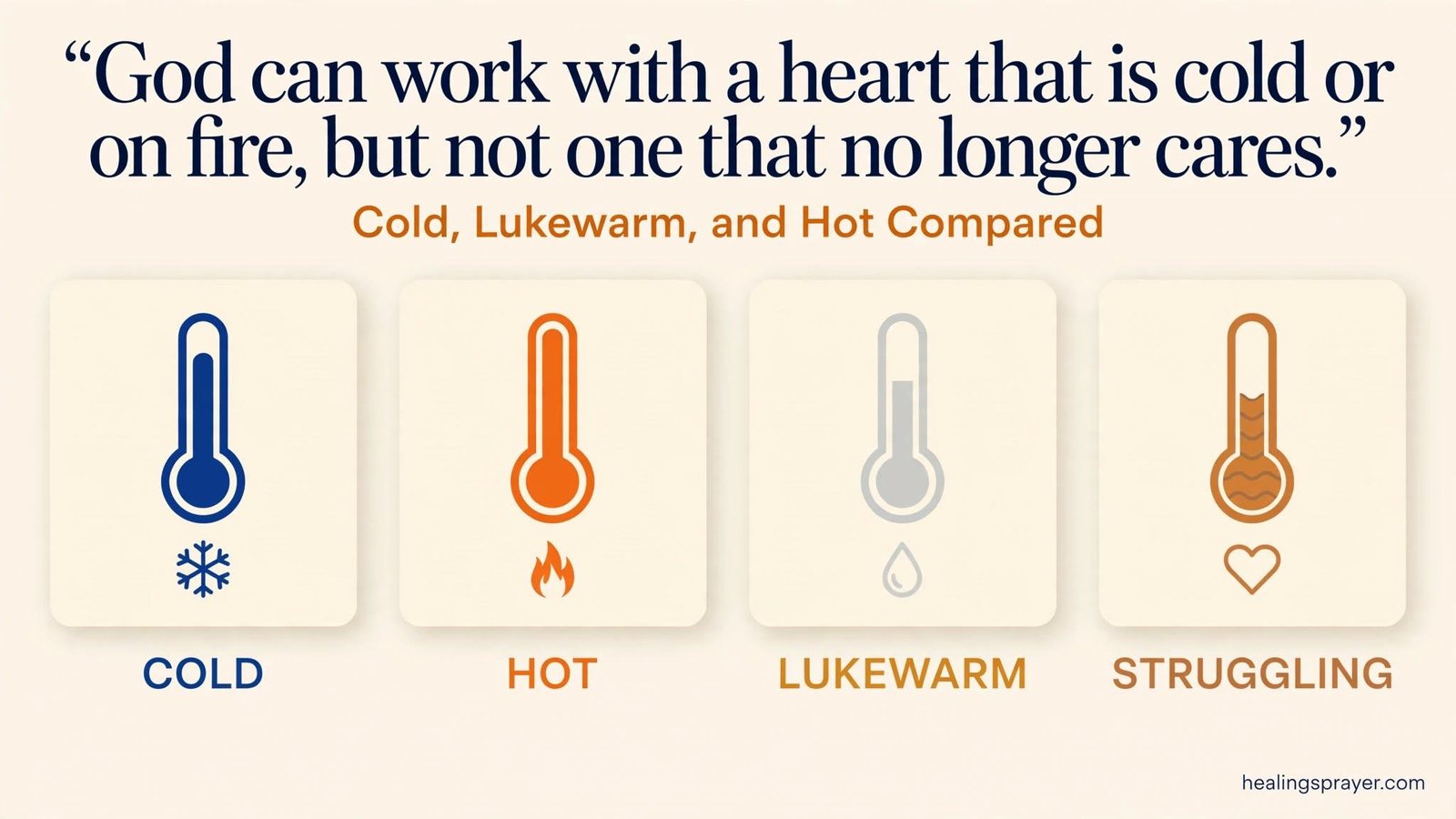
| Type | Attitude Toward God | Key Sign | Real Example (a usable first step) |
|---|---|---|---|
| Cold | Distant and aware of it | Knows they are far from God | “God, I am far from You. Help me.” (a simple honest prayer) |
| Lukewarm | Comfortable and indifferent | Feels fine, sees no need to change | Read Revelation 3:14-22 and ask: “Where am I comfortable?” |
| Hot | Eager and pursuing | Seeks God daily with joy | Keep the daily habit and invite someone else to join |
| Struggling believer | Weak but reaching | Feels pain over their distance | Tell one trusted friend: “I am struggling. Can you pray for me?” |
| Backslider | Turned away deliberately | Left faith practices behind | Return with Psalm 51 as a prayer of repentance |
Frequently Asked Questions About the Lukewarm Christian
What is a lukewarm Christian in simple words?
A lukewarm Christian is someone who believes in God but lives without real commitment or passion. Faith is part of their life, but it is not the center.
What does lukewarm mean in the Bible?
It means half-hearted and spiritually indifferent, neither fully devoted to God nor openly against Him. It comes from Jesus’ words to the church in Laodicea in Revelation 3:16.
Where is the lukewarm verse in the Bible?
It is in Revelation 3:15-16, within the letter to Laodicea (Revelation 3:14-22). It is the only place the word “lukewarm” appears in Scripture.
Which church was lukewarm in Revelation?
The church in Laodicea, a wealthy city in what is now western Turkey. It was known for banking, black wool, and eye medicine.
Why does Jesus prefer cold over lukewarm?
A cold person knows they need God, while a lukewarm person feels they already have enough. Awareness of need is closer to repentance than comfort is.
How do I know if I am a lukewarm Christian?
Check the 17 signs above. The clearest ones are a dry prayer life, tolerated sin, and not being bothered by either.
Can a lukewarm Christian change?
Yes. Jesus calls the lukewarm to repent and promises fellowship to anyone who opens the door (Revelation 3:20). Change usually begins with small, daily habits.
How long does it take to stop being lukewarm?
There is no fixed timeline. A 30-day reset can start the change, but habit research suggests lasting routines often take about two months or more, so stay patient and consistent.
Final Thoughts for the Lukewarm Christian
Being a lukewarm Christian is a real danger, but it is not a permanent condition. The Laodiceans were wealthy, comfortable, and blind to their need, and Jesus still did not give up on them. He rebuked them because He loved them, and He knocked because He wanted to come in.
If you recognized yourself in these signs, today is a good day to respond. Pray honestly, open your Bible, join a community, and ask God to rekindle your heart. A lukewarm faith can become a living faith again.

Welcome to Healings Prayer!
Healings Prayer is a faith-based platform created to offer comfort, hope, and encouragement through prayer and Scripture. Our mission is to help people find peace in difficult moments and draw closer to God through heartfelt prayers and Bible verses.