
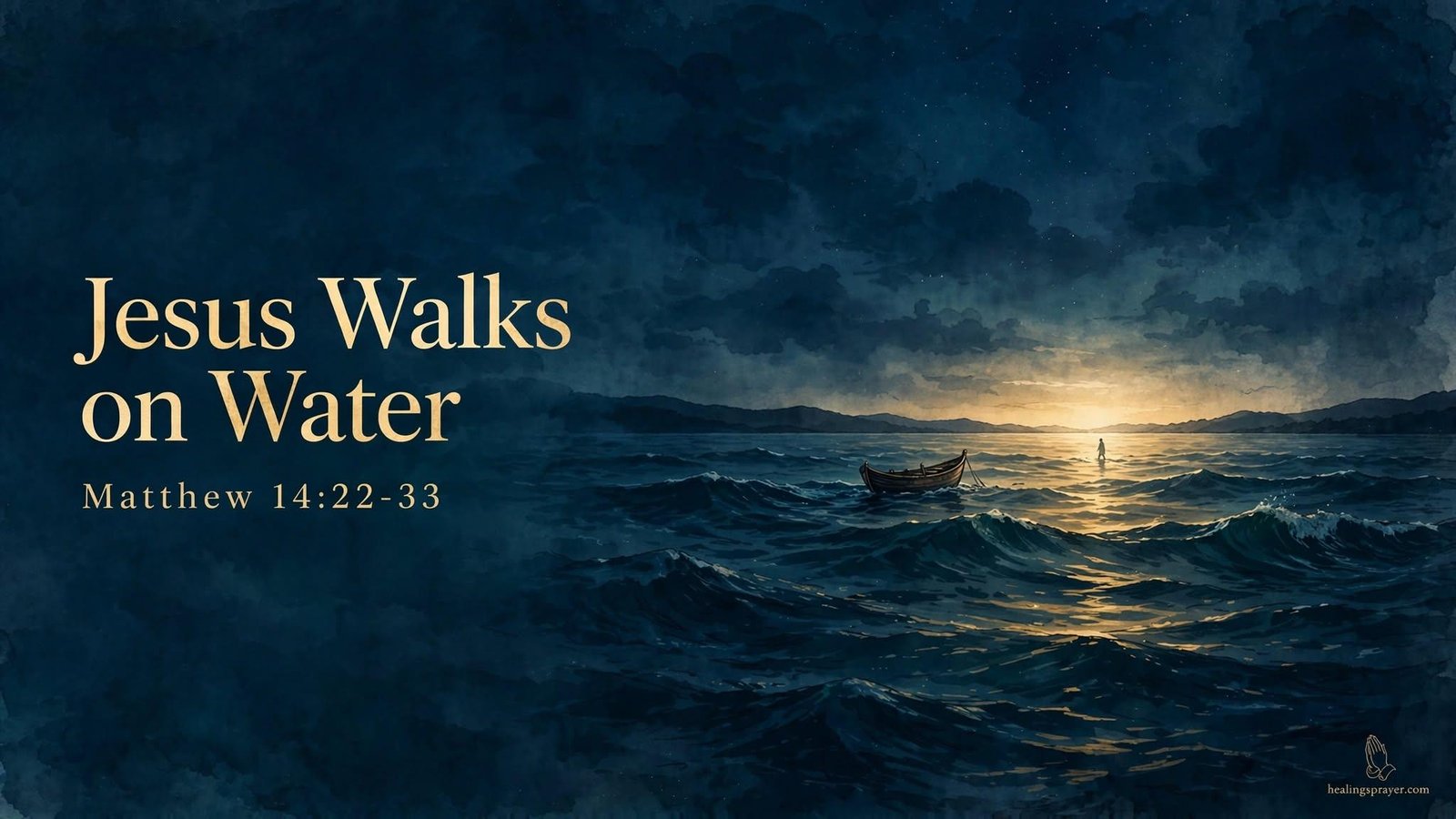
Read the story that shows what Jesus does when the storm is loudest.
Few scenes in the Gospels are as vivid as the moment Jesus walks on water across a stormy sea to reach His frightened disciples. The wind pushes against the boat, the night is dark and help arrives in a way no one expected.
This guide explains the Jesus walks on water story verse by verse, compares the accounts in Matthew, Mark and John, and answers common questions such as who walked on water with Jesus and how many times the miracle happened. You will also find the meaning of Jesus walking on water, seven lessons you can apply today and a short prayer to close.
What Is the Story of Jesus Walks on Water?
The story of Jesus walks on water is a miracle recorded in Matthew 14:22-33, Mark 6:45-52 and John 6:16-21, in which Jesus walks across the stormy Sea of Galilee at night to reach His disciples in their boat. In Matthew’s account, Peter also steps out onto the water before fear makes him sink and Jesus rescues him.
The Jesus walks on water story is one of the best-known miracles in the New Testament, and people search for it in many forms, including Jesus walking on water, Jesus walked on water and the story of Jesus walking on water. All of these point to the same event: a night crossing, a strong wind and Jesus arriving on the waves.
The Jesus walks on water miracle matters because it answers a question the disciples were still asking: who is this? By the end of the scene, the men in the boat have their answer, and it changes how they see Him.
Where the Story Appears: Matthew 14, Mark 6 and John 6
Three of the four Gospels tell the Jesus walks on water miracle, and each one places it right after Jesus feeds the crowd of about five thousand people.
- Matthew 14:22-33 is the longest version and the only one that includes Peter walking on the water.
- Mark 6:45-52 is shorter, adds that Jesus meant to pass by the boat, and links the disciples’ shock to their failure to understand the loaves.
- John 6:16-21 is the briefest and notes that the disciples rowed several miles before they saw Jesus, and that the boat reached land almost at once after He entered it.
Luke does not include the account. The three Gospels that tell the Jesus walks on water event share the same core: a storm, a walking Jesus, a fearful crew and words of comfort.
Jesus Walks on Water Scripture: Matthew 14:22-33 Explained

The fullest Jesus walks on water scripture is found in Matthew 14. Reading it in four short parts makes each moment easier to follow.
The Setting: A Boat, a Storm and the Fourth Watch (Matthew 14:22-24)
Jesus had withdrawn to a quiet place after hearing that John the Baptist was killed (Matthew 14:13), and the crowds followed Him anyway. Right after feeding them, Jesus tells His disciples to get into the boat and go ahead of Him to the other side of the lake. He then sends the people home and climbs a mountain alone to pray.
In the Jesus walks on water account, the boat is by evening already a long way from shore and being battered by waves because the wind is against it. The disciples are doing what Jesus asked, yet they are caught in a storm. That detail matters for everything that follows.
“It Is I”: Jesus Comes to His Disciples (Matthew 14:25-27)
In the fourth watch of the night, which was roughly between three and six in the morning, Jesus comes to them walking on the sea. The disciples see a figure on the water, cry out that it is a ghost and are terrified.
Jesus answers at once with one of the most comforting lines in the Gospels: “Take heart; it is I. Do not be afraid.” Many Bible commentators note that “It is I” uses the same Greek words Jesus uses elsewhere to say “I am,” which adds weight to His reassurance. When Jesus walks on water in this scene, He is not only calming a storm of fear but also revealing who He is.
When Peter Walked on Water (Matthew 14:28-31)
Peter answers with a bold request: if it is really Jesus, command him to come to Him on the water. Jesus says one word, “Come,” and Peter climbs out of the boat and walks toward Him.
Then Peter notices the wind, becomes afraid and begins to sink. He cries out, “Lord, save me,” and Jesus immediately reaches out, catches him and says, “You of little faith, why did you doubt?” The response is quick, close and gentle.
The Calm and the Worship (Matthew 14:32-33)
When Jesus and Peter climb into the boat, the wind stops. The disciples respond by worshiping Him and saying, “Truly you are the Son of God.”
This ending is the point of the whole Jesus walks on water scene. When Jesus walks on water and steps into the boat, the storm does not just settle. The men in the boat recognize who is with them.
Jesus Walking on Water in Mark 6 and John 6:16-21
Comparing the accounts shows how three writers describe the same night of Jesus walks on water. Each one adds a detail that helps you see the Jesus walks on water miracle from a slightly different angle.
Mark 6:45-52
Mark tells you that Jesus saw the disciples straining at the oars because the wind was against them. He came toward them in the fourth watch, walking on the sea, and Mark adds that He meant to pass by them.
The disciples thought He was a ghost and cried out. Jesus told them to take heart and not be afraid, then got into the boat and the wind stopped. Mark closes by saying they were completely amazed because they had not understood the miracle of the loaves, and their hearts were hard. Peter is not mentioned.
John 6:16-21 (Including John 6:16)
John 6:16 sets the scene: evening has come, and the disciples go down to the sea. They start across toward Capernaum, and darkness falls before Jesus joins them.
John 6:16-21 says a strong wind stirs the sea, and after rowing about three or four miles, the disciples see Jesus walking on the water and drawing near to the boat. They are afraid, but He tells them, “It is I; do not be afraid.” They are glad to take Him into the boat, and immediately the boat reaches the shore where they were heading. Peter is not mentioned here either.
Together, the three accounts show the same Jesus walks on water event told with different emphasis: Matthew focuses on faith through Peter, Mark on understanding and John on the sudden arrival.
Who Walked on Water With Jesus? The Story of Peter

Peter is the one who walked on water with Jesus. The apostle Peter is the only person the Bible records walking on water alongside Jesus, and his story appears only in Matthew 14:28-31.
Many readers of the Jesus walks on water story focus on Peter’s failure, but the moment deserves a closer look. Of all the men in the boat, Peter is the only one who asks to join Jesus on the waves, and for a few steps he does exactly what nobody else has ever done. That is what makes Peter walked on water more than a story of doubt.
Why did Peter sink? Matthew says he saw the wind and became afraid. His steps were real as long as his attention stayed on Jesus, and they faltered when his attention moved to the storm.
When Peter cried out for help, Jesus did not lecture him first. He reached out at once, and only after Peter was safe did He speak about doubt. Anyone who has ever asked why the Jesus walks on water story ends with Peter being rescued instead of left alone can find the answer in that quick, close hand. The story of Peter walking on water is really a story about who catches you.
Also Read : What Study Bible Is Right for Me? 25+ Powerful Best Study Bibles with Prayers
When, Where and How Many Times Did Jesus Walk on Water?
Three of the most common questions about the miracle are about its timing, its place and how often it happened.
When Did Jesus Walk on Water?
The Gospels place the Jesus walks on water event on the night right after Jesus fed the five thousand. Jesus had gone up a mountain to pray, and the disciples were crossing the lake without Him. He reached them in the fourth watch of the night, which was roughly the hours before dawn.
Where Did Jesus Walk on Water?
The Jesus walks on water miracle takes place on the Sea of Galilee, also called the Lake of Gennesaret or the Sea of Tiberias. The disciples were sailing toward the other side, and the accounts mention Capernaum, Bethsaida and Gennesaret as places connected to the journey.
How Many Times Did Jesus Walk on Water?
The Gospels record one occasion when Jesus walked on water, told in Matthew, Mark and John. Peter walked on the water briefly during that same event. Other storm stories, such as Jesus calming the wind and waves from inside a boat in Matthew 8, are different events and do not involve Him walking on the sea.
The Background: Why the Sea of Galilee Matters to the Jesus Walks on Water Story
To understand why the Jesus walks on water miracle carried such weight, it helps to know the setting. The Sea of Galilee is a freshwater lake in northern Israel surrounded by hills, and it is known for sudden, strong windstorms. Several of Jesus’ disciples were fishermen who had spent their lives on this lake, so they knew exactly how dangerous a night wind could be.
Night crossings were normal for fishermen, and the Romans divided the night into four watches. That is why the Gospels say Jesus came in the fourth watch, the last stretch before dawn. When experienced fishermen are straining at the oars and cannot make progress, readers are meant to feel how serious the storm had become.
In the Old Testament, the sea often stands for chaos and danger that only God can control. Psalm 107 describes sailors caught in a storm who cry out and are brought safely to harbor. Against that background, the sight of Jesus walking calmly over the waves carried a strong message for first-century Jewish readers: this is the kind of power the Scriptures attribute to God.
This background explains why Jesus walking on water was not just a rescue. It was a statement about who was in the boat’s path, and it is one reason the disciples ended the night in worship.
How Jesus Walks on Water Connects to the Feeding of the Five Thousand
All three accounts of the Jesus walks on water miracle follow the feeding of the five thousand, and that order is not an accident. In the feeding, Jesus meets the crowd’s hunger. On the lake, He meets His disciples’ fear.
Mark makes the link explicit. He says the disciples were astonished at the walking because they had not understood the loaves, and their hearts were hard. In other words, the same power that multiplied bread was standing in front of them on the waves, and they still had not connected the two events.
John shows the connection differently. In John 6, the Jesus walks on water scene is followed the next day by Jesus teaching about the bread of life. The two miracles and the teaching belong together: Jesus provides for His people and He is present with them.
Reading the events side by side helps you see the pattern. Jesus does not only give what you need. He also comes to you when you feel far from shore.
Did Jesus Walk on Water? Faith, History and Common Questions
Christians have traditionally understood the Jesus walks on water account as a real miracle. Three Gospels record it, and each one presents it as an event that made the disciples worship, not as a parable or a symbol.
Some readers of the Jesus walks on water story have proposed natural explanations, such as walking on floating ice or a shallow ridge of land. The Gospel writers do not present it that way. They describe a night storm, a boat far from shore and a walking figure that the disciples could not explain, which is why they reacted with fear and then worship.
Whether a person accepts the miracle is ultimately a matter of faith and worldview. Historians can study the manuscripts and the setting, but they cannot measure a miracle in a laboratory, so the question of Jesus walks on water always comes back to how a reader weighs the testimony of the Gospel writers. What the text itself makes clear is that the writers believed Jesus walks on water to show His authority over creation, and that the men who saw it were changed by what they saw.
What Does Jesus Walks on Water Mean?

The meaning of the Jesus walks on water miracle rests on four ideas that appear across the accounts, and each one speaks to what Jesus walks on water shows about God.
- Authority over creation. Old Testament passages such as Job 9:8 and Psalm 77:19 describe God moving over the waves and through the sea. When Jesus walks on water, the Gospels invite readers to see Him acting with that same authority.
- His identity. The words “It is I” and the disciples’ response, “Truly you are the Son of God,” show that the scene is about who Jesus is, not just what He can do.
- His presence in the storm. Jesus does not wait for the wind to die down. He comes to the disciples while they are still afraid and still rowing.
- The call to trust. Peter’s walk and sinking show that faith is not the absence of fear but the choice to keep looking toward Jesus while the wind still blows.
For everyday readers, the meaning of Jesus walking on water is simple: the One who rules the sea is also the One who comes to you in the middle of your own storm.
Symbolism in Jesus Walks on Water: The Sea, the Boat and the Wind
Beyond the historical scene, many Christians see symbolic layers in the Jesus walks on water account. These readings are not stated in the text, but they have shaped Christian teaching and art for centuries.
- The sea: In biblical imagery, the sea often represents chaos, danger and the unknown. Jesus walking on it shows that nothing in creation is outside His authority.
- The boat: Early Christian writers and later church art often used a boat to picture the community of believers. Seen this way, the disciples in the boat represent the church moving through hard seasons.
- The wind: The wind stands for the pressures that push against faith, such as fear, opposition and uncertainty. The wind is real, but it does not have the final word.
- The fourth watch: The hour before dawn is a natural image of help arriving just before the light, which is why this detail speaks to people waiting for a breakthrough.
- The outstretched hand: Jesus’ hand reaching for Peter is often read as a picture of grace, the rescue that comes because of who He is, not because of how well Peter walked.
These images help explain why Jesus walking on water is used so often in sermons, songs and devotionals. The scene is easy to picture and easy to apply, even for people hearing it for the first time.
7 Lessons From Jesus Walks on Water

The Jesus walks on water story is full of practical wisdom. These seven lessons come straight from the text.
Lesson 1: Jesus Sees You Before You Call
In the Jesus walks on water story, Mark 6:48 says Jesus saw the disciples straining at the oars. He was on the mountain and they were far out on the lake, yet He saw them. You do not need to be loud or perfect for Him to notice your struggle.
Lesson 2: Storms Can Come While You Are Obeying
Matthew 14:22 says Jesus made the disciples get into the boat, and the storm came after they obeyed. Hard seasons do not always mean you took a wrong turn. Sometimes you are exactly where you were told to be.
Lesson 3: Jesus Speaks Peace First
Before He explains anything, Jesus tells the disciples to take heart and not be afraid. His first move is comfort, not correction. Let His calm be the first voice you listen for when fear gets loud.
Lesson 4: Faith Begins With “Command Me”
Peter does not step out on his own idea. He asks Jesus to command him, and Jesus says “Come.” The Jesus walks on water story shows that real faith listens for the call before it takes the step, and it does not treat risk as proof of trust.
Lesson 5: Focus Decides Direction
Peter walks while he looks at Jesus and sinks when he looks at the wind. The wind did not suddenly begin; it was blowing the whole time. Where you place your attention shapes how steady you feel.
Lesson 6: Sinking Is Not the End
In Jesus walks on water, Peter’s prayer is only three words in English: “Lord, save me.” It is short, honest and enough. Jesus reaches out immediately. If you are sinking, you do not need a perfect prayer, only a real one.
Lesson 7: Worship Follows Rescue
Once Jesus is in the boat, the disciples worship. Gratitude is a natural response to being carried through something hard, and it keeps you from forgetting who carried you.
Jesus Walks on Water Bible Verses to Remember
If you want to memorize part of the Jesus walks on water story, these short passages are a good place to begin. The wording below is paraphrased, so check your own Bible translation for the exact text.
- Matthew 14:27: Jesus tells the frightened disciples to take heart because it is Him, and not to be afraid.
- Matthew 14:28-29: Peter asks to come to Jesus on the water, and Jesus answers with one word: come.
- Matthew 14:30: Peter sees the wind, becomes afraid and cries out for Jesus to save him.
- Matthew 14:31: Jesus reaches out at once, catches Peter and asks why he doubted.
- Matthew 14:33: The men in the boat worship Jesus and call Him the Son of God.
- Mark 6:50: All the disciples see Jesus, and He speaks to them right away so their fear does not linger.
- John 6:20: Jesus says “It is I; do not be afraid,” which is the heart of the reassurance in all three accounts.
- Isaiah 43:2: God promises to be with His people when they pass through the waters, a verse many readers connect to the Jesus walks on water miracle.
You can copy two or three of these onto index cards and place them where you will see them every day. Reading the Jesus walks on water scripture in small pieces makes it easier to remember when fear shows up unexpectedly.
How to Apply the Jesus Walks on Water Story in Daily Life
Knowing the story is helpful, and practicing what Jesus walks on water teaches is better. The Jesus walks on water account offers five simple habits you can use this week.
Name Your Storm
Write down the exact situation that is making you afraid, whether it is a job, a diagnosis, a relationship or a decision. Naming the storm keeps it from feeling bigger than it is, and it gives you something specific to bring to Jesus.
Take One Obedient Step
Peter took one step at a time. Choose the smallest action you believe you are being asked to take today, such as making a phone call, forgiving someone or asking for help, and do only that one thing.
Refocus When Fear Grows
When your thoughts start spinning, pause and repeat a short line from the story, such as “Take heart; it is I.” Say it slowly and breathe. Turning your attention back to Jesus is exactly what Peter needed to do.
Keep a Record of Rescues
Write down each time you felt carried through something hard. Reviewing that list during the next storm reminds you that the One who reached out before is still near. Isaiah 43:2 says God will be with His people when they pass through the waters, which is a strong verse to add to your list.
Pray a Short, Honest Prayer
You do not need long words. A prayer as short as “Lord, help me” is a real prayer. Say it aloud, and then stay quiet for a moment to listen.
Also Read : 90+ Powerful Prayers for Harvest with Bible Verses for protection and Abundance
Reflection Questions and Family Discussion Ideas
The Jesus walks on water story works well in small groups, family devotions and Sunday school lessons because it is short, visual and full of questions worth discussing. Use these prompts after reading Matthew 14:22-33 together.
- Why do you think Jesus sent the disciples into the boat before the storm came?
- What would you have felt in the boat when you first saw Jesus on the water?
- Why do you think Peter asked Jesus to command him to come?
- What was Peter looking at when he began to sink?
- What storms are you facing that feel bigger than you right now?
- When have you seen Jesus reach out to you at the moment you called for help?
- What is one small step you can take this week that would show trust in Jesus?
- How does the disciples’ worship at the end change the way you read the whole story?
For younger children, keep the retelling simple: a stormy night, a scared crew, Jesus walking on the water, Peter’s brave steps and a strong hand that catches him. A short craft, such as drawing a boat with paper waves, helps the Jesus walks on water story stick. Let children finish the sentence “Jesus is with me when…” so they connect the miracle to their own lives.
Jesus Walks on Water for Kids: Sunday School Lesson Ideas
Teachers and parents often look for Jesus walking on water for kids, and the Jesus walks on water story is a strong fit for a Sunday school lesson or a children’s sermon because it is dramatic, visual and easy to retell. Use these ideas to build a short lesson around Matthew 14:22-33.
- Big idea: Jesus is stronger than any storm, and we can call on Him when we are afraid.
- Memory verse: Choose Matthew 14:27, where Jesus tells the disciples to take heart because it is Him and not to be afraid. Write it on a paper wave and let the kids decorate it.
- Opening question: Ask, “What makes you feel afraid at night or in a storm?” Let each child answer before you begin the story.
- Retelling with motions: Rock side to side for the boat, wiggle your fingers for the rain and stretch out a hand when Jesus reaches for Peter.
- Float and sink activity: Fill a tub with water and let the kids test which objects float and which sink. Then explain that people cannot walk on water, but Jesus can, and He helped Peter too.
- Craft: Fold a paper boat, draw waves on blue paper and glue the boat on top so the children can retell the story with their own scene.
- Closing prayer: Have the children repeat, “Jesus, thank You for being with me when I am afraid.”
- Coloring page: Print a Jesus walks on water coloring page for younger children to color while you talk about the story.
For a children’s sermon, keep the message to about two minutes: a storm, a scared crew, a walking Jesus, a brave Peter and a strong hand that catches him.
Jesus Walks on Water Sermon Outline
Pastors and small-group leaders can use this three-point outline for a sermon on Matthew 14:22-33. It follows the flow of the Jesus walks on water passage and gives each point a clear application.
- Jesus sends you into the boat (14:22-24). Obedience does not guarantee calm water. Sometimes the storm arrives because you are exactly where Jesus asked you to be. Application: trust His purpose when the plan feels hard.
- Jesus comes to you in the storm (14:25-31). He arrives in the fourth watch, speaks peace and invites Peter to step out. Application: listen for His voice before you look at the wind, and take the step He gives you.
- Jesus saves and receives worship (14:31-33). He catches Peter, gets into the boat and calms the wind, and the disciples worship Him. Application: answer every rescue with thanks.
A closing thought for any message: the Jesus walks on water account is not mainly about walking. It is about the One who comes to you in the storm and stays with you until it passes.
A Short Prayer Inspired by Jesus Walks on Water

If you are in the middle of your own storm, use this prayer based on Jesus walks on water, or change it so it fits your situation.
Dear Jesus, thank You for coming to Your disciples in the middle of the night. You see me where I am, and You know how tired I feel. Speak peace to my fear the way You spoke it to them. When I am tempted to stare at the wind, turn my eyes back to You. If I begin to sink, reach out Your hand and lift me. Thank You that You are stronger than any storm I face. Amen.
Common Misunderstandings About Jesus Walks on Water
Even familiar stories can be misread, and Jesus walks on water is no exception. These five ideas about the Jesus walks on water miracle are worth correcting.
“Peter Failed”
Peter did something no other disciple did. He stepped out of the boat and walked on the water. His sinking is part of the story, but so are his steps, and Jesus did not remove him from the circle for failing.
“Doubt Means You Have No Faith”
Jesus calls Peter a man of little faith, not no faith. Peter’s cry for help was itself an act of trust. The story shows that faith and fear can be present at the same time, and that Jesus responds to both.
“This Story Promises No Storms”
Nothing in the account says the disciples would never face wind again. The promise is that Jesus comes to them in the storm. Expect His presence, not a life without waves.
“Only One Gospel Tells It”
Matthew, Mark and John all describe Jesus walks on water. Only Matthew adds Peter’s walk, but the core event appears in three Gospels, which is why it is so widely known.
“The Point Is the Water”
The walking is remarkable, but the accounts focus on who Jesus is and how the disciples respond. The scene ends with worship, not with a discussion about how the miracle worked.
Jesus Walks on Water at a Glance (Comparison Table)
This table summarizes the key moments in the Jesus walks on water miracle, where each one appears and how you can apply it.
| Moment | Where It Appears | What Happens | Practical Takeaway |
|---|---|---|---|
| The send-off | Matthew 14:22-23 | Jesus sends the disciples ahead in the boat and goes up to pray | Obedience does not guarantee smooth sailing, so keep trusting. |
| The storm | Matthew 14:24; Mark 6:48; John 6:18 | Strong wind and waves push against the boat | Name your storm out loud and bring it to Jesus. |
| The fourth watch | Matthew 14:25; Mark 6:48 | Jesus comes to them before dawn, walking on the sea | Help often arrives at the darkest hour, so keep watching. |
| “It is I” | Matthew 14:27; Mark 6:50; John 6:20 | Jesus tells them to take heart and not be afraid | Repeat this line slowly when fear gets loud. |
| Peter’s request | Matthew 14:28-29 | Peter asks to come, and Jesus says “Come” | Ask for direction before you take a big step. |
| The sinking | Matthew 14:30 | Peter sees the wind, becomes afraid and begins to sink | Notice where your attention has drifted. |
| The rescue | Matthew 14:31 | Jesus reaches out and catches Peter at once | Cry out honestly; a short prayer is enough. |
| The worship | Matthew 14:32-33 | The wind stops and the disciples worship Him | Say thank You after every rescue. |
Jesus Walks on Water FAQ
What is the story of Jesus walking on water?
The story of Jesus walking on water is a miracle in which Jesus walks across the Sea of Galilee at night to reach His disciples during a storm. It appears in Matthew 14:22-33, Mark 6:45-52 and John 6:16-21. In Matthew, Peter also walks on the water before he begins to sink and Jesus saves him.
Where is Jesus walks on water in the Bible?
The Jesus walks on water miracle is found in three Gospels: Matthew 14:22-33, Mark 6:45-52 and John 6:16-21. Matthew has the longest version and is the only one that includes Peter. Luke does not record the event.
Who walked on water with Jesus?
The apostle Peter walked on water with Jesus. His story appears only in Matthew 14:28-31, where he asks Jesus to command him to come and takes several steps before fear makes him sink.
How many times did Jesus walk on water?
The Gospels record one occasion when Jesus walked on water. The same night is told in Matthew, Mark and John. Peter also walked on the water briefly during that event.
When did Jesus walk on water?
Jesus walked on water at night, in the fourth watch, which was roughly three to six in the morning. It happened right after He fed the five thousand and sent His disciples ahead across the Sea of Galilee.
Did Jesus really walk on water?
The Gospels present Jesus walks on water as a real miracle, and Christians have traditionally understood it that way. Some readers suggest natural explanations, but the Gospel writers describe a supernatural event that caused the disciples to worship.
Why did Peter sink when he walked on water?
Peter sank because he noticed the wind and became afraid. Matthew 14:30 says his fear grew when he looked at the storm instead of at Jesus. He cried out, “Lord, save me,” and Jesus caught him at once.
What does John 6:16-21 say?
John 6:16-21 says the disciples went down to the sea at evening, and a strong wind rose while they rowed. After about three or four miles, they saw Jesus walking on the water toward the boat, and He told them not to be afraid. As soon as they took Him in, the boat reached the shore.
What is the meaning of Jesus walking on water?
The meaning of Jesus walking on water is that Jesus has authority over creation and comes to His people in the middle of their fear. Spiritually, the Jesus walks on water miracle shows that Jesus has authority over creation and comes to His people in the middle of their fear. It also invites you to keep your eyes on Him when circumstances feel overwhelming, as Peter had to learn.
Why did Jesus walk on water?
The Gospels do not state a single reason for why Jesus walked on water instead of taking a boat. Commentators suggest that Jesus wanted to reach His disciples during the storm and show His authority over the sea, which prompted them to worship Him as the Son of God.
What does “It is I” mean in the Jesus walks on water story?
“It is I” is Jesus’ way of identifying Himself and calming the disciples. The Greek words are the same ones used for “I am,” and many commentators see that as a hint of His divine identity. The comfort is that the figure on the water is not a ghost but the Lord they know.
Why did the disciples think Jesus was a ghost?
The disciples thought Jesus was a ghost because they were tired, afraid and did not expect to see anyone walking on the lake at night. Matthew 14:26 and Mark 6:49 both say they cried out in fear. Jesus answered right away so their fear would not grow.
What happened after Jesus walked on water?
After Jesus and Peter got into the boat, the wind stopped and the disciples worshiped Him. Matthew 14:34-36 says they landed at Gennesaret, where people brought the sick to Jesus to be healed. In John 6, the next day includes Jesus’ teaching about the bread of life.
Final Thoughts
The Jesus walks on water story is more than a dramatic scene from the Gospels. It shows a Savior who sees His followers in the storm, speaks peace before anything else and reaches out the moment they call for help.
Whether you are reading Jesus walks on water for the first time or the hundredth, let it remind you of three things: Jesus comes to you, His words can steady your fear, and a short, honest prayer is enough. Return to the Jesus walks on water account whenever the wind picks up, and keep your eyes on Him.

Welcome to Healings Prayer!
Healings Prayer is a faith-based platform created to offer comfort, hope, and encouragement through prayer and Scripture. Our mission is to help people find peace in difficult moments and draw closer to God through heartfelt prayers and Bible verses.
1 thought on “Jesus Walks on Water: Bible Story, Meaning and 7 Lessons for Your Faith”