

Psalm 46:5 — “God is within her, she will not fail” — has become one of the most searched and shared Bible verses of the last few years, printed on journals, engraved on jewelry, and posted across social media as a quiet declaration of strength. Whether you found this page by searching “Psalm 46:5,” “Psalms 46:5,” or the full phrase itself, you’re looking for the same thing: what this verse actually means, where it comes from, and how to make it more than just a quote you scroll past.
This guide covers all of it — the biblical roots, the real-life meaning, how women throughout scripture lived this exact promise, and practical ways to carry “God is within her, she will not fail” into your actual daily life, not just your Pinterest board.
What Does “God Is Within Her, She Will Not Fail” Mean?
“God is within her, she will not fail” means that a person’s ability to withstand hardship doesn’t come from her own willpower alone, but from God’s presence actively living and working within her. It’s a promise of internal steadiness, not the absence of difficulty.
This distinction matters more than it first appears. The phrase isn’t saying life won’t be hard, or that mistakes won’t happen, or that every plan will succeed. It’s saying that failure — in the sense of being permanently broken or defeated — isn’t the end of the story when God’s presence is the foundation someone is standing on. Strength here is sourced, not manufactured. It’s something given, not something you have to constantly generate through sheer effort.
For many women, this single sentence reframes the entire idea of resilience. Instead of “I have to be strong enough on my own,” the verse whispers something gentler and truer: “Something stronger than me is already within me, and because of that, I will not fail.” That’s the real weight behind “God is within her, she will not fail” — it moves the responsibility for holding everything together off your shoulders alone.
The Bible Verse Behind This Phrase: Psalm 46:5
This phrase is a paraphrased, more personal version of Psalm 46:5, which in the New International Version reads:
God is within her, she will not fall; God will help her at break of day.
The original verse uses “fall,” not “fail” — and that small shift is worth understanding, because it changes how people apply Psalm 46:5 to their own lives.
What Psalm 46 Is Really About
Psalm 46 wasn’t written as a quiet devotional thought. It was written during a period of intense upheaval — the psalm opens with mountains shaking, waters roaring, and nations in turmoil. It’s a psalm about crisis, not comfort in isolation, which is exactly why “God is within her, she will not fail” carries so much weight for people going through real, unglamorous hardship.
In the middle of that chaos, Psalm 46:5 makes a bold claim: the “city of God” — a symbol of God’s people and presence — will not fall, specifically because God is within it. Not because its walls are thick. Not because its army is strong. Because of what dwells inside it.
Scholars widely recognize Psalm 46 as a psalm of confidence, one of the sources behind Martin Luther’s hymn “A Mighty Fortress Is Our God.” The psalm’s central idea — that God’s presence is a source of unshakable stability — has carried through centuries of use in moments of collective and personal crisis, which is part of why “God is within her, she will not fail” still feels relevant thousands of years later.
How “She Will Not Fall” Became “She Will Not Fail”
Over time, as this verse moved from theological commentary into everyday use — quote graphics, jewelry, journals — “fall” was softened into “fail,” a word that speaks more directly to modern anxieties around performance, parenting, career pressure, and self-worth.
This isn’t a translation error; it’s a cultural adaptation. “Fall” in the original Hebrew context refers to collapse, destruction, or being overtaken by an enemy. “Fail” speaks to something more personal and everyday — not meeting a goal, not being enough, letting someone down. Both versions of Psalm 46:5 point to the same underlying promise: what’s within her is more permanent than what’s against her.
Who Is “Her” in Psalm 46:5?
In its original context, “her” doesn’t refer to an individual woman at all — it refers to Jerusalem, personified as “the city of God.” Biblical Hebrew often personifies cities and nations as female figures, and Psalm 46:5 continues that pattern, promising that Zion itself will not fall because God dwells within it.
The modern, personal reading of “God is within her, she will not fail” — applying it to an individual woman rather than a city — is a meaningful reinterpretation rather than the verse’s literal, original scope. Understanding this doesn’t make the modern application any less valid; if anything, it deepens it. The same steadiness once promised to an entire city is now claimed, verse by verse, by individual women walking through their own version of shaking ground.
Why This Phrase Resonates So Deeply With Women Today
This verse has found new life among women navigating motherhood, career pressure, grief, healing from past pain, or simply the mental load of daily responsibilities. Several specific reasons explain why “God is within her, she will not fail” lands so hard right now.
Inner Strength Over Outward Pressure
Modern life measures women constantly — output, appearance, parenting choices, career milestones. This verse quietly rejects that scoreboard. It suggests that success isn’t the absence of struggle, but not being destroyed by it. That’s a fundamentally different, more forgiving standard, and it’s one reason “God is within her, she will not fail” gets saved, shared, and re-read so often.
Divine Presence, Not Self-Reliance
A lot of empowerment messaging tells women to “find the strength within.” This verse says something slightly different and, for many, far more sustainable: the strength isn’t self-generated — it’s God’s presence living within. That takes the pressure off having to be endlessly strong on your own, every single day, with no outside help.
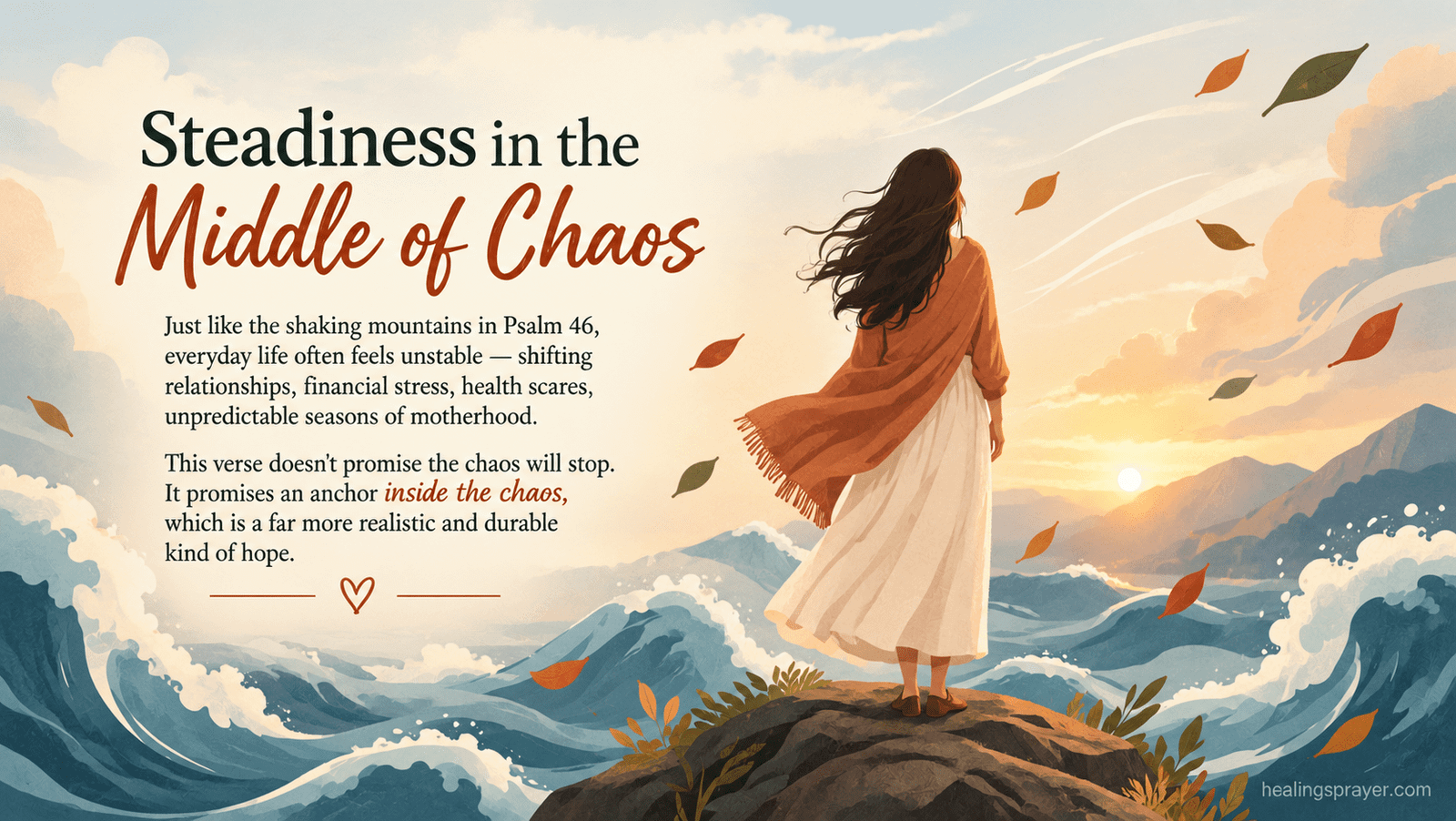
Steadiness in the Middle of Chaos
Just like the shaking mountains in Psalm 46, everyday life often feels unstable — shifting relationships, financial stress, health scares, unpredictable seasons of motherhood. This verse doesn’t promise the chaos will stop. It promises an anchor inside the chaos, which is a far more realistic and durable kind of hope.
Women in the Bible Who Reflect This Same Promise
The idea behind “God is within her, she will not fail” isn’t limited to one verse — it plays out across scripture in the lives of real women who faced real uncertainty and were carried through it. Looking at their stories gives the verse texture beyond a single sentence.
Ruth — Choosing Faith in Uncertainty
Ruth left everything familiar — her homeland, her people, her security — to follow Naomi into an unknown future with no guarantees. Her story (Ruth 1–4) shows that “not failing” often looks like continuing to show up in loyalty and faith, long before any outcome is visible. She didn’t know how her story would end when she made that choice; she simply kept walking forward, living proof that God is within her, she will not fail, even without a visible map of what comes next.
Esther — Courage Without Guaranteed Outcomes
Esther’s declaration, “If I perish, I perish” (Esther 4:16), captures the tension at the heart of “God is within her, she will not fail.” She acted in courage without a guaranteed safe outcome, trusting that her positioning “for such a time as this” wasn’t accidental. Her strength wasn’t the absence of fear — it was moving forward despite it, trusting that God is within her, she will not fail, long before the outcome was certain.
Hannah — Persisting Prayer Through Waiting
Hannah’s years of unanswered prayer for a child (1 Samuel 1) show that this verse’s promise doesn’t always mean immediate resolution. It means staying rooted and continuing to pray, even through seasons that feel like prolonged failure, until the “break of day” mentioned in Psalm 46:5 finally comes — a slow, patient reminder that God is within her, she will not fail, even when the waiting stretches on for years.
Deborah — Leading From a Place of Rootedness
Deborah, a judge and prophetess (Judges 4–5), led Israel from a place of settled confidence rather than anxious striving. Her story illustrates that this internal steadiness isn’t passive — it can show up as decisive leadership, clear judgment, and calm authority in high-pressure moments, proof once again that God is within her, she will not fail, even while carrying the weight of leading others.
Also Read: Powerful Prayers Against Anger with Bible Verses for Peace, Self-Control, and Healing
5 Signs God’s Strength Is Already Working Within You
Many women live out this verse without realizing it. Here are five signs this quiet, sourced strength is already active in your life.
You Recover Faster Than You Expect To
You’ve been through something hard, and instead of staying stuck, you found yourself functioning again — not because the pain disappeared, but because something held you steady enough to keep moving. That recovery is a quiet proof that God is within her, and she will not fail, even when it doesn’t feel that way in the moment.
You Feel Calm Before You Understand Why
There are moments of peace that don’t make logical sense given the circumstances. That unexplainable calm is often a sign of a presence bigger than the situation working beneath the surface.
You Keep Showing Up Even When Motivation Is Gone
Motivation is emotional and inconsistent. Showing up anyway — tired, uncertain, unmotivated — is a quieter, deeper kind of strength than hype ever produces, and it’s exactly what “she will not fail” looks like on an ordinary Tuesday.
You Forgive Without Losing Yourself
Forgiveness that doesn’t come from suppressing your feelings, but from a genuine internal release, often points to something working beneath the surface that isn’t pure willpower. It’s another quiet way of proving that God is within her, she will not fail — not even in the moments that call for the most grace.
You Trust the Process Without Seeing the Full Picture
Peace in uncertainty — being okay with not having all the answers yet — is one of the clearest markers of this verse being lived out, not just quoted on a wall. It’s the daily, unglamorous evidence that God is within her, she will not fail.
Why This Verse Shows Up on Tattoos, Necklaces & Bracelets
Beyond scripture study, “God is within her, she will not fail” (and its original wording, “she will not fall”) has become one of the most requested phrases in Christian jewelry, cuff bracelets, and fine-line tattoos — and that popularity isn’t random. It reflects a real need for a portable, physical reminder of this promise, something you can see or touch on the hard days when reading a full devotional isn’t realistic.
The Tattoo Meaning Behind “God Is Within Her”
As a tattoo, this phrase is usually chosen as a declaration, not decoration. People pick it, often in a small, minimalist script along the forearm, collarbone, or ribcage, to mark a specific season — surviving an illness, leaving an unhealthy relationship, rebuilding after loss, or simply choosing faith as a daily anchor. The tattoo’s meaning centers on three ideas:
- Divine presence over self-reliance — the ink marks a belief that isn’t dependent on personal willpower.
- A permanent reminder in an impermanent world — unlike a journal or phone wallpaper, it’s always visible.
- Identity, not aesthetics — for most wearers, it’s less about the design and more about not forgetting who’s carrying them.
Why It’s Become a Popular Jewelry Engraving
The same reasoning drives its popularity on stainless steel cuffs, mustard seed bracelets, and engraved necklaces, often searched alongside “Psalm 46:5 meaning.” A bracelet or necklace with this verse functions the same way a tattoo does — a small, wearable checkpoint you can touch during an anxious moment, a hard meeting, or a sleepless night, without needing to explain it to anyone.
If you’re not ready for a tattoo or jewelry, the same effect can come from writing “God is within her, she will not fail” on a card and keeping it in your wallet or car — the point isn’t the medium, it’s having a physical touchpoint you return to.

What This Verse Looks Like in Different Seasons of Life
The same promise applies differently depending on what season you’re actually walking through. Here’s what “God is within her, she will not fail” looks like in four common seasons.
In Motherhood
Motherhood often strips away the illusion of control — sleep, schedule, and identity all shift at once. In this season, this verse isn’t about being a perfect parent. It’s about the quiet reassurance that you are not solely responsible for holding everything together by sheer effort alone. On the days when patience runs out before the to-do list does, “God is within her, she will not fail” becomes less of a motivational quote and more of an actual lifeline — a reminder that showing up exhausted and imperfect still counts, because what’s carrying you isn’t your own limited energy.
In Grief and Loss
Grief doesn’t respond well to forced positivity, and this verse doesn’t ask it to. Instead, it offers something steadier: the idea that you can be genuinely shattered and still not be destroyed. “She will not fail” in grief doesn’t mean the pain disappears quickly. It means that even in the depth of loss, there’s a presence that keeps you breathing, functioning, and eventually healing, even when you can’t picture how that’s possible right now.
In Career Pressure and Burnout
Career environments often measure worth through output — deadlines met, targets hit, promotions earned. This verse pushes back gently against that entire framework. It suggests that your value and your stability were never meant to be built solely on performance. When burnout hits, returning to “God is within her, she will not fail” can be a way of separating your identity from your job title, remembering that your worth doesn’t collapse the moment your output does.
In Healing From Past Pain
Healing from trauma, a breakup, or a broken relationship with faith itself often involves a fear of repeating old failures. This verse offers a different lens: past failure — real or perceived — doesn’t define what’s possible going forward, because the source of strength moving you forward isn’t the same self that struggled before. It’s a presence that doesn’t run out, even when your own resolve has, which is exactly why God is within her, she will not fail, even in the seasons that feel like the slowest healing.

How to Apply “God Is Within Her, She Will Not Fail” to Your Daily Life
Believing this verse and living it are two different things. These four practices turn “God is within her, she will not fail” from a quote into a habit.
Start With a Morning Declaration
Speak the verse out loud before you check your phone or start your to-do list. Something as simple as saying, “God is within me, I will not fail today,” sets the tone before circumstances get the first word.
Create Visual Anchors
Write the verse somewhere you’ll actually see it — a sticky note on your mirror, your phone lock screen, or a card in your wallet. Repetition through sight builds the belief slowly, without forcing it.
Use It as a Prayer Journal Prompt
Each night, write one sentence about where you felt this strength show up that day, even in a small way. Over weeks, this becomes tangible proof, not just a hopeful idea.
Also Read : Lovely Prayers for Relationships Strengthening
Return to It in Hard Moments, Not Just Good Ones
The real test of “God is within her, she will not fail” isn’t reciting it when life is calm — it’s reaching for it the moment fear or self-doubt shows up. Keep it close specifically for those moments, not just as a decorative quote.

10 Journaling Prompts Inspired by This Verse
Use these prompts to turn “God is within her, she will not fail” into a personal, written practice rather than something you only read.
- Where in my life today did I feel carried, even briefly?
- What am I currently afraid of failing at — and what would it mean to hand that fear over?
- When was the last time I recovered from something I thought would break me?
- What does “God is within her, she will not fail” mean to me right now, in this specific season?
- What’s one area where I’ve been relying on my own strength instead of God’s presence?
- What would change if I truly believed I would not fail — not perfectly, but ultimately?
- Who in my life reflects this same quiet, sourced strength?
- What’s one small, physical reminder I can create for myself this week?
- What does “break of day” (Psalm 46:5) look like in my current situation?
- What’s one fear I’m ready to say out loud, and hand over, today?
How to Share This Verse With Someone Who’s Struggling
If someone in your life is going through a hard season, “God is within her, she will not fail” can be shared in a way that comforts rather than minimizes what they’re facing.
- Don’t use it to rush their pain. Offer “God is within her, she will not fail” as company, not a fix — pair it with listening, not just the verse itself.
- Give context, not just the quote. Briefly explaining Psalm 46:5’s background helps “God is within her, she will not fail” land as scripture, not just a trend.
- Pair it with a tangible gift. A card, a small bracelet, or a handwritten note with “God is within her, she will not fail” can carry more weight than a text message alone.
- Follow up. Sharing the verse once is a moment; checking in again later shows the promise wasn’t just a one-time send, but a genuine reminder that God is within her, she will not fail.
Also Read : Fasting Prayers with Bible Verses for Breakthrough
20 Affirmations Inspired by “God Is Within Her, She Will Not Fail”
Use these as daily declarations, journal starters, or reminders on hard days. Say them slowly, and let them settle rather than rushing through the list.
- God is within me, and I will not fail.
- What lives inside me is stronger than what stands against me.
- I do not need to carry this alone — God’s presence steadies me.
- Every mountain that shakes around me does not shake what’s within me.
- I am not falling apart; I am being held together.
- God will help me at the break of day, so I can rest tonight.
- My strength is sourced, not self-made.
- I will not be moved by what I cannot yet understand.
- Fear may visit, but it does not get to stay.
- I have survived every hard day so far — this one will be no different.
- God’s presence in me is louder than my doubt.
- I am steady, even when my circumstances are not.
- I trust what’s within me more than what’s around me.
- I do not fail permanently; I am held, corrected, and carried forward.
- God is within her — and she is me.
- God is within her, she will not fail, and today, that “her” is me.
- I release what I cannot control into the hands of the One who holds me.
- My past setbacks do not predict my future — God’s presence does.
- I choose to believe I will not fail, even before I see proof of it.
- She will not fail, because she was never carrying this alone.
Common Mistakes People Make When Trying to Live This Verse Out
- Treating it as a guarantee against hardship. Psalm 46:5 promises steadiness within difficulty, not the removal of difficulty itself.
- Using it once and expecting instant change. Like any spiritual practice, “God is within her, she will not fail” works through repetition and daily return, not a single recitation.
- Confusing “not failing” with “not struggling.” Struggle is allowed. The promise is about not being permanently undone by it, not about feeling nothing.
- Relying on the quote without engaging the actual scripture. Reading Psalm 46 in full gives far more depth and context than the shortened phrase alone.
- Only reaching for it in crisis. Building familiarity with the verse in calm seasons makes it far more accessible when hard seasons arrive.
- Applying it as a substitute for practical help. Faith and action work together — this verse encourages inner steadiness, not skipping doctors, counselors, or other real support.
- Forgetting it’s a daily practice, not a one-time fix. “God is within her, she will not fail” is meant to be returned to again and again, not filed away after the first time you read it.
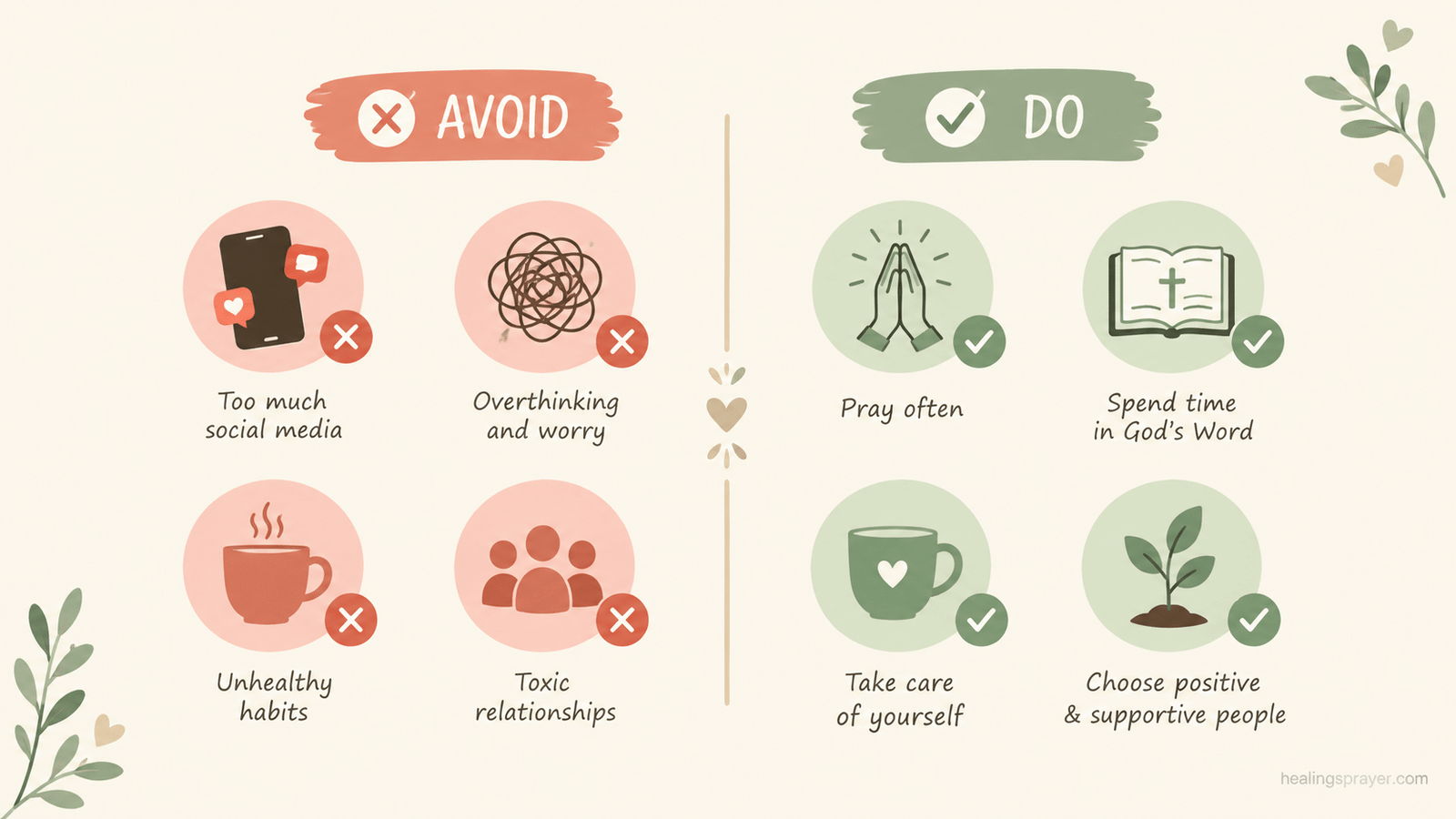
Related Bible Verses About God’s Strength Within You

The table below places Psalm 46:5 alongside other verses that carry a similar promise, along with a real, usable takeaway for each.
| Verse | What It Promises | Sample Way to Use It |
|---|---|---|
| Psalm 46:5 | God is within her, she will not fail — His presence means she will not fall | Say: “God is within me, I will not fail today.” |
| Isaiah 41:10 | God strengthens and upholds those who fear | Say: “I am upheld, even in my weakest moment.” |
| Philippians 4:13 | Strength comes through Christ, not self-effort | Say: “I can do this hard thing through the strength given to me.” |
| Psalm 34:18 | God is close to the brokenhearted | Say: “I am not too broken to be near to God right now.” |
| 2 Corinthians 12:9 | Power is made perfect in weakness | Say: “My weakness is not disqualifying; it’s where strength shows up.” |
Frequently Asked Questions
Is “God is within her, she will not fail” an actual Bible verse? It is a paraphrased version of Psalm 46:5, which in most translations reads “God is within her, she will not fall.” The word “fail” is a common modern adaptation rather than a direct translation, though both wordings are widely used interchangeably on jewelry, tattoos, and social media today.
What does Psalm 46:5 mean in context? Psalm 46:5 appears within a psalm about national crisis and upheaval, promising that God’s people will remain steady specifically because of His presence within them, not because of their own strength.
Is it “Psalm 46:5” or “Psalms 46:5”? The correct book name is singular — “Psalm 46:5” — though “Psalms 46:5” is a very common search variation and refers to the exact same verse within the Book of Psalms.
Can this verse apply to men as well as women? Yes. While the phrase “God is within her, she will not fail” has become especially popular among women, the underlying promise of God’s steadying presence applies to anyone who reads Psalm 46 in its original context.
How do I actually apply this verse when I’m struggling? Speak it aloud as a declaration, write it somewhere visible, and return to it specifically in hard moments rather than only when things feel calm and easy.
Does this verse mean I won’t make mistakes? No. It means mistakes and hard seasons don’t have the final say over your identity or your future, because your stability is rooted in something beyond your own performance.
Where else in the Bible is this same promise repeated? Similar promises of God’s strength dwelling within and sustaining a person appear throughout scripture, including Isaiah 41:10, Philippians 4:13, Psalm 34:18, and 2 Corinthians 12:9, each approaching the same idea from a slightly different angle.
Is this a verse specifically for women, or is that just how it’s used today? The original Hebrew imagery in Psalm 46:5 refers to “her” as the city of God, a collective symbol rather than an individual woman. Its modern, personal application to women is a cultural adaptation that many find meaningful, even though the verse’s original scope was broader.
What does “break of day” mean in Psalm 46:5? “Break of day” refers to dawn, symbolizing that help and relief arrive at the right time, not necessarily the moment trouble begins — it’s a reminder that God is within her, she will not fail, even while she waits for that dawn to come.
Final Thoughts
“God is within her, she will not fail” is more than a phrase people post for encouragement — it’s a modern echo of a very old promise found in Psalm 46:5, written for people standing in the middle of shaking, uncertain circumstances. The strength it describes isn’t something you have to manufacture on your hardest days. It’s something already present, waiting to be leaned on.
Whatever feels unsteady around you right now, this verse offers a simple redirection: look not at what’s shaking outside of you, but at what’s steady within you. God is within her, and she will not fail — and today, that promise is for you too.

Welcome to Healings Prayer!
Healings Prayer is a faith-based platform created to offer comfort, hope, and encouragement through prayer and Scripture. Our mission is to help people find peace in difficult moments and draw closer to God through heartfelt prayers and Bible verses.