
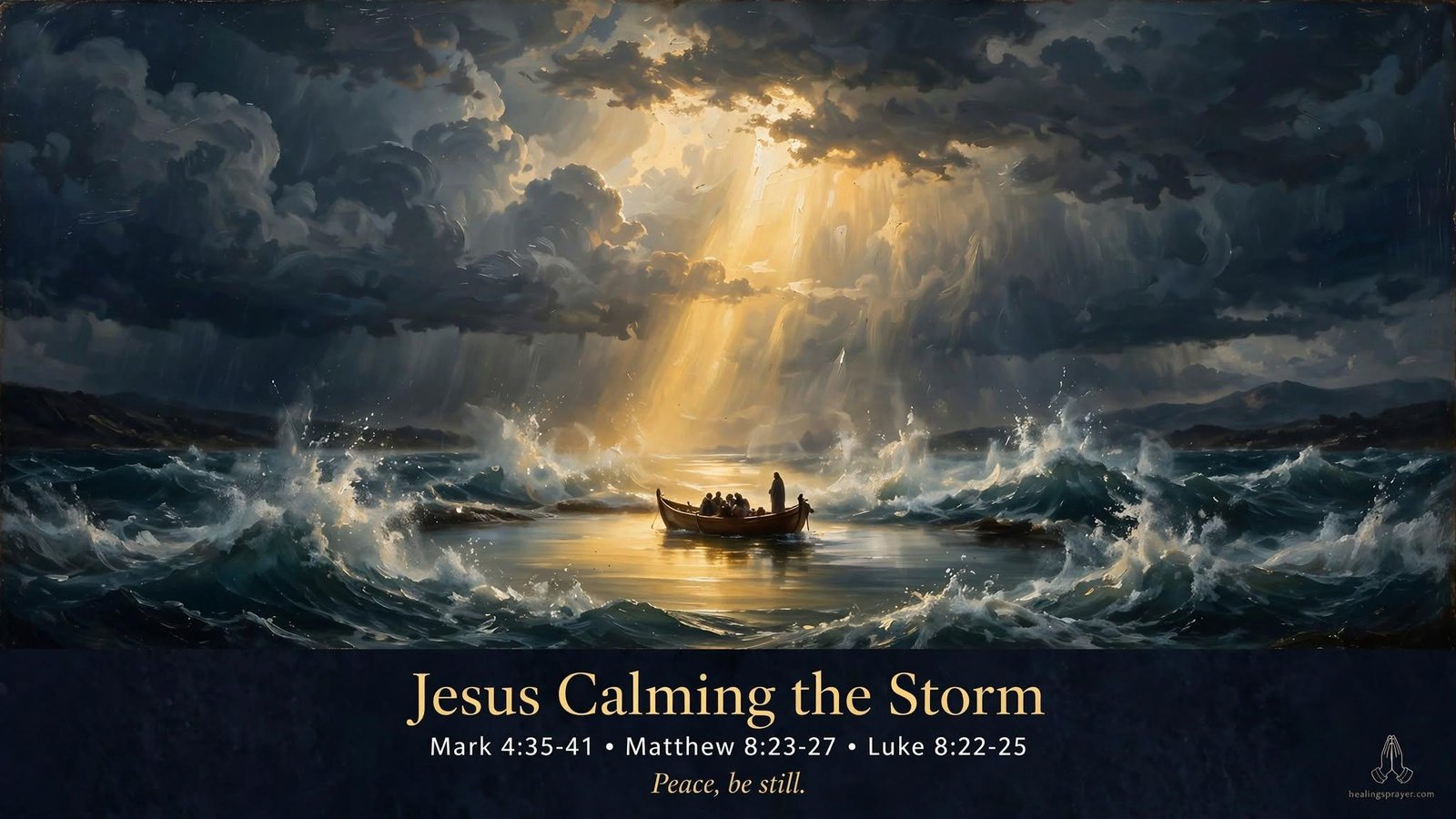
A word, a wave and a sudden calm: the story that still steadies hearts today.
Jesus calming the storm is one of the best-known miracles in the Gospels. Jesus, asleep in a boat, is woken by frightened disciples, speaks to the wind and the waves, and a great calm follows. This guide explains the story, the scripture, the meaning and what it can teach you when your own life feels stormy.
You will find the Mark 4:35-41 account in plain language, a comparison of the three Gospel versions, seven practical lessons and 24 prayers you can copy and use.
What Is Jesus Calming the Storm?
Jesus calming the storm is a miracle recorded in Mark 4:35-41, Matthew 8:23-27 and Luke 8:22-25, in which Jesus stops a violent storm on the Sea of Galilee with a spoken command. It shows his authority over nature and invites people to trust him when they are afraid.
The story matters for several reasons:
- It shows who Jesus is. The disciples end the story asking who this man could be, because even the wind and sea obey him.
- It speaks to fear. Many readers turn to Jesus calming the storm when they feel overwhelmed, anxious or alone.
- It is honest about faith. The disciples panic, cry out and are corrected, and they stay with Jesus anyway.
- It appears in three Gospels. That makes it one of the most widely told miracles of Jesus.
People search for this story in many ways: Jesus calms the storm, Jesus calms the sea, Jesus rebukes the storm, or Jesus asleep in the boat. All of these point to the same event on the same lake.
Key Facts About Jesus Calming the Storm
If you need a quick summary, here are the key facts about Jesus calming the storm:
- Where: the Sea of Galilee in northern Israel.
- Where to read it: Mark 4:35-41, Matthew 8:23-27 and Luke 8:22-25.
- When: in the evening, after a day of teaching in parables.
- Who: Jesus and his disciples in a fishing boat, with other boats nearby (Mark).
- What Jesus said: “Peace, be still” (Mark 4:39, King James wording), followed by a question about faith.
- What happened: the wind stopped, the sea went calm and the disciples were filled with awe.
- The key question: “Who then is this?”
These facts give the outline of Jesus calming the storm. The sections below add the details, the meaning and the practical lessons.
The Story of Jesus Calming the Storm (Mark 4:35-41)
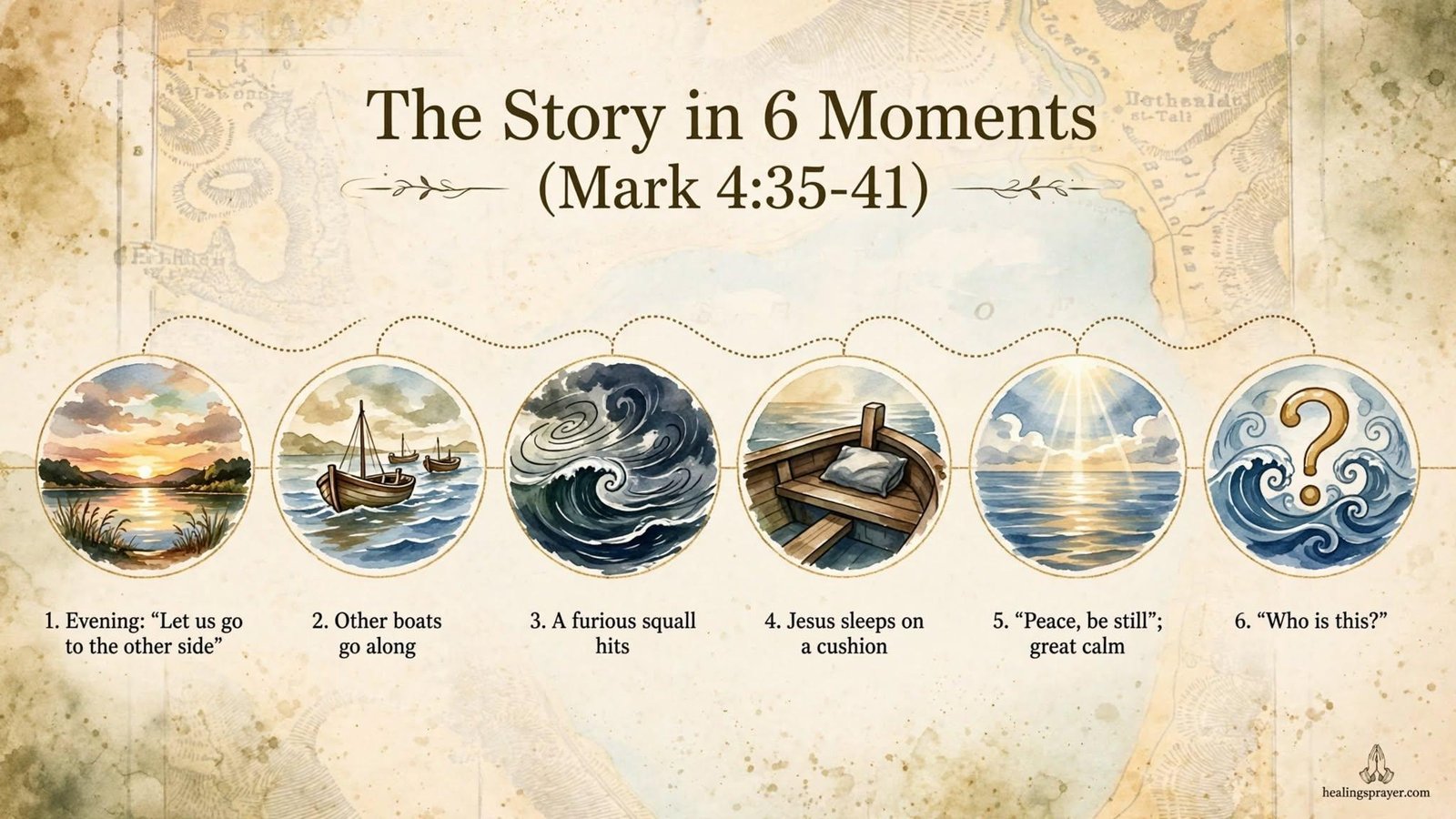
The most detailed account of Jesus calming the storm is in Mark. Here is the story in order, in plain language.
The Setting: Evening on the Sea of Galilee
The Sea of Galilee is a freshwater lake in northern Israel, roughly 13 miles long and 8 miles wide, and about 700 feet below sea level. Hills surround it, and strong winds can drop onto the water quickly.
Jesus had spent the day teaching crowds by the shore with parables (Mark 4:1-34). When evening came, he told his disciples, “Let us go to the other side.” They took him along in the boat, and Mark adds that other boats went with them (Mark 4:35-36).
Jesus Asleep in the Boat
Mark gives a detail the other Gospels leave out: Jesus was in the stern, asleep on a cushion (Mark 4:38). After a full day of teaching, he was tired.
This is why people search for Jesus asleep in the boat. The image shows his human side. He was not performing in that moment. He was resting.
The Storm and the Cry of the Disciples
A furious squall came up. Waves broke over the boat until it was nearly swamped. Several of the disciples were fishermen who knew this lake well, so their fear tells you the storm was serious.
They woke Jesus and asked if he cared that they were dying (Mark 4:38). The question is honest and raw. It is the cry of people who feel alone in danger.
What Did Jesus Say to Calm the Storm?
Many readers ask what Jesus said to calm the storm. In Mark 4:39, he rebuked the wind and spoke to the sea. The older King James wording is “Peace, be still.” Modern translations render it as “Quiet! Be still!”
The wind stopped and there was a great calm. The change was immediate, not a gradual fading.
The Question That Followed
After the calm, Jesus asked his disciples why they were so afraid and whether they still had no faith (Mark 4:40). Their fear then changed. Mark says they were filled with awe and asked one another who this was, since even the wind and sea obey him (Mark 4:41).
That final question is the heart of Jesus calming the storm. The miracle of Jesus calming the storm leads to a question about the identity of Jesus.
Jesus Calming the Storm Scripture: Mark, Matthew and Luke Compared
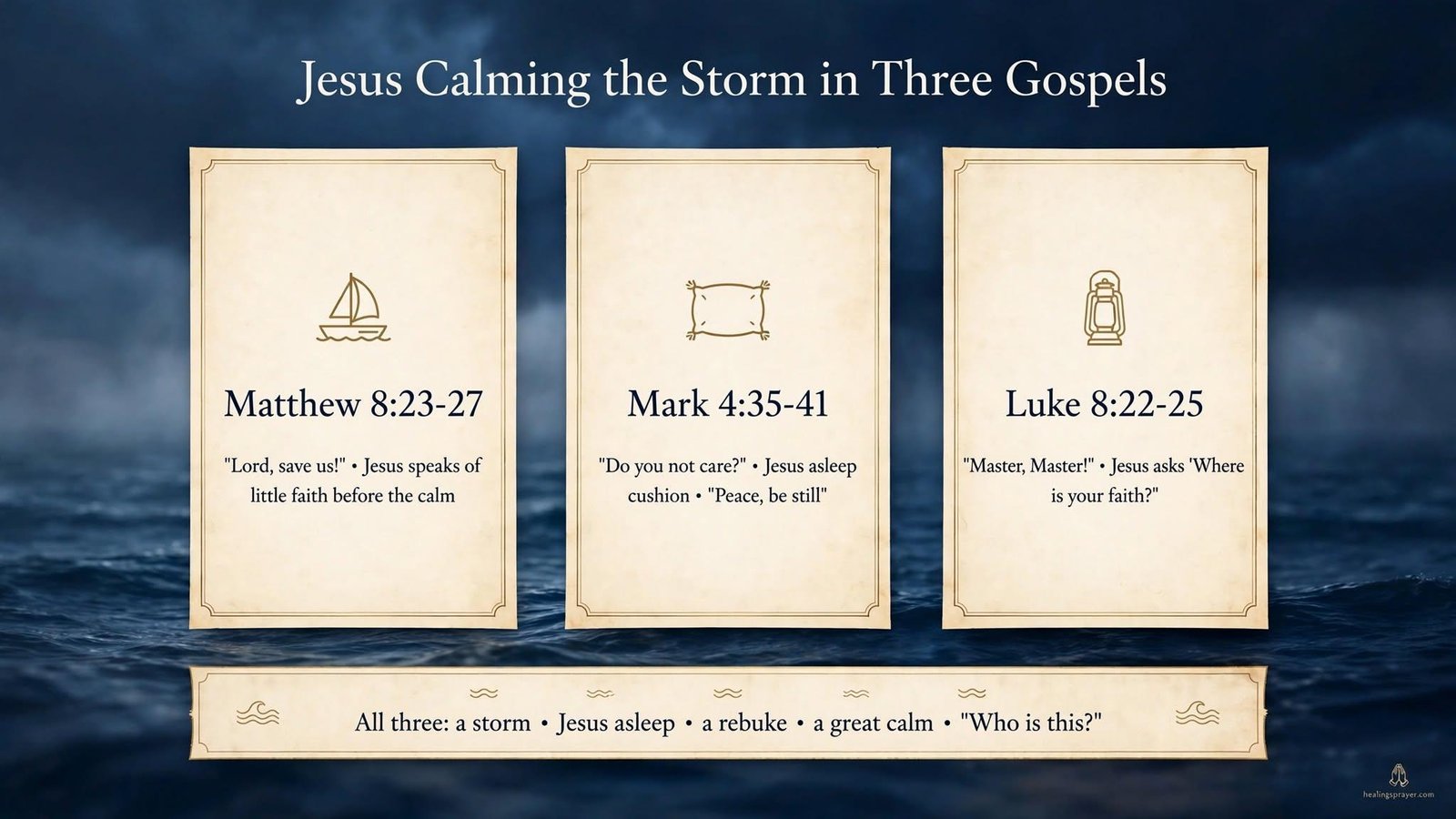
Jesus calming the storm appears in all three Synoptic Gospels. The core events match, but each writer highlights different details. Reading them together gives a fuller picture.
Mark 4:35-41
Mark’s version of Jesus calming the storm is the most vivid. It includes the cushion in the stern, the other boats and the disciples’ pointed question about whether Jesus cares. Jesus speaks directly to the sea, then asks about their faith after the calm.
Matthew 8:23-27
Matthew places the story after Jesus teaches about the cost of following him. His word for the storm can also mean a shaking, like an earthquake. The disciples cry, “Lord, save us!” and Jesus speaks about their little faith before he rebukes the winds and the sea.
Luke 8:22-25
Luke calls Jesus “Master” in the disciples’ cry. He notes that Jesus fell asleep as they sailed, and he describes a windstorm coming down on the lake. Jesus asks, “Where is your faith?” after the calm, and the disciples are afraid and amazed.
Across all three accounts of Jesus calming the storm you find the same shape: a crossing, a storm, a sleeping Jesus, a rebuke and a great calm.
Jesus Calms the Sea or the Storm: Why the Wording Differs
You may have seen the miracle called Jesus calms the sea, Jesus calm the storm, Jesus calming the sea or just calming the storm. These are different names for one event.
- Matthew speaks of a “sea” because the Galilee was commonly called a sea.
- Luke calls it a “lake,” which matches the actual body of water.
- Mark and Luke both speak of wind and waves.
- Church writers and teachers often use the short title “calming the storm.”
Jesus calming the storm is also different from Jesus walking on water (Matthew 14:22-33). In that account, Jesus comes to the disciples across the water during another storm, and Peter steps out of the boat. Both stories show Jesus’ authority over wind and sea, but they are two separate events.
Jesus Calming the Storm Meaning: What the Miracle Reveals
The meaning of Jesus calming the storm works on several levels. It is a historical account, a statement about who Jesus is and a source of comfort for people in trouble.
Authority Over Creation
In the Old Testament, God alone controls the sea. Psalm 89:9 says he rules the raging sea, and Psalm 65:7 speaks of him calming the roar of the waves. When Jesus commands the wind and water with a word, the Gospel writers show him acting with the authority that belongs to God.
That is why the disciples are stunned. They are asking who has the right to speak to the sea and be obeyed.
The Humanity and Divinity of Jesus
In one scene, Jesus sleeps from tiredness, and then he commands a storm. Christians see both his real humanity and his divine authority in the same boat.
This helps readers who want a Savior who understands weakness and also has power to help.
Why Did Jesus Rebuke the Storm?
Mark 4:39 and Luke 8:24 use the word “rebuke,” which the Gospels also use when Jesus speaks to evil spirits and sickness. Interpreters read this in different ways. Some see it as a sign of Jesus’ authority over everything that threatens life. Others see a vivid way of saying he commanded the storm to stop.
Either way, the main point is clear. Jesus speaks and the storm obeys. Jesus rebukes the storm, and peace follows.
Echoes of the Old Testament
Psalm 107:23-30 describes sailors caught in a storm who cry to the Lord, and he stills the storm to a whisper and brings them to harbor. Readers in the first century would have heard that psalm in the background of this story.
The story of Jonah also stands in contrast. Jonah slept in a boat during a storm because he was running from God, and the sailors were afraid (Jonah 1). In the Gospel story, Jesus sleeps because he is at rest, and the storm yields to him.
Why Jesus Calming the Storm Still Speaks Today
Almost two thousand years later, Jesus calming the storm is still one of the most read and taught stories in the Gospels. There are several reasons.
- Everyone knows a storm. The image fits fear, illness, money trouble, grief and sudden change. Readers do not need a lot of background to see themselves in the boat.
- It is short and memorable. You can read the full account of Jesus calming the storm in under a minute, and the key words, “Peace, be still,” are easy to carry with you.
- It is honest. The disciples panic, cry out and ask a hard question. Faith in this story is not neat or polished.
- It points beyond the problem. The story does not end with relief alone. It ends with a question about who Jesus is.
- It is part of regular worship. In the Roman Catholic Sunday lectionary, Mark 4:35-41 is read in Year B, and many churches preach on Jesus calming the storm during seasons of stress or uncertainty.
For these reasons, the story keeps returning in sermons, hymns, children’s lessons and personal devotion.
7 Lessons from Jesus Calming the Storm
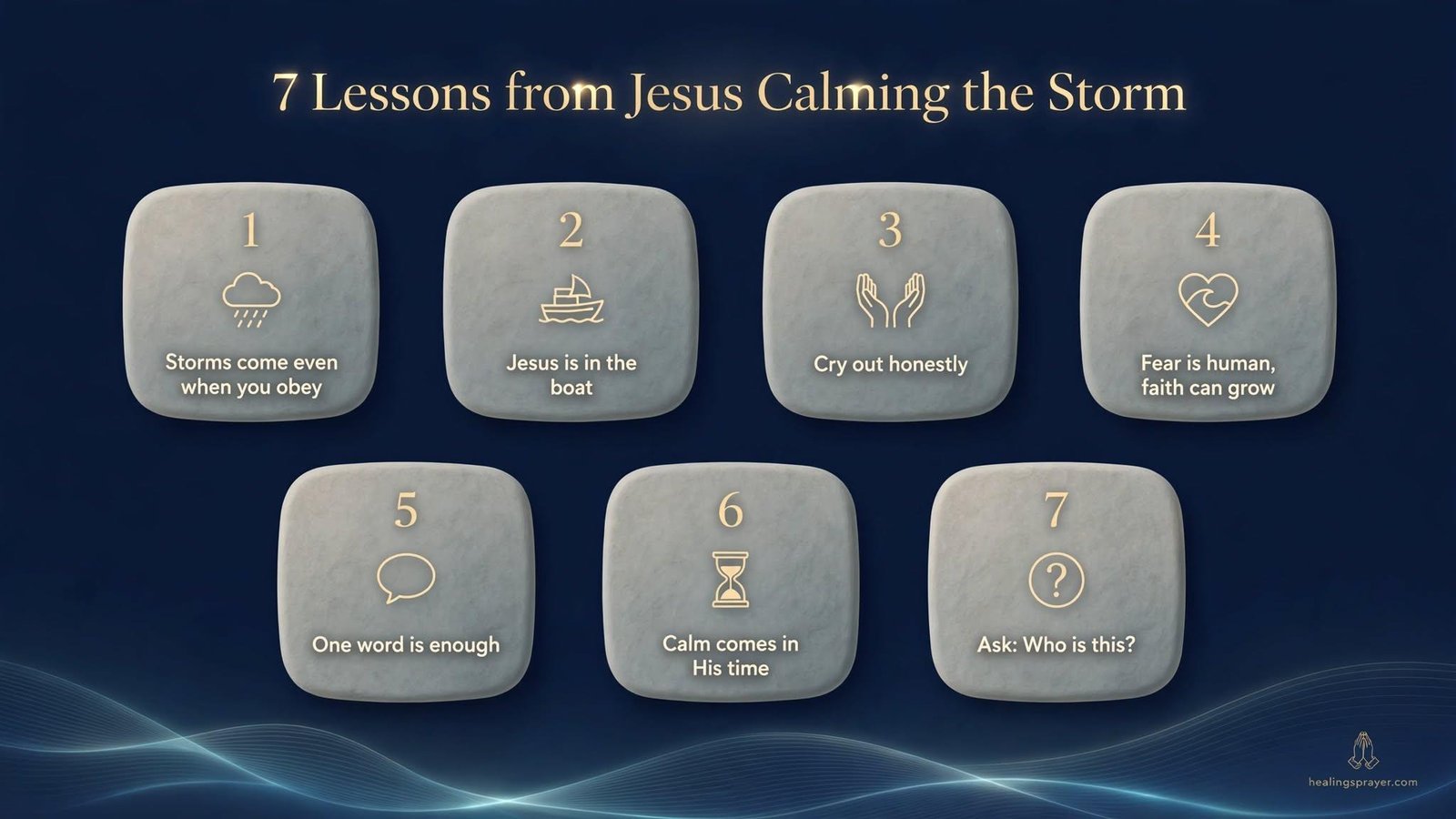
Here are seven practical lessons you can draw from Jesus calming the storm. Each one ends with a simple action.
Lesson 1: Storms Come Even When You Are Obeying
The disciples were not in the storm because they had done wrong. Jesus himself said, “Let us go to the other side,” and they followed him into the boat. The storm came during obedience.
Hard times do not always mean you took a wrong turn. Apply it: when trouble comes, do not assume you are being punished. Ask instead what you can learn and where you can find help.
Lesson 2: Jesus Is in the Boat With You
The story never says Jesus watched from the shore. He was in the boat. In the same way, Christians believe Jesus is present with them in the middle of trouble, not only after it.
Isaiah 43:2 promises that God is with his people when they pass through the waters. Apply it: say aloud, “Jesus is in my boat,” when fear rises.
Lesson 3: It Is Right to Cry Out
The disciples woke Jesus and spoke bluntly. The Gospels do not hide their words, and Jesus does not walk away from them. Psalm 107:28 also notes that people in trouble cried out to the Lord, and he brought them out of their distress.
Honest prayer is welcome. Apply it: write a prayer that says exactly what you feel, with no polished language, and read it to Jesus.
Lesson 4: Fear Is Human, and Faith Can Grow
Jesus asked why they were afraid and whether they had no faith. It is a challenge, but it also opens the door to growth. The disciples stayed with him and learned more about who he was.
Fear does not disqualify you. Apply it: name your fear in one sentence, then name one thing you know to be true about Jesus.
Lesson 5: One Word From Jesus Is Enough
Jesus did not use a long speech or a ritual. He spoke to the sea, and it obeyed. The Gospel writers show that his word carries full authority.
Apply it: choose one short line from Scripture, such as “Peace, be still,” and repeat it slowly when your mind is racing.
Lesson 6: Calm Comes in His Time
Jesus slept before he spoke. The disciples wanted action at once, but the calm came when he stood up. Waiting is hard, yet the story shows that the storm was never out of his control.
Apply it: while you wait, do the next small, faithful thing, such as one prayer, one phone call or one task.
Lesson 7: The Storm Leads to a Bigger Question
The miracle ends with the disciples asking who Jesus is. The storm opened their eyes to him. Many people say their hardest seasons deepened their faith.
Apply it: after a storm has passed, take a few minutes to write what you learned about Jesus and about yourself.
Also Read : The Lord Is My Shepherd: Psalm 23 KJV Meaning, Full Text & 25 Prayers
When Jesus Seems Silent in Your Storm
One of the most searched ideas around Jesus calming the storm is Jesus on the boat in the storm, or Jesus in the boat during the storm. People want to know what it means when Jesus seems asleep while they are afraid.
The Bible does not hide this feeling. In Psalm 44:23, a writer cries out, asking the Lord to wake up. The disciples ask whether Jesus cares. Honest prayers like these are part of Scripture.
Here is how the story speaks to a season of silence:
- Silence is not absence. Jesus was in the boat the whole time, even while asleep.
- Your question is allowed. The disciples asked, “Do you not care?” and were not turned away.
- The storm is not the final word. The story ends in calm, and the disciples are changed.
- You can ask for help from people too. Prayer works alongside friends, family, pastors and professionals.
If you feel that Jesus is asleep in your storm, you are not the first person to feel that way. Keep praying, keep talking and keep going to the people and places where you find support.
Jesus Calming the Storm in Art, Hymns and Church Tradition
Jesus calming the storm has inspired artists, hymn writers and church leaders for centuries.
- Painting. Rembrandt painted The Storm on the Sea of Galilee in 1633, his only seascape. It was stolen from the Isabella Stewart Gardner Museum in Boston in 1990 and has not been recovered. Eugène Delacroix also painted several versions of Christ on the Sea of Galilee in the 1850s.
- Hymns. Mary Ann Baker wrote “Master, the Tempest Is Raging” in 1874, inspired by the Gospel account. The naval hymn “Eternal Father, Strong to Save,” by William Whiting, draws on sea and storm imagery from the Psalms.
- Church symbolism. The boat became an early Christian symbol for the church, carried through storms by Christ. The word “nave,” for the main part of a church building, comes from the Latin word for ship.
- Teaching. Preachers and teachers have used Jesus calming the storm as an illustration of trust, prayer and the authority of Christ over fear.
This history shows that the story has comforted readers in many centuries and places. When you read Jesus calming the storm today, you join a long line of people who have turned to it in hard times.
24 Prayers Inspired by Jesus Calming the Storm
Below are four categories with six prayers each. They are written in plain language so you can copy them, read them aloud or change them to fit your situation.
Pray slowly, and let each prayer be a real conversation. The words are only a starting point.
Short Prayers: “Peace, Be Still”
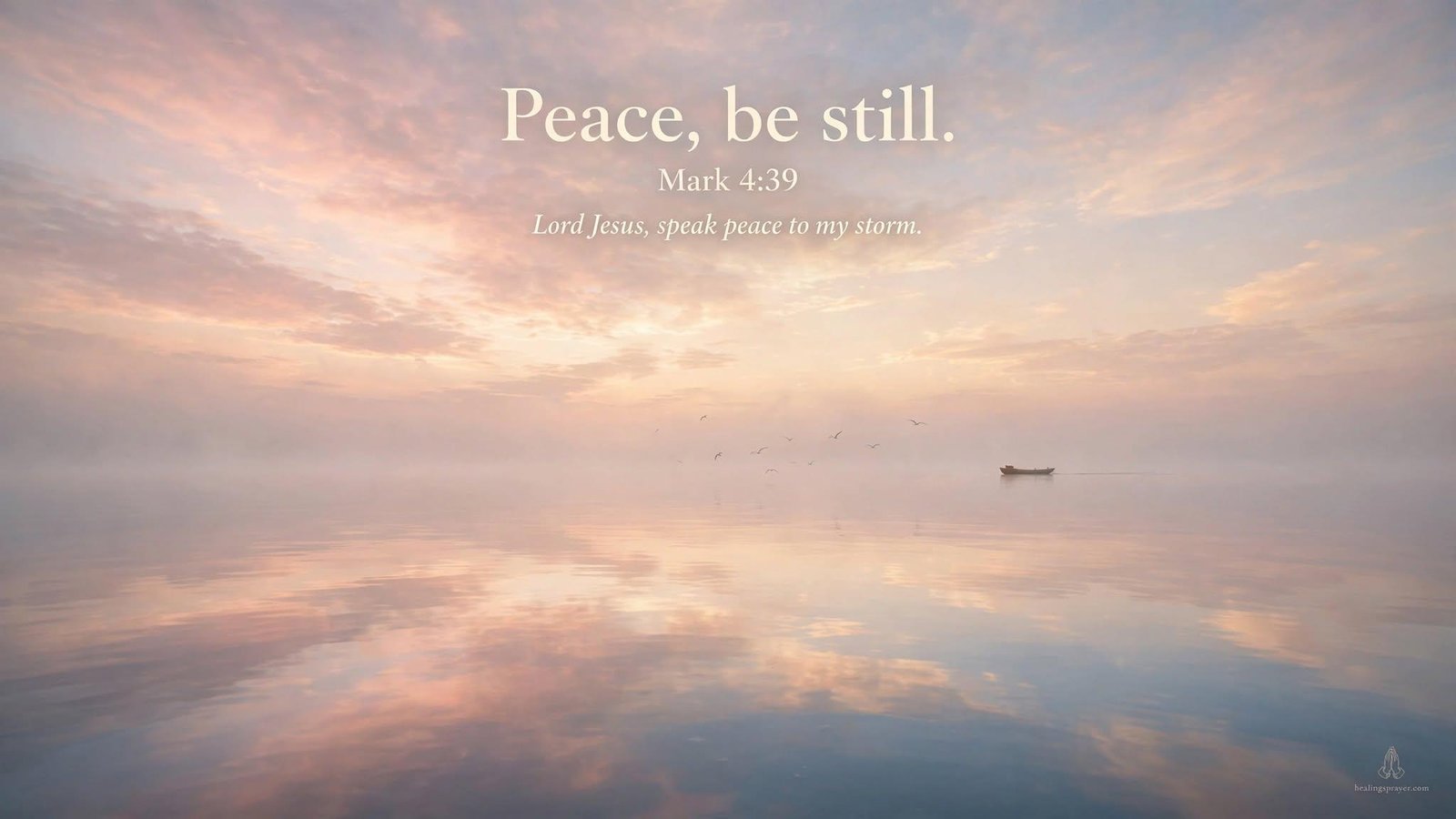
These short prayers take their wording from Jesus calming the storm. They can be said in a few seconds, which is helpful when you are anxious or rushed.
- Lord Jesus, speak peace to my storm. A simple prayer for any moment of stress.
- Peace, be still. Jesus, calm my heart today. Say it when your thoughts feel loud.
- Lord, save me. I trust you in this storm. This echoes the disciples’ cry in Matthew 8:25.
- Jesus, you are in my boat. I will not be afraid. A reminder that Jesus is present with you.
- Master of the wind and the waves, steady me. This borrows the word “Master” from Luke 8.
- Jesus, increase my faith when the waves rise. Pray it when you feel your trust slipping.
How to use this group: Choose one line and repeat it slowly with each breath. A short prayer from Jesus calming the storm is easy to remember when you cannot find longer words.
Prayers for Anxiety and Fear
Fear can feel like a storm inside your chest. These prayers draw from Jesus calming the storm to bring comfort when your mind is racing.
- Lord Jesus, my thoughts are rushing like waves. Speak to them as you spoke to the sea. Slow my breathing, quiet my mind and remind me that you are near.
- Jesus, you slept in the boat and the storm was never out of your hands. Teach me to rest in you tonight, even while my worries are loud.
- Lord, I cannot control what might happen. Take the fear I am gripping tightly and give me the peace you promised.
- Father, when fear says the worst will happen, help me to hear Jesus say, “Peace, be still.” Let that peace settle in my heart.
- Jesus, I bring you my racing heart and my panic. Hold me steady, send help through people I can trust and help me take the next small step.
- Lord, thank you that fear is not the end of my story. Strengthen my faith, one breath at a time, and bring calm where I feel shaken.
How to use this group: Read one of these prayers slowly, then take five deep breaths. If anxiety is severe or lasts for weeks, please speak with a doctor or mental health professional as well. Prayer and professional care can work together.
Prayers for Family, Home and Relationships
Homes have storms too: arguments, stress and worry. These prayers bring Jesus calming the storm into the daily life of a family.
- Jesus, there is tension in our home. Be in our boat. Calm our words, soften our hearts and help us to listen to one another.
- Lord Jesus, speak peace into the arguments in our family. Where pride has built walls, bring humility and forgiveness.
- Father, watch over my children when I cannot. Calm their fears, guard their steps and let them know Jesus is with them in every storm.
- Jesus, I pray for my marriage. Where we feel far apart, bring us back together. Teach us to face storms side by side, not against each other.
- Lord, bring peace between me and the person I am struggling with. Help me to speak gently, forgive freely and let go of bitterness.
- Jesus, Master of wind and waves, calm the money worries and pressures in this household. Give us wisdom, patience and daily provision.
How to use this group: Say one of these together as a family at the table or before bed. Praying for peace is strongest when it is followed by one kind action, such as an apology or a shared chore.
Prayers for Health, Loss and Hard Seasons
Some storms are long. These prayers use Jesus calming the storm to offer comfort during illness, grief and uncertainty.
- Lord Jesus, I am facing a health storm. Give me courage, comfort my body and mind, and guide the doctors who care for me.
- Jesus, I pray for someone who is sick. Be present with them, ease their pain and give their family strength.
- Lord, my heart is heavy with loss. You know what I am carrying. Stay close, and give me a peace I cannot make on my own.
- Jesus, when the way ahead is unclear, steady my steps. Help me to trust you with what I cannot see.
- Father, this season is long and I am tired. Renew my strength, send people to support me and remind me that you do not leave me alone.
- Lord Jesus, when I feel that you are asleep, give me the honesty to cry out and the faith to wait. Bring calm in your time, and help me to trust you until then.
How to use this group: Read one prayer each day for a week and write one sentence about how you are feeling. If you are grieving or facing a serious illness, lean on trusted people and professional support as well.
Also Read : Jesus Walks on Water: Bible Story, Meaning and 7 Lessons for Your Faith
How to Apply Jesus Calming the Storm in Daily Life
Reading about Jesus calming the storm is a start. Applying it is where it begins to help. These steps work with any of the prayers above.
A 5-Minute Storm Prayer Routine
- Stop and breathe (1 minute). Sit down, put your phone aside and take slow breaths.
- Name the storm (30 seconds). Say in one sentence what you are afraid of or struggling with.
- Read a short passage (1 minute). Read Mark 4:35-41, or just verses 37 to 41.
- Pray one prayer from this guide (1 minute). Choose the category that fits your situation.
- Close with “Peace, be still” (1 minute and 30 seconds). Repeat the line quietly, and then sit in silence.
A calm, short routine done every day works better than a long prayer done once in a while.
Breathing and Scripture Together
Slow, controlled breathing is widely recommended by health organizations as a way to ease stress. You can combine it with a short line from Scripture:
- Breathe in slowly and say, “Peace.”
- Breathe out slowly and say, “Be still.”
- Repeat for one to two minutes.
This pairs the physical calm of slow breathing with the words of Jesus calming the storm.
When You Need More Than Prayer
Jesus calming the storm is a story of hope, but it does not mean you should face every problem alone. If you are dealing with ongoing anxiety, depression, abuse or a medical problem, please reach out to a doctor, counselor or trusted pastor.
If you or someone near you is in immediate danger, contact your local emergency number or a crisis line in your area. Asking for help is a wise step, and many people find that faith and professional care support each other.
Reading Mark 4:35-41 Slowly: A Guided Reflection
A slow reading can show you details you would miss in a quick one. Read Jesus calming the storm three times, each with a different focus:
- First reading: notice the scene. Picture the evening, the boat, the cushion and the waves. Write down one detail that stands out.
- Second reading: notice the feelings. Look at the fear of the disciples and the calm of Jesus. Ask which feeling is closest to yours.
- Third reading: notice the words. Listen to what Jesus says and what the disciples ask. Write one sentence about what you hear.
Finish by writing a one-line prayer in your own words. This simple method turns Jesus calming the storm from a story you know into a conversation you have.
Using Jesus Calming the Storm in a Sermon, Bible Study or Sunday School
Jesus calming the storm works well for teaching because it has a clear shape and a strong question at the end. Here is a simple outline you can use.
A three-point sermon outline:
- The storm (Mark 4:35-37). Storms come, even to obedient followers.
- The cry (Mark 4:38). Honest prayer is welcome.
- The calm (Mark 4:39-41). Jesus speaks, and the question becomes “Who is this?”
Discussion questions for a small group:
- Why do you think Jesus was asleep?
- What do you think the disciples expected when they woke him?
- Which detail in the story stands out to you?
- When have you cried out to God in a storm?
- What does the question “Who is this?” mean for you today?
- What is one storm you want to bring to Jesus this week?
Ideas for children:
- Fill a clear bottle with water and blue food coloring, shake it to show waves, then watch it settle as a picture of calm.
- Make a paper boat and move it through “waves” on a blue cloth.
- Teach the short prayer “Jesus, calm my heart” and say it together.
Keep the language simple for children and focus on one point: Jesus is with us and has power over what scares us.
Common Mistakes When Reading the Story
A few common misreadings can weaken what the story offers. Avoid these five.
Mistake 1: Expecting That Storms Will Never Come
Jesus calming the storm does not promise a life without storms. John 16:33 says Jesus’ followers will have trouble in this world, and also that he has overcome the world. The promise is his presence and ultimate victory.
Mistake 2: Treating “Peace, Be Still” as a Magic Phrase
The words are powerful because of who speaks them. Repeating them is a helpful prayer, but they are not a formula that forces outcomes. Prayer is trust in a person, not a spell.
Mistake 3: Shaming People for Feeling Afraid
Some readers use Jesus’ question about faith to scold anxious people. The disciples were afraid and were still taught and loved. Fear deserves compassion, not blame.
Mistake 4: Ignoring the Context
Jesus calming the storm comes after a day of parables and leads into the healing of a man in the region of the Gerasenes in Mark 5. Reading the surrounding chapters helps you see how Mark presents Jesus’ authority over nature, spirits and sickness.
Mistake 5: Skipping the Old Testament Background
Psalm 107 and Psalm 89 help explain why the disciples were so amazed. Reading these psalms gives Jesus calming the storm more depth and shows why the question “Who is this?” matters.
Questions to Reflect On After Reading Jesus Calming the Storm
Use these questions for journaling, prayer or a conversation with a friend. Take your time with each one.
- What is the biggest storm in your life right now?
- Where do you feel that Jesus is asleep, and what would you say to him?
- Which part of Jesus calming the storm speaks most to you today?
- What is one fear you can hand over this week, in prayer?
- Who in your life could pray with you through this season?
- After a storm has passed, what has it taught you about Jesus?
Write short answers. The goal is not to find perfect words, but to bring honest thoughts to prayer.
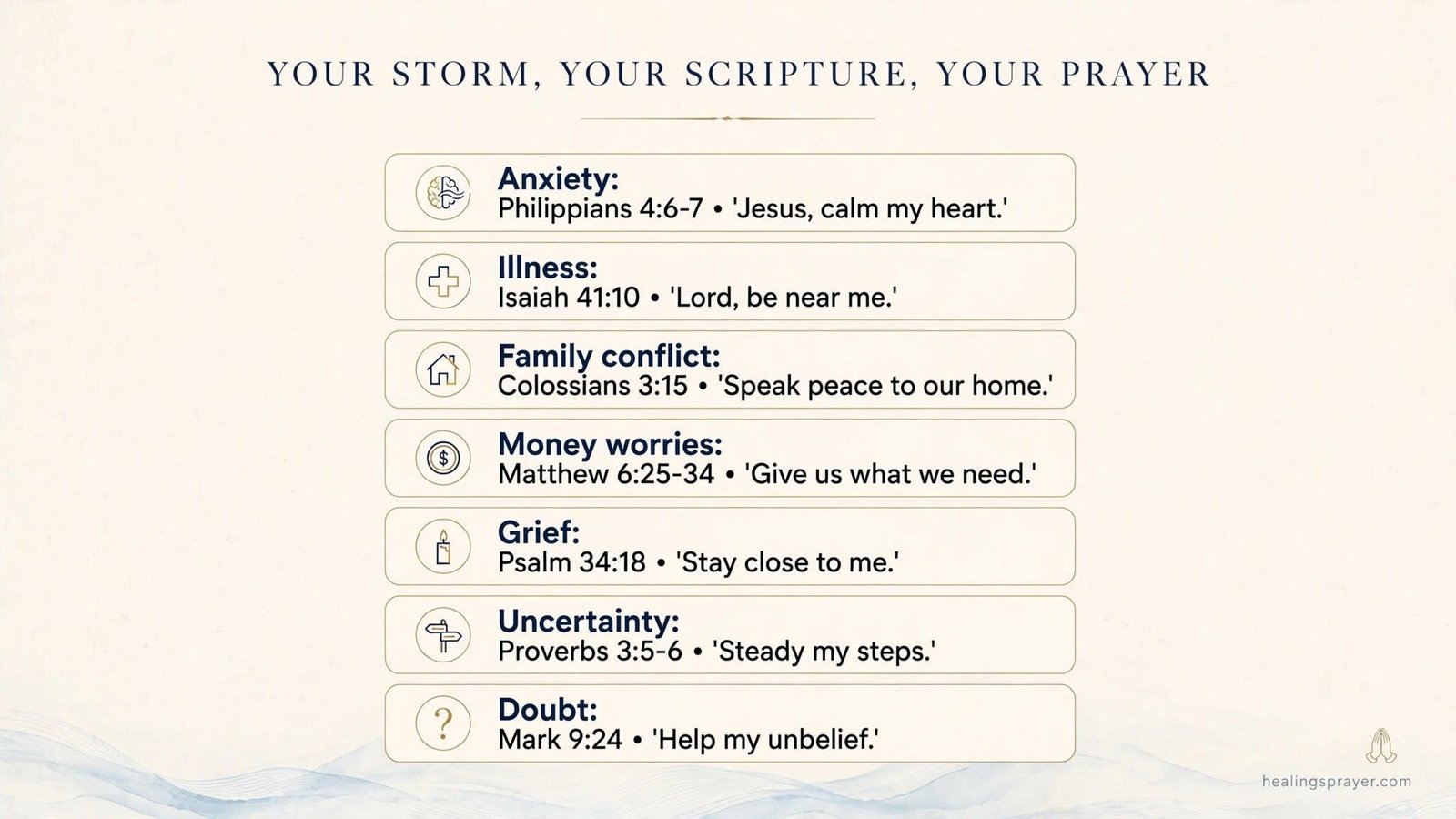
Comparison Table: Your Storm, Scripture and Prayer
| Your Storm | What Jesus Calming the Storm Shows | Scripture to Read | Example Prayer Line |
|---|---|---|---|
| Anxiety and fear | Jesus is present and has authority over what scares you | Philippians 4:6-7 | “Jesus, calm my heart today.” |
| Illness | You are not alone in the boat | Isaiah 41:10 | “Lord, be near me and those who care for me.” |
| Family conflict | Jesus can speak peace into chaos | Colossians 3:15 | “Speak peace into our home.” |
| Money worries | Jesus cares about practical needs | Matthew 6:25-34 | “Give us what we need today.” |
| Grief and loss | Honest cries are welcome | Psalm 34:18 | “Stay close to me in my sadness.” |
| Uncertainty | Calm may come in his time | Proverbs 3:5-6 | “Steady my steps when I cannot see.” |
| Doubt | Faith can grow through fear | Mark 9:24 | “Help my unbelief.” |
Use this table as a quick guide when you want a Scripture and a short prayer that fit your situation, drawn from Jesus calming the storm.
FAQ About Jesus Calming the Storm
What is the story of Jesus calming the storm?
The story of Jesus calming the storm tells how Jesus, asleep in a boat on the Sea of Galilee, was woken by frightened disciples and stopped a violent storm with a word. It ends with a great calm and the disciples asking who Jesus is.
Where is Jesus calming the storm in the Bible?
It appears in Mark 4:35-41, Matthew 8:23-27 and Luke 8:22-25. Mark gives the most detail, including the cushion in the stern and the other boats.
What did Jesus say to calm the storm?
In Mark 4:39, Jesus told the sea, “Peace, be still” (King James wording), and rebuked the wind. Modern translations say “Quiet! Be still!” and the wind died down at once.
Why was Jesus asleep in the boat?
The Gospels do not give a reason, but Mark shows Jesus asleep on a cushion after a full day of teaching. Readers often see this as a sign of his real humanity and also of his calm trust.
Why did Jesus rebuke the storm?
The Gospels use the word “rebuke” to show Jesus speaking with authority, as he does elsewhere with evil spirits and sickness. Interpreters differ on the exact meaning, but they agree it shows his power over what threatens life.
Is Jesus calming the storm the same as Jesus walking on water?
No, they are two different events. In the calming of the storm, Jesus is in the boat and stops the wind. In the walking on water account (Matthew 14:22-33), Jesus comes to the disciples across the sea.
What is the meaning of Jesus calming the storm?
The meaning is that Jesus has authority over creation, is present with his followers in trouble and invites them to trust him. The story also raises the question the disciples asked: “Who is this?”
How can Jesus calming the storm help with anxiety?
It can remind you that Jesus is with you in fear and that peace can come through trust and prayer. Combine slow breathing with a short prayer such as “Peace, be still,” and seek professional help if anxiety is severe or lasting.
Final Thoughts on Jesus Calming the Storm
Jesus calming the storm is more than an ancient miracle. It is a story about fear and faith, about honest prayer and about a Savior who is present in the boat. It does not promise a life without waves, but it shows who is with you when they rise.
Choose one lesson or one prayer from this guide today. Say it slowly, bring your real storm to Jesus and come back to Mark 4:35-41 whenever you need to hear the story again. Jesus calming the storm remains a steady source of peace for anyone who feels shaken.

Welcome to Healings Prayer!
Healings Prayer is a faith-based platform created to offer comfort, hope, and encouragement through prayer and Scripture. Our mission is to help people find peace in difficult moments and draw closer to God through heartfelt prayers and Bible verses.