

By the healingsprayer.com team
Twelve everyday men, one life-changing calling. Meet the 12 disciples of Jesus and see what each one still teaches you today.
What Are the 12 Disciples of Jesus?
The 12 disciples of Jesus were the twelve men He chose from His wider group of followers to learn from Him, travel with Him, and later carry His message to others. Their names appear in Matthew 10:2-4, Mark 3:16-19, Luke 6:13-16, and Acts 1:13.
If you are asking who were the 12 disciples, the short answer is that they were mostly working men from Galilee. Four were fishermen, one was a tax collector, and one is called a Zealot. Jesus trained them for about three years before sending them out.
The 12 disciples of Jesus did not come from the religious elite. Jesus did not choose scholars, priests, or wealthy leaders. He chose people who were willing to follow Him, listen, and grow.
The Gospels use two titles for this group. Disciple means “learner” or “student,” and apostle means “one who is sent.” Both words describe the same twelve men in most passages, and this guide uses both.
By the end of this complete guide to the 12 disciples of Jesus, you will know every name, the key Bible verses for each man, the differences between the lists, and what early Christian writers say happened to them afterward.
Why the 12 Disciples of Jesus Still Matter
Readers still search for the 12 disciples of Jesus for good reasons. Their lives answer questions about faith, doubt, failure, and calling.
Here are four reasons their stories matter:
- They were eyewitnesses. Acts 1:21-22 shows that being present from Jesus’ baptism to His resurrection was required for this group.
- They connect to Israel’s twelve tribes. In Matthew 19:28, Jesus links the twelve to the renewal of God’s people.
- They are honored in Scripture’s final vision. Revelation 21:14 says the wall of the new Jerusalem has twelve foundations carrying the names of the twelve apostles.
- They show who Jesus chooses. The Gospels openly record their arguments, fears, and mistakes, which makes them relatable.
The 12 disciples of Jesus also make the New Testament easier to read. The same names return across the Gospels, Acts, and the letters, so knowing them gives you a map for everything else.
Their lives give you honest examples of loyalty, doubt, failure, and a second chance. Few Bible groups teach as many practical lessons in so few pages.
Who Are the 12 Disciples? Names in Order With Bible Verses
Here is the list of the 12 disciples of Jesus in the order Matthew gives it, with one key Bible reference for each man. People often search for the “12 disciples names in order” or the “12 apostles called in order,” and this is the standard order from Matthew 10:2-4.
- Simon Peter — Matthew 16:15-19
- Andrew — John 1:40-42
- James, son of Zebedee — Acts 12:1-2
- John — John 13:23
- Philip — John 1:43-46
- Bartholomew (Nathanael) — John 1:47-49
- Thomas — John 20:26-29
- Matthew (Levi) — Matthew 9:9
- James, son of Alphaeus — Mark 3:18
- Thaddaeus (Judas, son of James) — Matthew 10:3
- Simon the Zealot — Luke 6:15
- Judas Iscariot — Matthew 26:14-16
This is the standard list of the 12 disciples of Jesus, and the same twelve people appear in every Gospel list. A few of them carry more than one name, and a later section explains why.
The 12 Disciples of Jesus Explained One by One
Each profile of the 12 disciples of Jesus below covers who the man was, where he appears in the Bible, what happened afterward, and one takeaway you can use.
1. Simon Peter

Simon Peter was a Galilean fisherman and the natural spokesman of the group. Jesus gave him the name Peter, which means “rock,” and he is named first in every list of the 12 disciples of Jesus. His Aramaic name, Cephas, appears in John 1:42 and in Paul’s letters.
Key Bible moments:
- Declared Jesus to be the Messiah and Son of the living God (Matthew 16:16)
- Denied Jesus three times on the night of the arrest (Luke 22:54-62)
- Was restored by Jesus and told to care for His followers (John 21:15-17)
- Preached on the day of Pentecost (Acts 2:14-41)
What happened next: Peter became a leading voice of the early church in Jerusalem. Early church writers, including the historian Eusebius, report that he was executed in Rome under Emperor Nero.
Takeaway: Failure does not have to be final when you return and keep following.
2. Andrew
Andrew was Peter’s brother and a fisherman from Bethsaida. John 1:35-40 shows he first followed John the Baptist before he followed Jesus. Among the 12 disciples of Jesus, Andrew is best known for bringing other people to meet Him.
Key Bible moments:
- Brought his brother Peter to Jesus (John 1:40-42)
- Pointed out the boy with five loaves and two fish (John 6:8-9)
- Helped bring Greek visitors to Jesus (John 12:20-22)
What happened next: Later tradition says Andrew preached in regions around the Black Sea and in Greece, and died by crucifixion in the city of Patras. These accounts come from writings after the New Testament, so they are best read as tradition.
Takeaway: Quiet, steady service that connects people to Jesus carries lasting weight.
3. James, Son of Zebedee
James was a fisherman and the older brother of John. Jesus nicknamed the two brothers “Sons of Thunder” in Mark 3:17. James belonged to the inner circle of the 12 disciples of Jesus, together with Peter and John.
Key Bible moments:
- Was present when Jesus raised Jairus’ daughter (Mark 5:37)
- Witnessed the Transfiguration on the mountain (Mark 9:2)
- Was near Jesus in Gethsemane (Mark 14:33)
- Asked for a place of honor in Jesus’ kingdom and learned about servant leadership (Mark 10:35-45)
What happened next: King Herod Agrippa I had James killed with a sword around AD 44 (Acts 12:1-2). He is the only one of the twelve whose death is recorded in the New Testament as a martyr.
Takeaway: Real commitment can carry a real cost, and ambition is best shaped into service.
4. John
John was James’s brother and a fisherman. Tradition identifies him as “the disciple whom Jesus loved” and as the writer of the Gospel of John, three letters, and Revelation. He is often thought to be the youngest of the twelve, though the Bible does not state his age.
Key Bible moments:
- Leaned beside Jesus at the Last Supper (John 13:23)
- Stood near the cross, where Jesus entrusted His mother Mary to John’s care (John 19:26-27)
- Reached the empty tomb and believed (John 20:2-8)
- Wrote about Jesus’ call to love one another (1 John 4:7-12)
What happened next: Revelation 1:9 places John on the island of Patmos. The early writer Irenaeus connects his later life with the city of Ephesus, and tradition says he lived to old age.
Takeaway: Closeness to Jesus shows itself in love, loyalty, and faithfulness at hard moments.
5. Philip
Philip came from Bethsaida, the same town as Peter and Andrew. Jesus called him with two words in John 1:43, “Follow me.” Philip is one of the 12 disciples of Jesus who is quick to invite others.
Key Bible moments:
- Brought Nathanael to Jesus with the invitation “come and see” (John 1:45-46)
- Was asked by Jesus where to buy bread for the crowd (John 6:5-7)
- Asked Jesus to show the disciples the Father (John 14:8-9)
What happened next: Some early writers place Philip’s later ministry and burial in Hierapolis in Asia Minor. Do not confuse him with Philip the evangelist in Acts 8, who was a different man (Acts 6:5).
Takeaway: You do not need every answer to invite someone to see Jesus for themselves.
6. Bartholomew (Nathanael)
Bartholomew is a family name meaning “son of Tolmai.” Most readers identify him with Nathanael, who appears in John 1 and John 21:2, where he is called Nathanael of Cana. Matthew, Mark, and Luke list Bartholomew, while John names Nathanael, and the pairing with Philip supports the link.
Key Bible moments:
- Asked whether anything good could come from Nazareth (John 1:46)
- Was described by Jesus as an Israelite without deceit (John 1:47)
- Confessed Jesus as Son of God and King of Israel (John 1:49)
- Was with the disciples at the Sea of Galilee after the resurrection (John 21:2)
What happened next: Traditions link Bartholomew with Armenia and India, and many accounts say he died as a martyr. Details differ between sources.
Takeaway: Honest questions can lead to strong faith when you keep coming close.
7. Thomas

Thomas was also called Didymus, which means “twin.” He is the best-known honest skeptic among the 12 disciples of Jesus, but the Gospels show more than doubt in his story.
Key Bible moments:
- Was ready to go with Jesus even if it meant dying (John 11:16)
- Asked how the disciples could know the way (John 14:5), which led to Jesus’ words “I am the way, the truth, and the life”
- Said he would believe only after seeing the risen Jesus, then declared “My Lord and my God!” (John 20:24-29)
What happened next: The Acts of Thomas and the tradition of the St. Thomas Christians of Kerala say he took the Gospel to India and died near present-day Chennai. These accounts are old and widely held in India, though they come from outside the New Testament.
Takeaway: Honest doubt, brought to Jesus rather than hidden, can become some of the strongest faith.
8. Matthew (Levi)

Matthew worked as a tax collector in Capernaum. Mark 2:14 and Luke 5:27 call him Levi, and most readers see these as the same man. Among the 12 disciples of Jesus, Matthew had the job people trusted least, because tax collectors worked for Rome and often took extra money.
Key Bible moments:
- Was called by Jesus from his tax booth with the words “Follow me” (Matthew 9:9)
- Hosted a meal where Jesus sat with tax collectors and others (Matthew 9:10-13)
- Is traditionally credited with writing the Gospel of Matthew
What happened next: Eusebius says Matthew first preached to Hebrew-speaking people before going elsewhere. Later accounts of his death differ, so no single version can be confirmed.
Takeaway: Your past or your job does not disqualify you from Jesus’ call.
9. James, Son of Alphaeus
James, son of Alphaeus, is one of the least documented of the 12 disciples of Jesus. He appears by name in Matthew 10:3, Mark 3:18, Luke 6:15, and Acts 1:13, but the Gospels record no speech or event for him alone.
What we can say:
- Mark 15:40 mentions “James the younger,” and some readers connect this with him. This is why he is sometimes called James the Less.
- Mark 2:14 calls Levi (Matthew) a “son of Alphaeus,” so some readers wonder whether the two were brothers. The Gospels never say so.
What happened next: Traditions about his later life are mixed with stories of other men named James, so they are hard to confirm.
Takeaway: Faithful service does not need recognition to matter. Being present and obedient counts.
10. Thaddaeus (Judas, Son of James)
Thaddaeus has two names in the lists. Matthew 10:3 and Mark 3:18 say Thaddaeus, while Luke 6:16 and Acts 1:13 say Judas, son of James. Most readers treat these as the same person among the 12 disciples of Jesus. Some translations render Luke’s phrase as “Judas the brother of James.”
Key Bible moment:
- At the Last Supper, “Judas (not Iscariot)” asked why Jesus would show Himself to the disciples and not the world (John 14:22).
What happened next: Later traditions connect him with Syria, Edessa, and Armenia, sometimes paired with Simon the Zealot. Accounts vary and cannot be verified.
Takeaway: Sincere questions about how and why Jesus works belong in a life of faith.
11. Simon the Zealot
Luke 6:15 and Acts 1:13 call him Simon the Zealot, while Matthew 10:4 and Mark 3:18 call him “the Cananaean,” a word linked to the Aramaic term for zealous. Scholars discuss whether this means he belonged to the Zealot movement that resisted Rome, or whether it describes his personal zeal. Either way, he is a distinctive member of the 12 disciples of Jesus.
Why his place stands out:
- If “Zealot” refers to the political movement, Simon would have opposed the Roman system that Matthew the tax collector worked for.
- Jesus placed both men in the same group, which shows that His call can bring opposing people together.
What happened next: Later traditions place Simon in Persia or Egypt. These accounts differ and cannot be verified.
Takeaway: Following Jesus can unite people who would normally disagree.
12. Judas Iscariot
Judas Iscariot is last in every list, and each list notes that he betrayed Jesus. He is the only one of the 12 disciples of Jesus who turned against Him. He also served as the group’s treasurer (John 12:4-6).
Key Bible moments:
- Agreed to hand Jesus over for thirty pieces of silver (Matthew 26:14-16)
- Identified Jesus with a kiss in Gethsemane (Matthew 26:47-50)
- Felt remorse and returned the silver (Matthew 27:3-5)
What happened next: Matthew 27:5 and Acts 1:18 describe his death differently, and readers have long worked on how the two accounts fit. Matthias was chosen to take his place among the twelve (Acts 1:21-26).
Takeaway: Being close to Jesus is not the same as being committed to Him, so guard your heart.
12 Disciples of Jesus vs. the 12 Apostles: What Is the Difference?

Many readers use the terms interchangeably, and the Bible does too in many places. The two words still have different meanings, which is why the 12 disciples of Jesus are also known as the twelve apostles.
What Does “Disciple” Mean?
A disciple is a learner who follows a teacher. In the Gospels, the word describes anyone who followed Jesus and learned from Him, not only the twelve.
So all of the twelve were disciples, but not every disciple was one of the twelve.
What Does “Apostle” Mean?
An apostle is a person who is sent with a message and authority. Mark 3:14 says Jesus appointed the twelve to be with Him and to be sent out to preach. Luke 6:13 says He chose twelve and named them apostles.
The New Testament also calls Paul an apostle (1 Corinthians 15:9), though he was not one of the twelve.
Who Replaced Judas Iscariot?
Matthias replaced Judas. In Acts 1:21-26, the believers set a requirement that the replacement must have followed Jesus from His baptism to the resurrection. They prayed, cast lots, and Matthias was added to the eleven.
This restored the group to twelve, which supports the link with the twelve tribes of Israel.
Did Jesus Have More Than Twelve Followers?
Yes. Luke 10:1 says Jesus appointed seventy (some manuscripts say seventy-two) others and sent them ahead of Him. Luke 8:1-3 names women who traveled with Jesus and supported His work, including Mary Magdalene, Joanna, and Susanna.
Acts 1:15 mentions a gathering of about 120 believers. The 12 disciples of Jesus were the core group inside a much larger circle.
How the 12 Disciples of Jesus Prayed and Why Prayer Shaped Their Calling
Prayer sits at the center of the story of the 12 disciples of Jesus. Luke 6:12-13 says Jesus spent the whole night in prayer on a mountain before He chose the twelve. He made His choice after prayer, not before it.
That detail gives you a clear model for your own decisions: pray first, then choose.
Prayer moments in the lives of the twelve:
- They asked to learn. In Luke 11:1, one of the disciples asked Jesus to teach them to pray, and Jesus gave them the Lord’s Prayer (Matthew 6:9-13).
- They were told to stay alert. In Gethsemane, Jesus told Peter, James, and John to watch and pray (Matthew 26:40-41).
- They prayed together. Acts 1:14 says the eleven were united in constant prayer with Mary and others before Pentecost.
- They prayed before big decisions. Matthias was chosen only after the group prayed (Acts 1:24).
- They kept prayer as a priority. In Acts 6:4, the apostles said they would give themselves to prayer and the ministry of the word.
- They prayed at set times. Peter and John went to the temple at the hour of prayer (Acts 3:1).
This pattern shows that the 12 disciples of Jesus learned to rely on prayer and were not trained to rely only on their own strength.
A short prayer inspired by the 12 disciples of Jesus:
Lord Jesus, teach me to pray as You taught Your disciples. Make me honest like Thomas, faithful like John, and willing like Peter to return after I fall. Give me a heart that follows You each day and shares Your love with others. Amen.
Also Read : What Study Bible Is Right for Me? 25+ Powerful Best Study Bibles with Prayers
How the Gospels Organize the 12 Disciples of Jesus
The four lists of the 12 disciples of Jesus follow a pattern that most casual readers miss. Seeing it makes the names far easier to remember.
The Three Groups of Four
Matthew, Mark, and Luke arrange the twelve into three groups of four. The first name in each group is always the same, though the order of the other three can change.
- Group 1: Peter, Andrew, James, John
- Group 2: Philip, Bartholomew, Thomas, Matthew
- Group 3: James son of Alphaeus, Thaddaeus, Simon the Zealot, Judas Iscariot
Peter always leads the first group, Philip the second, and James son of Alphaeus the third. Judas Iscariot is always named last.
The Inner Circle
Within the twelve, three men were closest to Jesus: Peter, James, and John. They alone were with Him at the raising of Jairus’ daughter, the Transfiguration, and in Gethsemane (Mark 5:37; 9:2; 14:33).
Sent Out Two by Two
Mark 6:7 says Jesus sent the twelve out in pairs, giving them authority over unclean spirits. Sending them in pairs gave each man a partner for support, wisdom, and shared witness.
Why Do the Bible Lists Use Different Names for the Same Disciples?
Some names change between lists because people at that time often carried more than one name. The differences do not mean the lists disagree about who the twelve were.
- Simon Peter is also called Cephas (Aramaic) and Peter (Greek).
- Bartholomew is likely the same man as Nathanael. Bartholomew is a family name meaning “son of Tolmai.”
- Matthew is called Levi in Mark 2:14 and Luke 5:27.
- Thaddaeus appears as Judas, son of James, in Luke and Acts.
- Simon the Zealot is called “the Cananaean” in Matthew and Mark.
- Thomas is called Didymus, meaning “twin.”
Also note that the Gospel of John never gives a full list of the twelve. It does tell stories of several of them, so reading John alongside the other Gospels fills in the picture.
What Happened to the 12 Disciples of Jesus? Scripture vs. Tradition
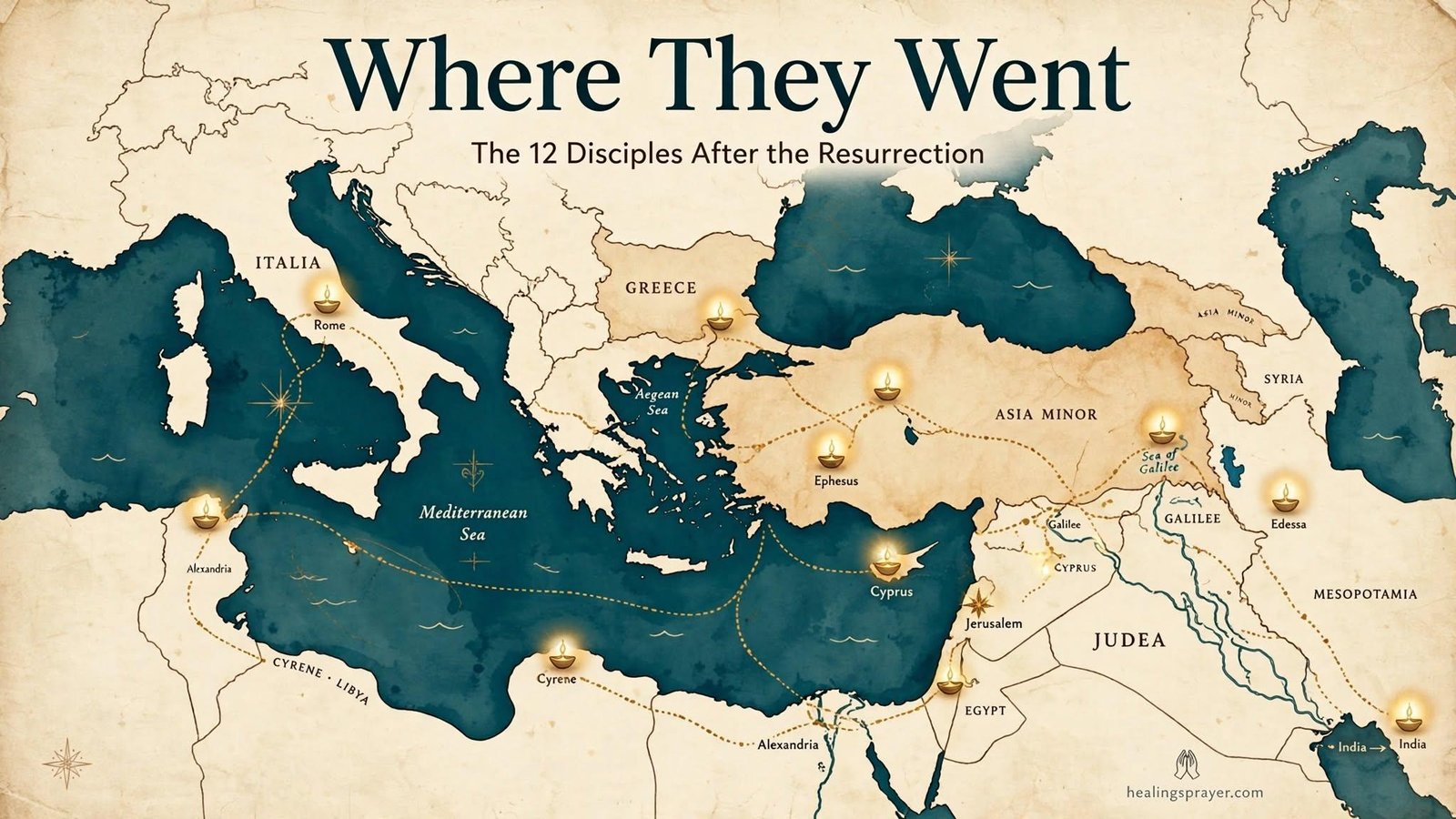
The Bible records the death of only one of the 12 disciples of Jesus as a martyr: James, son of Zebedee (Acts 12:2). It also records the death of Judas Iscariot, though the two accounts differ in detail (Matthew 27:5; Acts 1:18). Almost everything else about how the others died comes from sources outside the Bible.
Early writers such as Irenaeus (second century) and Eusebius (fourth century) preserve some of these traditions. Others come from later collections, such as the Acts of Thomas, which carry less historical weight.
A simple way to sort what you read:
- The Bible says: James was executed by Herod Agrippa I. Peter and John were arrested and later led the church in Jerusalem. Judas died after the betrayal.
- Early church writers say: Peter was executed in Rome, and John lived in Ephesus.
- Regional and later traditions say: Thomas reached India, Bartholomew went to Armenia, and Andrew died in Patras, Greece.
When you read about what happened to the 12 disciples of Jesus, label each claim as Bible, early writers, or later tradition. That habit protects you from repeating legends as facts.
How to Apply the Lessons of the 12 Disciples of Jesus Today
Knowing names and facts is only the start. The real value comes when you let each life shape yours.
A Simple Way to Study Each Disciple
Use this four-step routine for each man:
- Read the list first. Start with Matthew 10:2-4 and Luke 6:12-16 to see every name together.
- Read one disciple’s key verses. Use the verses in this guide for one man per day.
- Write one sentence. Note what the passage shows about his strength or weakness.
- Pray one line. Ask God to build that strength in you or heal that weakness.
In twelve days, you will have studied all of the 12 disciples of Jesus with practical notes you can review later.
Match the Lesson to Your Situation
If You Struggle With Doubt
Read the story of Thomas in John 20:24-29. Bring your honest questions to Jesus in prayer instead of hiding them. Jesus met Thomas with patience, not rejection.
If You Feel Overlooked
Study James, son of Alphaeus, and Andrew. Their quiet roles show that faithful work in the background matters to Jesus, even when others do not notice it.
If You Have Failed
Read Peter’s denial in Luke 22:54-62, and then his restoration in John 21:15-17. Jesus gave Peter a new task after his worst moment, and He can do the same for you.
If You Disagree With Someone Close to You
Look at Matthew and Simon the Zealot. They came from opposite sides of the political world, yet Jesus placed them in one group. Shared purpose can be stronger than past differences.
Also Read : 35+ Powerful Prayers for Guidance and Direction with Bible Verses to Seek God’s Will
A Memory Method for Teaching the List
If you teach children or a Sunday school class, use the three groups of four. Say each group out loud together and repeat it daily for one week.
- Group 1: Peter, Andrew, James, John (the fishermen)
- Group 2: Philip, Bartholomew, Thomas, Matthew
- Group 3: James, Thaddaeus, Simon, Judas
A short helper sentence is “Pete And Jim Join, Phil Brings Tom Matt, Jim Thad Sim Jud.” It sounds silly, and that is exactly why it sticks.
Common Mistakes When Studying the 12 Disciples of Jesus
Avoid these errors so your study stays accurate and useful:
- Treating tradition as Scripture. Details about how most disciples died come from tradition, not the Bible. Label them clearly.
- Mixing up men with the same name. There are two Jameses, two Simons, and two men named Judas among the followers of Jesus. Use the full descriptions, such as “son of Zebedee” or “Iscariot.”
- Confusing Philip the disciple with Philip the evangelist. They are different men in different parts of the New Testament.
- Assuming “disciple” always means “one of the twelve.” The Gospels also use the word for a larger group of followers.
- Judging a disciple by one moment. Thomas is more than his doubt, and Peter is more than his denial. Read the whole record before deciding who a person was.
- Memorizing names without context. A list is easy to forget. Pair each name with one verse and one lesson, as this guide does.
- Ignoring the Gospel of John. John does not give a full list, but it adds details about Andrew, Philip, Thomas, and Nathanael that the other Gospels skip.
The 12 disciples of Jesus are best studied slowly, with the Bible open beside any commentary you read.
The 12 Disciples of Jesus at a Glance (Comparison Table)
Use this summary table to review all of the 12 disciples of Jesus quickly, with one practical takeaway for each.
| # | Disciple | Also Known As | Background | Key Verse | Example Takeaway You Can Apply |
|---|---|---|---|---|---|
| 1 | Simon Peter | Cephas | Fisherman | Matthew 16:16 | After a mistake, return and ask for a new start |
| 2 | Andrew | Brother of Peter | Fisherman | John 1:40-42 | Invite one person to church or Bible study this week |
| 3 | James | Son of Zebedee | Fisherman | Acts 12:2 | Turn ambition into service for others |
| 4 | John | Beloved disciple | Fisherman | John 13:23 | Stay close to Jesus through daily prayer |
| 5 | Philip | — | From Bethsaida | John 1:45-46 | Say “come and see” instead of arguing |
| 6 | Bartholomew | Nathanael | From Cana | John 1:47-49 | Ask honest questions, then listen |
| 7 | Thomas | Didymus | Called “the Twin” | John 20:28 | Bring doubt to Jesus in prayer |
| 8 | Matthew | Levi | Tax collector | Matthew 9:9 | Respond to Jesus’ call without delay |
| 9 | James | Son of Alphaeus | Little recorded | Mark 3:18 | Serve faithfully even when unseen |
| 10 | Thaddaeus | Judas, son of James | Little recorded | John 14:22 | Ask sincere questions about God’s ways |
| 11 | Simon | The Zealot | Zealous activist | Luke 6:15 | Work with people who differ from you |
| 12 | Judas Iscariot | — | Treasurer, betrayer | Matthew 26:14-16 | Guard your heart against greed and secret sin |
Frequently Asked Questions About the 12 Disciples of Jesus
Who are the 12 disciples of Jesus?
The 12 disciples of Jesus are Simon Peter, Andrew, James son of Zebedee, John, Philip, Bartholomew, Thomas, Matthew, James son of Alphaeus, Thaddaeus, Simon the Zealot, and Judas Iscariot. Their names are listed in Matthew 10:2-4, Mark 3:16-19, Luke 6:13-16, and Acts 1:13.
What are the names of the 12 disciples in order?
The order in Matthew 10:2-4 is Simon Peter, Andrew, James, John, Philip, Bartholomew, Thomas, Matthew, James son of Alphaeus, Thaddaeus, Simon the Zealot, and Judas Iscariot. The order changes slightly inside each group of four in the other lists.
Which disciple did Jesus love?
The Gospel of John refers to “the disciple whom Jesus loved” (John 13:23), and tradition identifies this person as John. The Bible does not state the name directly.
Who was the first disciple Jesus called?
The Gospels describe the first calling differently. Matthew 4:18-20 and Mark 1:16-18 name Simon Peter and Andrew first, while John 1:35-40 says Andrew and another unnamed disciple first met Jesus.
Which disciple betrayed Jesus?
Judas Iscariot betrayed Jesus for thirty pieces of silver (Matthew 26:14-16). He identified Jesus to the authorities in Gethsemane with a kiss.
Who replaced Judas among the twelve?
Matthias replaced Judas Iscariot. The believers prayed and cast lots, and Matthias was counted with the eleven (Acts 1:21-26).
Are the 12 disciples and the 12 apostles the same people?
Yes, the same twelve men are called both disciples and apostles. “Disciple” means learner, and “apostle” means one who is sent. Jesus had other disciples too, so the word disciple is wider than the twelve.
How did the 12 disciples of Jesus die?
The Bible records only James’s death as a martyr (Acts 12:2) and describes the death of Judas Iscariot in two passages. Other deaths come from early church writers and later traditions, so details vary.
Which of the 12 disciples were fishermen?
Peter, Andrew, James, and John were fishermen on the Sea of Galilee. Matthew was a tax collector, and the Gospels do not record the work of the others.
Which disciples wrote books of the Bible?
Tradition credits Matthew and John with the Gospels that carry their names, and John with 1, 2, and 3 John and Revelation. Peter is traditionally the author of 1 and 2 Peter, though some scholars debate the authorship of 2 Peter.
Final Thoughts on the 12 Disciples of Jesus
The 12 disciples of Jesus were not perfect, and the Bible never pretends they were. They doubted, argued, ran, and denied, yet Jesus called them, taught them, and trusted them with His mission.
Their stories show that calling comes before qualification and that prayer comes before every big decision. Each of the 12 disciples of Jesus leaves a lesson you can apply to your own faith, whether you need courage, honesty, humility, or a fresh start.
Start with one disciple today, read the key verses in this guide, and say a short prayer asking God to grow that quality in you. As you learn the names, roles, and lessons of the 12 disciples of Jesus, you will read the Gospels with greater clarity and a stronger faith.

Welcome to Healings Prayer!
Healings Prayer is a faith-based platform created to offer comfort, hope, and encouragement through prayer and Scripture. Our mission is to help people find peace in difficult moments and draw closer to God through heartfelt prayers and Bible verses.