
“The Lord is my shepherd: five words that have carried people through fear, grief, and hard nights for about three thousand years.“
“If you searched for the Lord is my shepherd, you probably want one of three things: the exact words of Psalm 23, an explanation you can trust, or a prayer to say right now. This guide gives you all three.”
You will find the full Psalm 23 KJV text, a clear verse by verse meaning, the Hebrew background, 25 original shepherd’s prayers, and a simple 7-day plan to bring the psalm into your daily life.
“Every section is written to be practical. You can read it once, come back to a single verse, or copy a prayer for a card, a message, or a service.”
Whether you are grieving, worried, unwell, or simply thankful, the Lord is my shepherd is a good place to begin.
What Does “The Lord Is My Shepherd” Mean?
The Lord is my shepherd means that God personally guides, provides for, and protects the person who trusts him, the way a shepherd cares for his flock. It is the opening line of Psalm 23, and it is written as a statement of trust, not a request.
People often ask, “what does the Lord is my shepherd mean in everyday life?” The short answer is that you have someone caring for you who knows the way, even when you do not.
The phrase holds three ideas at once:
- Guidance: the shepherd leads, and you follow.
- Provision: the flock lacks nothing it truly needs.
- Protection: the shepherd stays close when danger comes.
Sheep cannot find clean water on their own, and they panic easily. That is why the picture is so honest. Saying the Lord is my shepherd admits that you need care, and it states your confidence that you have it.
The Lord is my shepherd explained in one line: you are known, led, and kept.
Which Verse Is “The Lord Is My Shepherd”?
It is Psalm 23:1. Anyone asking what verse is the Lord is my shepherd will find it right at the start of the chapter.
Readers search for it in many ways: psalm the Lord is my shepherd, psalms the Lord is my shepherd, or just “the Lord is my.” They remember the opening words but not the location.
The chapter is also called the 23rd Psalm, Psalms 23rd, or 23 Psalms. All of these names point to the same six verses in the Book of Psalms.
Who Wrote Psalm 23? A Psalm of David
The heading reads “A Psalm of David.” Tradition credits King David, and the details fit. Before he became king, David looked after his father’s sheep, as 1 Samuel 16 and 17 describe.
He knew what a shepherd does: finding water, guarding the flock, and staying with the sheep through the night. When David writes that the Lord is my shepherd, he borrows the picture from his own daily work.
A psalm of David written from that experience carries weight. He is not describing something he read about. He is describing what he did every day for animals that depended on him.
The Hebrew Words Behind “The Lord Is My Shepherd”
In Hebrew, the opening line is only two words: Yahweh ro’i. The word ro’i means “my shepherd,” and it is personal, not distant.
When you see LORD in capital letters in the KJV, it stands for the name of God, written as YHWH in Hebrew. Some translations use Jehovah instead. The American Standard Version (1901) reads “Jehovah is my shepherd,” which is why people search for Jehovah is my shepherd.
It is the same psalm and the same God, and the Lord is my shepherd in either wording. Knowing this helps you read the line correctly. The psalm is not addressed to a vague higher power. It is addressed to a named, personal God who cares.
Psalm 23 KJV: “The Lord Is My Shepherd” Full Text
Below is the complete Psalm 23 KJV, also searched as 23rd Psalm KJV and KJV Psalm 23. The King James Version is in the public domain in the United States, so you can share it in cards, bulletins, and posts.
1 The LORD is my shepherd; I shall not want.
2 He maketh me to lie down in green pastures: he leadeth me beside the still waters.
3 He restoreth my soul: he leadeth me in the paths of righteousness for his name’s sake.
4 Yea, though I walk through the valley of the shadow of death, I will fear no evil: for thou art with me; thy rod and thy staff they comfort me.
5 Thou preparest a table before me in the presence of mine enemies: thou anointest my head with oil; my cup runneth over.
6 Surely goodness and mercy shall follow me all the days of my life: and I will dwell in the house of the LORD for ever.
The KJV is the version most people know by heart. Read it aloud once, slowly. The rhythm was made to be heard, and the line the Lord is my shepherd; I shall not want settles quickly into memory.
Old KJV Words Made Simple
- Maketh, leadeth, restoreth: makes, leads, restores.
- Thou, thee, thy: you and your.
- Yea: yes, or even.
- Preparest, anointest: prepare, anoint.
- Runneth: runs.
Once you know these, the classic wording reads as clear Psalm 23 English and no longer feels distant.
Psalm 23 Meaning Verse by Verse
Each section below gives you the meaning, the background, and one practical way to apply the verse. Read them in order, or jump to the one you need today.
Verse 1: “The LORD Is My Shepherd; I Shall Not Want”
David begins with a personal word: my. God is not only the shepherd of a crowd. He is the shepherd of the one reading, and the Lord is my shepherd becomes a statement each person can make for themselves.
“I shall not want” does not promise that every wish will be granted. It means you will lack nothing essential while you follow the shepherd. Wants and needs are different, and the psalm speaks to needs.
This one verse sets the theme for the other five. Rest, guidance, protection, and welcome all flow from the first line. Because the Lord is my shepherd, everything after it follows.
Apply it: Write down three needs you are worried about. Read verse 1 slowly next to that list, and mark which ones you can hand over to God today.
Verse 2: Green Pastures and Still Waters
Sheep lie down only when they feel safe, fed, and unafraid. So green pastures and still waters describe rest that the shepherd creates, not rest a sheep can force on its own.
Calm water matters too. Philip Keller, who raised sheep himself, wrote in A Shepherd Looks at Psalm 23 (1970) that sheep are afraid of fast-moving streams. A caring shepherd leads them to quiet places to drink.
The lesson is that peace is often given before it is earned. You do not have to build the pasture. You have to be willing to lie down in it.
Apply it: Take five quiet minutes today with no screens. Treat that time as your pasture, and say “the Lord is my shepherd” once before you return to your day.
Verse 3: “He Restoreth My Soul”
Life wears people out. “He restoreth my soul” promises renewal for the tired and discouraged. The Hebrew word for soul, nephesh, points to your whole inner life: energy, mood, will, and desire.
The paths of righteousness are the right paths. God leads you there “for his name’s sake,” which means the guidance rests on his character, not on how well you have done.
That is good news if you feel behind. The shepherd does not lead because you earned it. He leads because of who he is, and the Lord is my shepherd whether the week went well or not.
Apply it: Name one area where you feel worn out. Ask for restoration there first, instead of asking for everything at once.
Verse 4: The Valley of the Shadow of Death

This is the most quoted line of the 23rd Psalm and the reason it is read at funerals. Notice the wording: you walk through the valley. It is a route, not a place to live.
The Hebrew phrase often translated “shadow of death” can also mean deep darkness. That is why the NIV reads “darkest valley.” Both readings describe the same experience: a season when fear is real.
Notice the change in pronouns. Verses 1 to 3 say “he.” Verse 4 says “thou art with me.” In the darkest moment, the psalm stops talking about God and starts talking to him.
The Lord is my shepherd in green pastures, and verse 4 says he is the same shepherd in the valley.
The Rod and the Staff
The rod protected the flock from predators and was used to count sheep as they passed beneath it. The staff, with its curved end, guided sheep and pulled them out of trouble.
Together they show protection and gentle correction, and the psalm calls both of them comforts. A shepherd who only comforted would not keep you safe, and one who only corrected would not feel like a shepherd.
Apply it: When fear rises, say “thou art with me” out loud, slowly, three times. Then add: the Lord is my shepherd, and I will not walk this alone.
Also Read : Hope-Filled Christmas Eve Bible Verses to Read, Reflect, and Celebrate
Verse 5: A Table Prepared and a Cup That Overflows
The picture shifts from shepherd to host. God sets a table while enemies are still close, which shows that his care does not wait for problems to end.
In the ancient Near East, pouring oil on a guest’s head was a sign of honor and welcome. “My cup runneth over” describes generosity beyond what was asked.
There are two images and one message: you are not only protected, you are honored. Because the Lord is my shepherd, you are treated as a guest of value, not a burden.
Apply it: List three good things already in your life. Read verse 5 beside that list, and thank God for each one by name.
Verse 6: Goodness, Mercy, and a Lasting Home
Most English versions say goodness and mercy will follow you. The Hebrew verb, radaf, is often translated “pursue,” so a fuller picture is goodness and mercy chasing after you. The word for mercy, chesed, means steady, loyal love. (Standard Hebrew lexicons such as Brown-Driver-Briggs list these meanings.)
The psalm ends with a home: “I will dwell in the house of the LORD for ever.” The shepherd who leads you also brings you in.
That is why the psalm ends with confidence instead of worry. Because the Lord is my shepherd, my future is held, not left to chance.
Apply it: At the end of each day, name one good thing that showed up without being asked. Over a week, the list becomes proof that goodness is following you.
Psalm 23 KJV vs NIV and Other English Versions
Many readers search for psalm 23 English or Psalms 23 NIV because they want modern wording. Every major translation of the Lord is my shepherd carries the same message, but the style differs.
- KJV (1611): formal and rhythmic, best for memorizing, reading aloud, and services.
- NIV: modern English. It renders verse 4 as “darkest valley” instead of “valley of the shadow of death.” It is copyrighted, so read it on a licensed site such as Bible Gateway.
- ASV (1901): uses Jehovah in place of LORD.
- NKJV and ESV: stay close to the KJV phrasing with updated grammar.
Reading two versions side by side is the fastest way to understand each phrase. Use the KJV for memory and a modern version for clarity.
If you publish the text on a website or in printed material, remember that the NIV and ESV are copyrighted, while the KJV is free to use in the United States.
How Different Traditions Read Psalm 23
Psalm 23 is loved across Jewish and Christian worship, and each tradition uses it a little differently.
- Jewish tradition: The psalm is known in Hebrew as Mizmor l’David, and many communities sing it at the third Sabbath meal.
- Older Catholic and Orthodox numbering: Bibles based on the Greek and Latin traditions number it Psalm 22, because the psalms are counted slightly differently. The words are the same.
- Scottish Psalter (1650): A rhyming version set to music, most often sung to the tune Crimond, is still common at weddings and funerals.
- Hymns: “The King of Love My Shepherd Is” (Henry Williams Baker, 1868) retells the psalm as a hymn.
All of these show the same point: the Lord is my shepherd has served as a sung prayer for generations, not only a text to read.
Also Read : 80+ Powerful Words for Strength, Healing, and Peace
God My Shepherd, God Our Shepherd: The Shepherd Theme in the Bible
The shepherd image runs through the whole Bible, which is why people also search for God my shepherd and God our shepherd. Psalm 23 is the most personal example, but it is not the only one.
- Genesis 48:15: Jacob speaks of God as the one who has shepherded him all his life.
- Psalm 80:1: “Give ear, O Shepherd of Israel,” a plea for God’s guidance of the whole community.
- Isaiah 40:11: God feeds his flock like a shepherd and gathers the lambs in his arms.
- Ezekiel 34: God promises to search for his scattered sheep and care for them himself.
- John 10:11: Jesus says, “I am the good shepherd.”
- Hebrews 13:20: Jesus is called the great shepherd of the sheep.
- 1 Peter 5:4: Jesus is called the chief Shepherd.
These passages show that the Lord is my shepherd is not a single poetic line. It is a theme Scripture returns to from Genesis to the New Testament.
Psalm 23 and John 10 fit together well. In one, David says the Lord is my shepherd. In the other, Jesus says he is the good shepherd who knows his sheep by name.
What Sheep Teach Us About “The Lord Is My Shepherd”
Sheep are known for needing help, and that is what makes the image honest. Four traits explain why the comparison works:
- They lose their way easily. Sheep wander when no one leads them, and people do the same when worry or busyness takes over.
- They fear danger. Sheep depend on the shepherd’s presence to feel safe. People also rest better when they know they are not alone.
- They need steady supply. Sheep cannot store food or find clean water on their own.
- They know their shepherd’s voice. John 10 describes sheep that recognize the shepherd when he calls.
The point is not that people are foolish. The point is that everyone needs care, and the psalm gives that care a name.
Reading a familiar passage slowly is also a grounding practice, much like the steady breathing wellness professionals often recommend for stress. That is one reason the Lord is my shepherd is so often the first passage people reach for in hard moments.
For deeper study, two widely respected resources are Philip Keller’s A Shepherd Looks at Psalm 23 and Charles Spurgeon’s nineteenth-century commentary The Treasury of David.
The Lord Is My Shepherd Prayer: 25 Ready-to-Use Shepherd’s Prayers
People search for the Lord is my shepherd prayer, the shepherd’s prayer, and the Lord is my shepherd prayer words because they want something to say right now. Each prayer below is original, short, and built on a line from Psalm 23.
Read them as written, or change a few words to fit your situation. To pray for someone else, swap “I” and “me” for their name. You can also read Psalm 23 itself as your prayer, pausing after each verse.
5 Morning Shepherd’s Prayers
- Father, because the Lord is my shepherd, I begin this day without fear. Lead me where you want me to go, give me what I need, and keep my heart steady. Amen.
- Lord, you make me lie down in green pastures. Quiet my mind before the day gets busy, and help me start from rest, not from worry. Amen.
- Shepherd of my soul, I will not want. Provide for my work, my health, and my home today, and teach me to trust your supply. Amen.
- Good Shepherd, lead me in the right paths today. Because the Lord is my shepherd, I do not have to guess. Make my next step clear. Amen.
- God, thank you that goodness and mercy follow me. Help me notice them today and pass them on. The Lord is my shepherd, and I begin this day in peace. Amen.
5 Prayers for Anxiety and Fear
- Lord, when my thoughts race, remind me that the Lord is my shepherd and that you stay with me. I will fear no evil, because you are near. Amen.
- Father, lead me beside still waters. Slow my breathing, calm my heart, and let your peace settle where worry has been. Amen.
- Because the Lord is my shepherd, I am not alone in this valley. Walk with me one step at a time until I am through. Amen.
- God, your rod and staff comfort me. Guard me from what I cannot control, and guide me in what I can. Amen.
- Shepherd, restore my soul tonight. The Lord is my shepherd, so I put down the weight I carried all day and rest. Amen.
5 Prayers for Grief and Funerals
- Lord, you are the shepherd of everyone who mourns. Be near us in this valley, and hold us in our loss. Amen.
- Father, thank you that the Lord is my shepherd even in sorrow. Comfort me now, and keep the one I love in your care. Amen.
- God of comfort, when the shadow feels long, be our light. Give us strength for the days ahead, and remind us that the Lord is my shepherd today and always. Amen.
- Lord, thank you for the life we are remembering. Let goodness and mercy follow all who grieve, all their days. Amen.
- Shepherd, we do not have every answer, but we have your promise. Because the Lord is my shepherd, I trust that you hold this family together. Amen.
5 Prayers for Illness and Healing
- Lord, you restore the soul. Bring healing to my body, and give me patience while I recover. Amen.
- Father, be with the doctors, nurses, and caregivers. Give them wisdom and steady hands, and give me trust in the process. Amen.
- Because the Lord is my shepherd, I will not face this diagnosis alone. Stay close, and carry what I cannot. Amen.
- Good Shepherd, I ask for rest that comes from you. The Lord is my shepherd, so let my nights be peaceful and my days steady. Amen.
- God, I pray for someone I love who is unwell. Care for them the way a shepherd cares for a weak lamb, and bring them strength. Amen.
5 Prayers for Guidance and Gratitude
- Lord, thank you that I lack nothing I truly need. Teach me to see what I already have. Amen.
- Father, I place my family in your care. Lead each of us in your paths, and keep us close to you and to one another. Because the Lord is my shepherd, we are covered. Amen.
- Shepherd, I am facing a decision. Show me the right path, and give me courage to take it. Amen.
- God, my cup overflows today. Thank you for your kindness, and help me share it with those in need. Amen.
- Father, I trust that the Lord is my shepherd today and for the rest of my life. Keep me close, and bring me home to you. Amen.
How to Use These Prayers
- In a card or message: Copy one prayer and add the person’s name at the start.
- At a service or gathering: Read a prayer aloud slowly, then read Psalm 23 in the KJV.
- In a journal: Write the prayer by hand, then add two lines about what you are asking for today.
- With family: Take turns reading one prayer each at the table or before bed.
How to Apply Psalm 23 in Daily Life
Reading the psalm once is a start. A simple routine helps the words stay with you. The plan below takes about five minutes a day.
A 7-Day Psalm 23 Reading Plan
- Day 1: Read all six verses aloud, slowly, one time.
- Day 2: Focus on verse 1. Write down what you need right now, and say “the Lord is my shepherd” after each item.
- Day 3: Focus on verse 2. Take five quiet minutes with no screens.
- Day 4: Focus on verse 3. Name one area where you need restoration.
- Day 5: Focus on verse 4. Repeat “thou art with me” whenever you feel afraid.
- Day 6: Focus on verse 5. List everything you are thankful for.
- Day 7: Read the whole psalm again. Notice which verse speaks to you most now, and finish by saying the Lord is my shepherd out loud.
How to Memorize Psalm 23
Six verses are short enough to learn in about a week. Once you know the Lord is my shepherd by heart, you can pray it anywhere: in traffic, in a waiting room, or before sleep.
- Learn one verse a day. Add the next verse only after the last one feels solid.
- Write it by hand. Writing slows you down and helps the words stick.
- Read it aloud before sleep. The last thing you read is easier to recall.
- Attach it to a habit. Say a verse while your coffee brews or while you walk.
- Test yourself without looking. Check your version against the text, then repeat.
You can also personalize the psalm. Replace “I” and “me” with the name of a loved one when you are praying for them. Keep the wording of the verse, and change only the pronouns.
When to Turn to Psalm 23
- At funerals and memorials: Verse 4 offers comfort to those who grieve.
- During illness or hospital stays: The picture of the shepherd who restores the soul brings calm.
- In times of anxiety or fear: “I will fear no evil” is a reminder to trust.
- At a new beginning: A move, a new job, or a new season all call for guidance.
- In daily prayer: Many people read it each morning to start the day with trust.
In every one of these moments, the Lord is my shepherd gives you a simple line to hold.
Common Mistakes When Reading the 23rd Psalm
- Reading it as a promise of no hardship. Verse 4 assumes you will meet valleys. The promise is not that life is easy, but that the Lord is my shepherd in every valley.
- Skipping to verse 4 only. Verses 1 to 3 explain why you can trust the shepherd. Read all six verses for the full picture.
- Rushing through it. Speed reading turns it into background noise. Slow down, and pause after each verse.
- Treating it as a funeral text only. It was written for daily life. Use it on ordinary mornings, too.
- Copying modern versions without permission. The NIV and ESV are copyrighted. If you publish the text on a site or in a card, use the KJV or check the license.
- Using it in place of professional help. Psalm 23 can comfort you, but it does not replace medical or mental health care when you need it.
Final Thoughts: Because the Lord Is My Shepherd
Because the Lord is my shepherd, the psalm ends with belonging, not fear. Six verses give you provision, rest, restoration, presence, welcome, and a lasting home.
Read the Psalm 23 KJV text slowly, use the verse by verse meaning to understand it, and pray the shepherd’s prayer that fits your day. Return to it in the good seasons as much as the hard ones.
When life feels uncertain, come back to five words: the Lord is my shepherd. They are simple enough to say in one breath and strong enough to hold you through the night.
5. Comparison / Summary Table
Psalm 23 at a Glance: Verse, Meaning, and Prayer Line
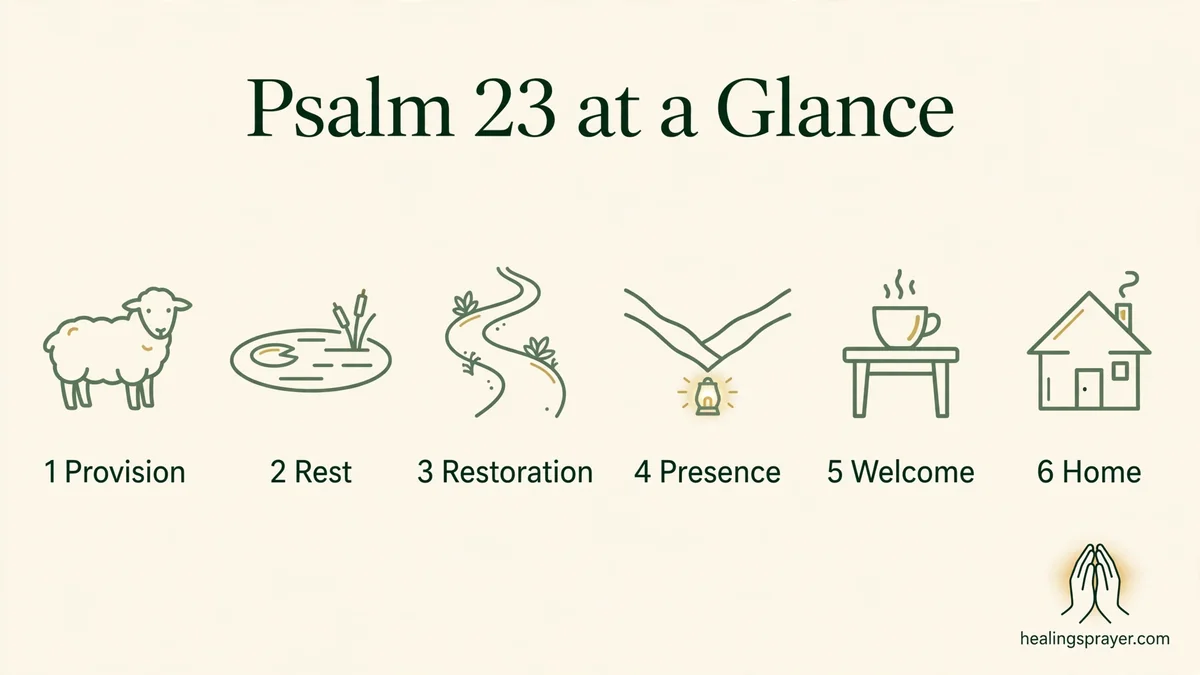
| Verse | Shepherd Image | Core Meaning | Example Line to Pray |
|---|---|---|---|
| 1 | Shepherd and sheep | Provision | “Because the Lord is my shepherd, I lack nothing I truly need today.” |
| 2 | Green pastures, still waters | Rest | “Lead me to quiet places and calm my mind.” |
| 3 | Restored soul, right paths | Restoration and guidance | “Restore my strength and show me the next step.” |
| 4 | Valley, rod, and staff | Presence in fear | “Thou art with me, so I will not fear.” |
| 5 | Table, oil, overflowing cup | Welcome and abundance | “Thank you for giving me more than I asked for.” |
| 6 | Goodness, mercy, house of the Lord | A lasting home | “Because the Lord is my shepherd, my future is held.” |
6. Frequently Asked Questions
What does “the Lord is my shepherd” mean?
The Lord is my shepherd means God guides, provides for, and protects the person who trusts him. The image comes from a shepherd who leads the flock to food and water and stays close when danger comes.
What verse is “the Lord is my shepherd”?
It is Psalm 23:1. The line opens the 23rd Psalm, which has six verses in total.
Who wrote Psalm 23?
Tradition credits King David. The chapter heading reads “A Psalm of David,” and David worked as a shepherd before he became king.
What does “I shall not want” mean?
It means you will lack nothing essential while you follow the shepherd. It does not mean every desire will be fulfilled.
Why is Psalm 23 read at funerals?
Verse 4 promises that God is present in the “valley of the shadow of death.” That promise gives comfort to those who are grieving, and it reminds them that the Lord is my shepherd even in loss.
Is “Jehovah is my shepherd” the same psalm?
Yes. Some translations, such as the American Standard Version, use “Jehovah” where the KJV prints “LORD.” Both stand for God’s personal name in Hebrew.
What is the difference between Psalm 23 KJV and NIV?
The meaning is the same, and the wording differs. The KJV uses classic language, while the NIV uses modern English, such as “darkest valley” in verse 4. Both carry the message that the Lord is my shepherd.
What is “the shepherd’s prayer”?
It is a prayer based on Psalm 23, often the psalm itself or a short prayer built from its lines. The Lord is my shepherd prayer is not the same as the Lord’s Prayer, which comes from Matthew 6.
Can I pray “the Lord is my shepherd” for someone else?
Yes. Replace “I” and “me” with the person’s name, and keep the rest of the words. Praying that the Lord is my shepherd on behalf of a loved one is a common and gentle way to intercede.

Welcome to Healings Prayer!
Healings Prayer is a faith-based platform created to offer comfort, hope, and encouragement through prayer and Scripture. Our mission is to help people find peace in difficult moments and draw closer to God through heartfelt prayers and Bible verses.