

Ask Believe Receive is not a trick to get what you want. It is a way of praying that trusts God to hear you and to answer you.
If you have ever wondered what ask believe receive really means, this guide explains it in plain words, using the Bible verse behind it.
You will learn the context of Mark 11:24, the three steps of ask believe receive, and why some prayers seem to take longer than others. You will also get 30 short prayers to copy, a 7-day practice, and a prayer journal template.
What Is Ask Believe Receive? (Mark 11:24 Explained Simply)
Ask Believe Receive is a three-step prayer pattern taken from Jesus’ teaching in Mark 11:24 and Matthew 7:7: you ask God clearly, you believe He hears you, and you receive His answer with trust, whether it comes now or later.
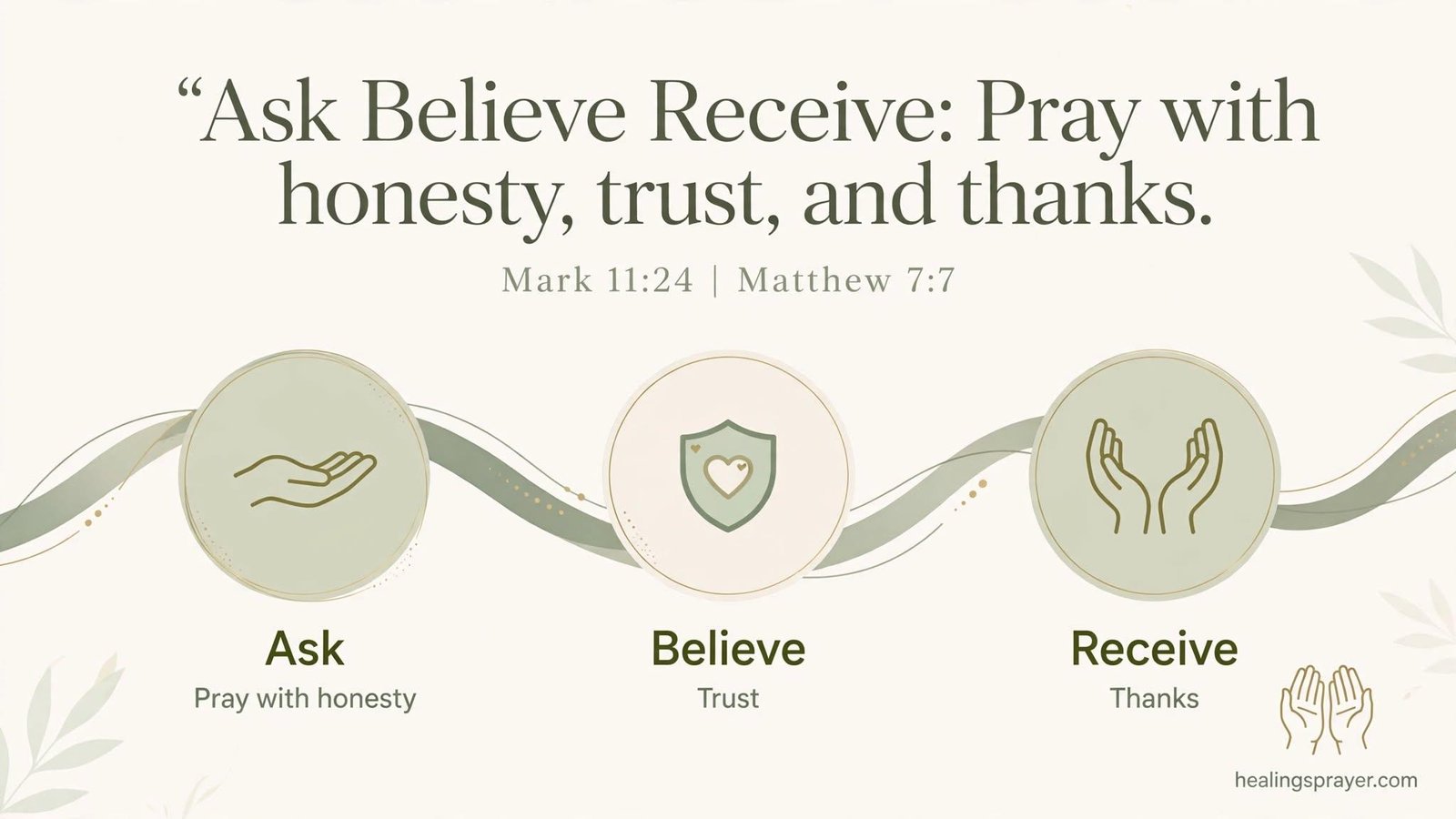
The words are short, but each one carries weight. Ask means you bring your real request to God in your own words. Believe means you trust that He listens. Receive means you accept what He gives, with open hands and a calm heart.
The pattern is simple enough to remember on a hard day. That is part of why so many believers use ask believe receive as a daily prayer rhythm.
A Simple Definition You Can Remember
Here is a one-line version you can keep: ask honestly, believe deeply, receive gratefully.
- Ask: tell God exactly what is on your heart.
- Believe: trust that He hears you, even when you cannot see results yet.
- Receive: accept His answer, and give thanks before and after it arrives.
When you use ask believe receive this way, prayer becomes a conversation instead of a performance. You are not trying to force an outcome. You are trusting a God who already knows what you need.
Where the Ask Believe Receive Idea Comes From
The phrase ask believe receive appears in two places today. The first is the Bible. The second is the modern self-help world, where it is often linked to the law of attraction.
The Bible roots are older and deeper. Two passages stand behind them:
- Matthew 7:7: Jesus tells you to ask, seek, and knock, and promises that God answers.
- Mark 11:24: Jesus tells you to believe that you have received what you pray for. The KJV reads: “What things soever ye desire, when ye pray, believe that ye receive them, and ye shall have them.”
The exact three-word phrase is not printed in Scripture. It is a summary of these verses, and the teaching behind it is clearly biblical.
Self-help versions usually place the power in your own thoughts. The biblical version places the power in God. That difference changes how you pray, and a later section compares the two side by side.
Knowing the source keeps your ask believe receive practice grounded in Scripture and not in hype.
Mark 11:22-25 in Context: What Jesus Was Really Teaching
Most people quote only verse 24. But that verse sits inside a short teaching of four verses, and each one shapes how ask believe receive should work in your life.
Jesus gave this teaching after the disciples noticed that the fig tree He had cursed was withered (Mark 11:12-14, 20-21). Peter pointed to the tree, and Jesus answered by teaching them about faith and prayer.
Verse 22: Have Faith in God
Jesus begins with four words: “Have faith in God.” Everything that follows rests on that sentence.
The faith in ask believe receive is not faith in your own words or your own strength. It is faith in the character of God: He is good, He hears, and He acts.
Without this foundation, the rest of the passage turns into a formula. With it, the passage becomes a relationship.
Verse 23: Speaking to the Mountain
In verse 23, Jesus talks about telling a mountain to be lifted and thrown into the sea. He uses a picture of something impossible to show how powerful faith in God can be.
Many Bible teachers read this as a figure of speech for obstacles that feel immovable, such as fear, sickness, or a closed door. The point is not the mountain. The point is that nothing is too big for God.
This verse widens the range of what you can bring in your ask believe receive prayers.
Verse 24: Whatever You Ask for in Prayer
This is the verse most people search for. In the NIV wording, it tells you that whatever you ask for in prayer, you should believe that you have received it, and it will be yours.
Notice three things about this verse:
- It begins with prayer. The believing happens inside a conversation with God, not outside it.
- It uses the word “whatever.” You are invited to bring everything to God, large and small.
- It asks for belief. That means trust, not pressure or hype.
There is also a small note about the verb “receive.” Greek manuscripts differ slightly on its form, and translators have handled it in different ways. That is why some Bibles say “you have received” and others say “ye receive.”
Whichever wording you read, the call of ask believe receive stays the same: pray with confident trust in God.
This verse is the heart of ask believe receive, and it works best when you read it together with the verses around it.
Verse 25: Forgive Before You Pray
Verse 25 is often skipped, yet it finishes the thought. Jesus says that when you stand praying, you should forgive anyone you hold something against, so that your Father in heaven can forgive you too.
This means ask believe receive includes a heart check. Before you ask, you let go of bitterness. A prayer carried with unforgiveness feels heavy, and a prayer carried with a clear heart feels light.
Ask yourself one simple question before praying: Is there someone I need to forgive today?
Mark 11:22-25 at a Glance
Here is the whole passage in four lines, so you can see how ask believe receive fits together:
- Verse 22: Put your faith in God.
- Verse 23: Faith in God can face impossible obstacles.
- Verse 24: Ask in prayer, and believe.
- Verse 25: Forgive others as you pray.
Why Ask Believe Receive Matters in Your Prayer Life
Prayer can feel one-sided when you do not know how to start. Ask believe receive gives you a clear shape, so you are never staring at a blank page wondering what to say.
Here is why this pattern matters:
- It makes your prayers specific. Asking clearly replaces vague wishes with honest requests.
- It builds trust. Believing moves you from worry toward peace, because you place the outcome in God’s hands.
- It trains gratitude. Receiving teaches you to notice answers, including small ones you would have missed.
- It keeps prayer personal. You are speaking to a Father, not repeating a script.
Many believers also find that ask believe receive calms anxious thinking. Philippians 4:6-7 supports this: it tells you to bring your requests to God with thanksgiving, and it promises a peace that goes beyond understanding.
Each step also protects the other two. Asking without believing becomes complaining. Believing without asking becomes passive waiting. Receiving without the first two becomes guesswork.
That is why ask believe receive is a complete prayer pattern and not just a catchy phrase.
What Ask Believe Receive Is Not
Clear limits keep your faith healthy. Here is what this pattern does not promise:
- It is not a guarantee that every wish will arrive in the exact way you picture it.
- It is not a magic formula where the right words force God’s hand.
- It is not a replacement for wisdom, patience, or taking sensible action.
- It is not a test that you fail if you feel doubt on a hard day.
Keeping these limits in mind protects your faith. When you practice ask believe receive with humility, a delayed answer does not break your trust.
The 3 Steps of Ask Believe Receive
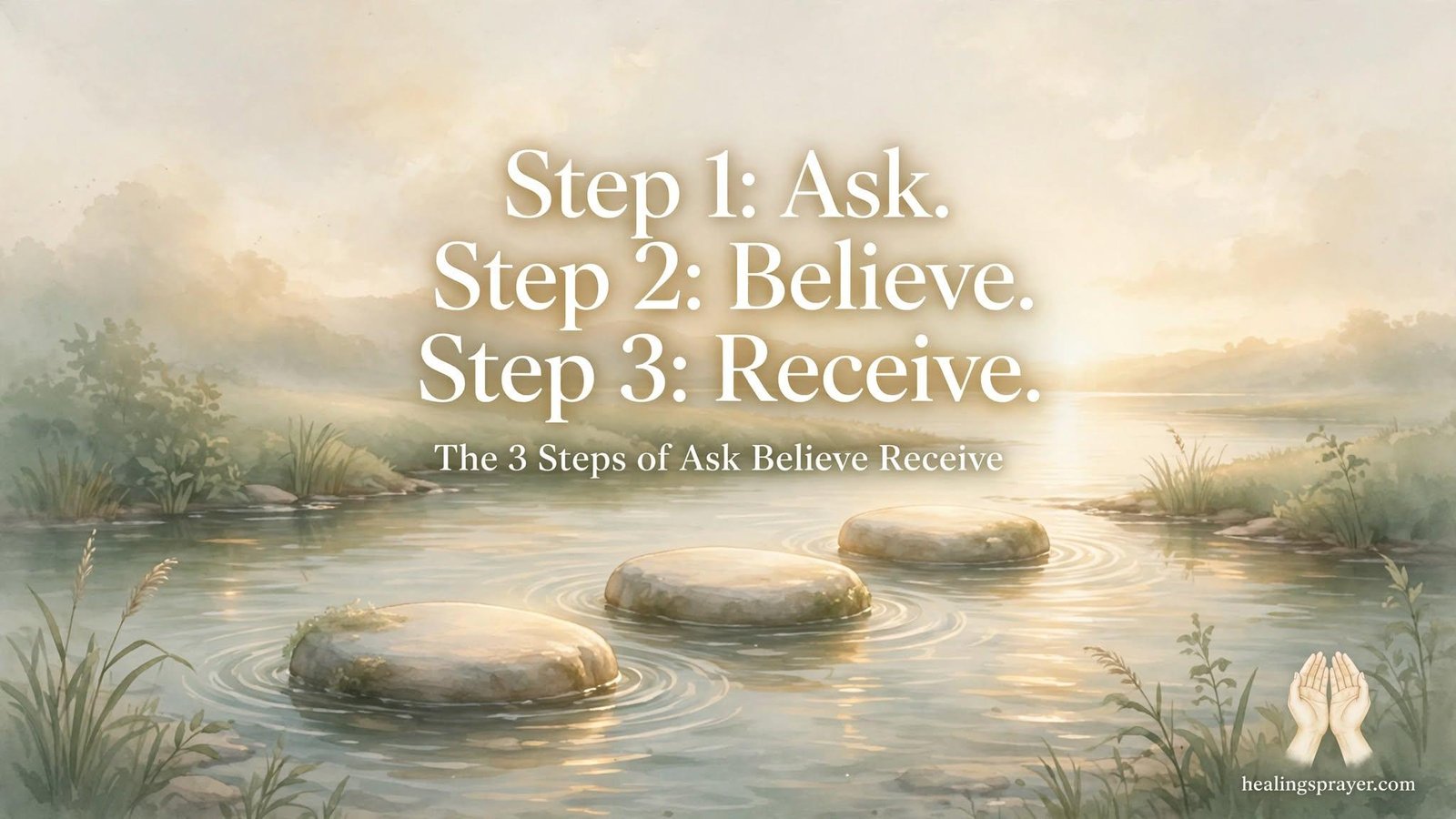
Now let us break ask believe receive into three practical steps you can use today. Each step has a short practice you can try right away.
Step 1: Ask With Clear and Honest Words
The first step of ask believe receive is to ask. Jesus said, “Ask, and it shall be given you” (Matthew 7:7). The invitation is open, and you do not need fancy language.
Here is how to ask well:
- Be specific. Name what you actually need, not a general “help me.”
- Be honest. Tell God what you feel, including fear, tiredness, or confusion.
- Be simple. One or two plain sentences are enough.
- Be humble. Add “Your will be done,” as Jesus did in Luke 22:42.
God already knows your needs, so asking is not about informing Him. It is about opening your heart and placing the matter in His hands.
Quick Practice
Write one request on paper, in one sentence. Begin with “Lord, I ask for…” and read it aloud as a prayer. This small act turns a vague worry into a clear ask.
Step 2: Believe That God Hears You
The second step of ask believe receive is to believe. Hebrews 11:1 describes faith as confidence in what you hope for and assurance about what you cannot yet see.
Believing does not mean you feel certain about the outcome. It means you trust that God hears you and cares about you. James 1:6 tells you to ask in faith without doubting, which points to steady trust and not perfect emotion.
Here is how to build belief:
- Read a promise. Pick one verse, such as Mark 11:24, and read it slowly.
- Speak it back. Say, “I believe You hear me, Lord.”
- Remember past help. Recall times God has already helped you and list them.
- Release control. Hand the outcome to God and stop rehearsing worst cases.
Doubt does not disqualify you. Many believers pray, “I believe; help my unbelief,” echoing Mark 9:24. That honest prayer is a real act of faith.
Quick Practice
Choose one verse and write it where you will see it today, on a note or phone lock screen. Each time you see it, whisper: “I believe You hear me.”
Step 3: Receive With Open Hands
The third step of ask believe receive is to receive. This means you accept God’s answer with gratitude, whether it is a clear yes, a different path, or a season of waiting.
Receiving begins before the answer arrives. Philippians 4:6 says to make your requests known with thanksgiving, so thankfulness is part of the prayer itself.
Here is how to receive well:
- Give thanks in advance. Thank God for hearing you before you see results.
- Watch for answers. Notice small signs, open doors, and unexpected help.
- Accept the shape of the answer. God may answer in a way that differs from your plan.
- Record what happens. Writing it down trains you to see His work.
Psychology supports the habit of gratitude. Research by Robert Emmons and Michael McCullough, published in 2003, found that people who regularly listed things they were thankful for reported higher well-being than those who focused on daily hassles.
Quick Practice
Finish your prayer by saying, “Thank You, Lord, for hearing me.” Then write down one thing you are grateful for today, even if it is small.
Ask Believe Receive vs. the Law of Attraction
Many people who search for ask believe receive meet the law of attraction first. Popular books and videos use the same three words, so the two ideas are often mixed together.
They share a surface similarity, but the source of power is different. This comparison helps you pray with clarity:
- The source: Biblical ask believe receive places power in God. The law of attraction places power in your own thoughts and energy.
- The relationship: Biblical prayer is a conversation with a Father who loves you. The law of attraction treats the universe as a system that responds to your focus.
- The outcome: Biblical prayer accepts that God may say yes, no, or wait. The law of attraction usually promises results if your belief is strong enough.
- The motive: Biblical prayer asks according to God’s will (1 John 5:14). The law of attraction centers on what you personally want.
- The failure point: In the law of attraction, a missing result suggests your belief was too weak. In biblical prayer, a delayed answer invites trust, not self-blame.
This difference matters for your peace. When your ask believe receive practice rests on God’s character and not on your mental effort, a hard season does not crush you with guilt.
It also keeps your prayer humble. You ask boldly, but you leave the answer with the One who sees what you cannot.
Also Read : 80+ Powerful Words for Strength, Healing, and Peace
7 Bible Verses That Support Ask Believe Receive
These seven verses show that ask believe receive is built on more than one passage. Read them slowly, and pray one each day if you like.
1. Matthew 7:7-8. “Ask, and it shall be given you; seek, and ye shall find; knock, and it shall be opened unto you.” This is the clearest invitation to ask, and it gives the first step of ask believe receive its foundation.
2. Matthew 21:22. “And all things, whatsoever ye shall ask in prayer, believing, ye shall receive.” Jesus pairs asking with believing, which mirrors Mark 11:24.
3. James 1:6. “But let him ask in faith, nothing wavering.” This verse shows that belief is part of the asking itself, not an extra step added later.
4. 1 John 5:14-15. John writes that if we ask anything according to God’s will, He hears us. This verse keeps ask believe receive anchored in God’s purposes and not just personal wishes.
5. John 15:7. Jesus links answered prayer with staying close to Him and letting His words stay in you. A prayer life rooted in Scripture shapes what you ask.
6. Hebrews 11:1. “Now faith is the substance of things hoped for, the evidence of things not seen.” This verse defines the believing step of ask believe receive.
7. Philippians 4:6-7. Paul tells you to make your requests known to God with thanksgiving, and he promises peace that guards your heart and mind. This verse covers all three steps in one sentence.
Together, these passages show a steady pattern. You ask, you believe, you give thanks, and you keep your heart close to God.
Yes, No, or Wait: How God Answers Prayer
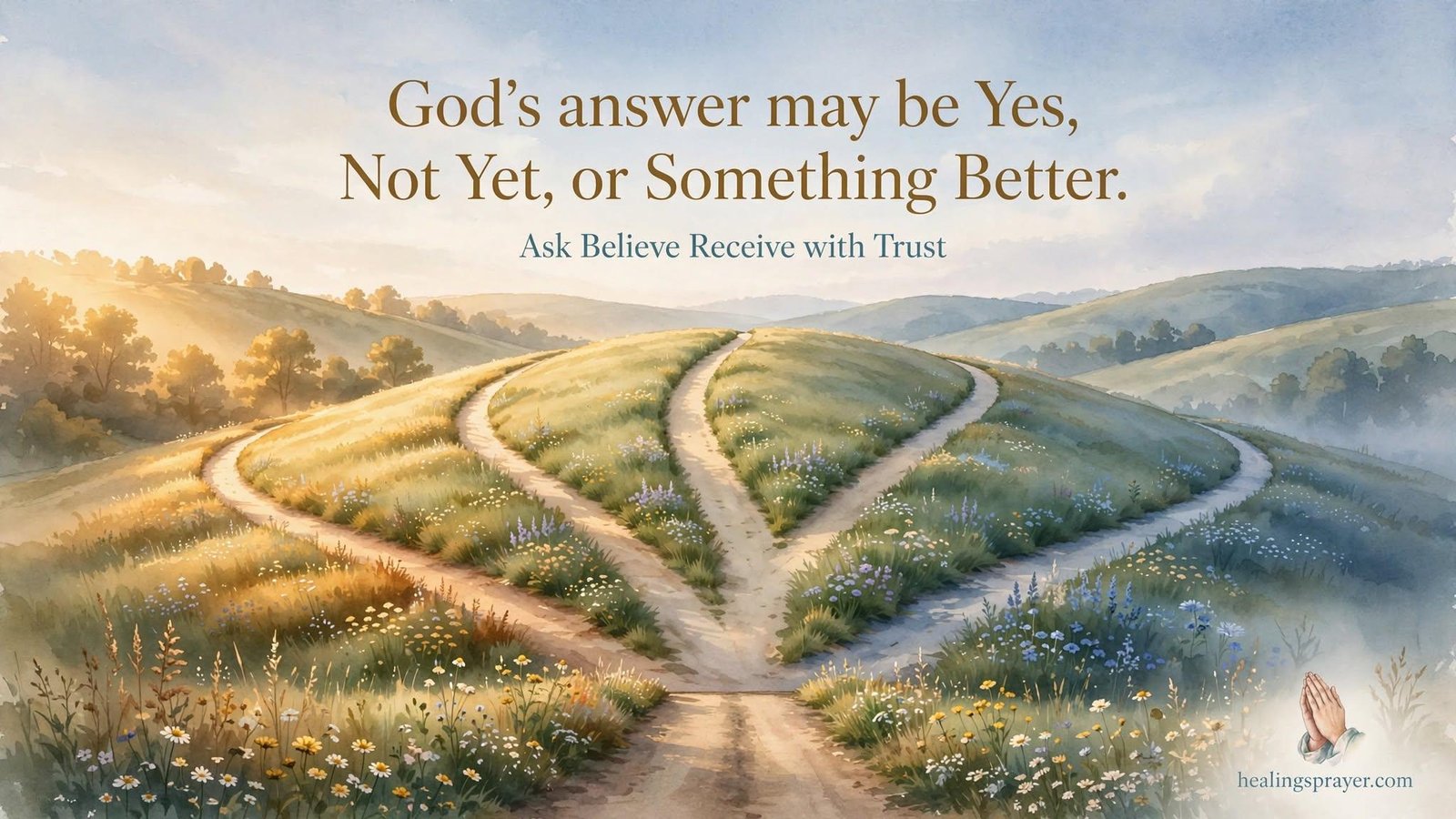
A common question about ask believe receive is simple: what if God does not give what I asked for? The Bible shows that God answers in more than one way.
Here are the three common answers:
- Yes. God grants the request as you asked. Receive it with thanks and use it well.
- No. God declines because He sees harm or a better plan. In Luke 22:42, Jesus prayed that the cup might pass, and then submitted to the Father’s will.
- Wait. God delays the answer for a purpose. Daniel 10:12-13 shows that an answer can be sent from the first day of prayer, yet take time to arrive.
A “no” or “wait” does not cancel ask believe receive. It reveals that receiving includes receiving God’s wisdom, not only the outcome you pictured.
Jesus also taught persistence. In Luke 18:1, He told His followers that they should always pray and not give up. Continuing to ask is part of faith, not a lack of it.
When an answer seems slow, return to the first verse of the passage: “Have faith in God.” Your trust rests on Him, not on a timeline.
Why Some Prayers Feel Unanswered
Every believer meets seasons when prayer feels quiet. Understanding the common reasons helps you keep practicing ask believe receive without discouragement.
Here are reasons the Bible and Christian teaching point to:
- Timing. God sees the whole picture. His timing often differs from ours (Isaiah 55:8-9).
- Motive. James 4:3 says some prayers go unanswered because they are asked with wrong motives, such as pure self-gratification.
- Unforgiveness. Mark 11:25 links prayer with a forgiving heart. Holding resentment can make prayer feel heavy.
- Disobedience. Staying in a pattern you know is wrong can dull your sense of closeness to God (Psalm 66:18).
- A better answer. God may be preparing something larger than what you asked for.
- Growth. Waiting often shapes patience, humility, and deeper trust.
None of these reasons means God has stopped listening. They are invitations to examine your heart gently, not to blame yourself.
If you feel stuck, try this short check:
- Is my request honest and clear?
- Is there someone I need to forgive?
- Am I open to God’s will, even if it differs from mine?
- Am I thanking Him for what He has already done?
Then keep going. Ask believe receive is a daily rhythm, not a one-time attempt, and steady practice builds steady trust.
30 Short Prayers to Pray and Believe (Ready to Copy)

These prayers follow the ask believe receive pattern in plain, honest words. Each category has exactly six prayers. Copy them, change them, or use them as a starting point for your own.
Prayers for Healing
Healing prayers bring physical, emotional, and spiritual needs to God. Use these when you want to ask believe receive with a weary body or heart.
- Lord, I ask for healing in my body and peace in my mind. I believe You hear me, and I receive Your care with thanks.
- Father, I place every pain in Your hands today. I trust that You are near, and I receive strength for this day.
- God of mercy, I ask You to restore what is weak in me. I believe You are working, even when I cannot see it.
- Jesus, You healed with a word, so I ask with confidence. I believe in Your power, and I receive Your peace.
- Lord, I ask You to comfort those I love who are hurting. I believe You love them more than I do, and I receive Your comfort for them.
- Father, I ask for patience in my recovery. I believe You are with me in every slow step, and I receive Your rest.
Prayers for Peace
Peace prayers calm anxious thoughts and quiet a crowded mind. Philippians 4:6-7 is a good companion verse for ask believe receive in this area.
- Lord, I ask You to quiet my racing thoughts. I believe Your peace is greater than my worry, and I receive it now.
- Father, I bring my anxiety to You with thanksgiving. I believe You hear me, and I receive peace that guards my heart.
- Jesus, speak calm over my day. I believe You are in control, and I receive Your stillness.
- God, I ask You to take the heavy things I keep carrying. I believe You can hold them, and I receive rest.
- Lord, I ask for peace in my home and in my heart. I believe You are present here, and I receive Your calm.
- Father, I ask for a night of rest. I believe You watch over me, and I receive sleep with a thankful heart.
Prayers for Guidance
Guidance prayers ask for wisdom when a decision feels unclear. James 1:5 promises wisdom to those who ask, which fits naturally with ask believe receive.
- Lord, I ask for wisdom in the choice in front of me. I believe You will show me the way, and I receive Your direction.
- Father, I ask You to close the doors that are wrong and open the ones that are right. I believe You lead me, and I receive Your guidance.
- God, I ask for clear thinking and a humble heart. I believe You give wisdom freely, and I receive it with thanks.
- Jesus, I ask You to order my steps today. I believe You walk ahead of me, and I receive Your leading.
- Lord, I ask for courage to follow Your direction. I believe You go with me, and I receive Your strength.
- Father, I ask for patience while I wait for clear answers. I believe Your timing is good, and I receive Your peace in the waiting.
Prayers for Family
Family prayers cover the people closest to you. Bring them to God using the ask believe receive pattern, and include forgiveness where it is needed.
- Lord, I ask You to protect my family today. I believe You watch over each person, and I receive Your covering.
- Father, I ask for unity and kindness in our home. I believe You can soften hearts, and I receive Your love for us.
- God, I ask You to guide my children in Your ways. I believe Your plans for them are good, and I receive Your wisdom as a parent.
- Jesus, I ask for healing in our broken relationships. I believe You make things new, and I receive Your grace.
- Lord, I ask You to bless my parents with health and joy. I believe You care for them, and I receive a thankful heart for them.
- Father, I ask for forgiveness to flow in our family. I believe You forgive us first, and I receive the freedom to forgive.
Prayers for Provision
Provision prayers bring daily needs to God without shame. Jesus taught His followers to ask for daily bread, and this is a natural place to practice ask believe receive.
- Lord, I ask for what my household needs. I believe You know it already, and I receive Your provision with thanks.
- Father, I ask You to open honest work for me. I believe You provide, and I receive Your timing.
- God, I ask for wisdom with money and generosity in my heart. I believe You supply, and I receive Your guidance.
- Jesus, I ask You to meet my needs today. I believe You care about daily bread, and I receive it gratefully.
- Lord, I ask You to remove fear about tomorrow. I believe You hold the future, and I receive today’s peace.
- Father, I ask for contentment as well as provision. I believe You give what is good, and I receive it with open hands.
Also Read : 200+ Loyalty Quotes That Build Trust, Love, and Honest Relationships
A 7-Day Ask Believe Receive Prayer Practice
A pattern becomes real when you practice it. This 7-day plan helps you build ask believe receive into a steady habit, with one small action each day.
Day 1: Ask. Write one clear request in a single sentence. Pray it aloud, beginning with “Lord, I ask for…”.
Day 2: Believe. Read Hebrews 11:1 slowly. Pray, “I believe You hear me,” and list two ways God has helped you before.
Day 3: Receive. Thank God in advance for hearing your request. Write down three things you are grateful for today.
Day 4: Forgive. Read Mark 11:25. Name anyone you need to forgive, and pray for their good, even if it feels hard.
Day 5: Align. Read 1 John 5:14-15. Add “Your will be done” to your request, and ask God to shape your desires.
Day 6: Persist. Read Luke 18:1. Ask again, calmly, and note anything you have noticed since Day 1.
Day 7: Review. Look back over the week. Write down any answers, signs, or growth in peace, and thank God for each one.
At the end of the week, you will have a written record of your ask believe receive practice. That record becomes encouragement for the weeks ahead.
Prayer Journal Template
A journal gives your ask believe receive practice a clear structure. It also helps you notice answers that you might otherwise forget. Copy this template into a notebook or document:
Date:
My Request (Ask):
Verse I am standing on (Believe):
What I am thanking God for (Receive):
Anyone I need to forgive (Mark 11:25):
One wise action I can take:
Answer or sign I noticed:
Date I reviewed this entry:
Fill in the first four lines when you pray. Return to the last three lines when you see a result, a change in peace, or a closed door.
Over time, this simple habit builds a quiet history of God’s faithfulness. It also trains the receive step of ask believe receive, because you become used to noticing and recording His work.
Common Mistakes When Practicing Ask Believe Receive
Even sincere believers can slip into habits that weaken their prayer life. Here are eight common mistakes, with a simple fix for each.
1. Treating it like a formula. Some people repeat the words as if they force an outcome. Fix: remember that ask believe receive is a conversation with a Father, not a spell.
2. Praying vaguely. General requests are hard to recognize when they are answered. Fix: write one clear sentence for each request.
3. Skipping forgiveness. Mark 11:25 is part of the same teaching. Fix: include a short forgiveness check before you pray.
4. Confusing belief with certainty. Believing does not mean predicting the result. Fix: trust God’s character, and leave the outcome with Him.
5. Asking only for self. James 4:3 warns about selfish motives. Fix: include others in your prayers and add “Your will be done.”
6. Quitting too soon. Luke 18:1 teaches persistence. Fix: set a 7-day practice, then continue with a weekly review.
7. Ignoring wise action. Faith and effort work together. Fix: after you pray, take one sensible step that matches your request.
8. Forgetting gratitude. Without thanks, ask believe receive can slide into a wish list. Fix: end every prayer with thanksgiving.
Avoiding these eight mistakes keeps your prayer honest, steady, and grounded. It also helps your ask believe receive practice stay healthy for the long term.
Ask Believe Receive Summary Table
This table gives you a quick view of ask believe receive, with a real example line for each row.
| Step | What It Means | Key Verse | Example Line You Can Pray |
|---|---|---|---|
| Ask | Bring a clear, honest request to God | Matthew 7:7 | “Lord, I ask for peace in my home today.” |
| Believe | Trust that God hears and cares | Mark 11:24 | “Father, I believe You hear me, even now.” |
| Receive | Accept His answer with thanks | Philippians 4:6 | “Thank You, Lord, for what You are doing.” |
| Forgive | Release bitterness before you pray | Mark 11:25 | “Jesus, help me forgive as You forgave me.” |
| Wait | Trust His timing and keep praying | Luke 18:1 | “God, I trust You while I wait.” |
Return to this table whenever your ask believe receive practice feels unclear. The five rows cover the full pattern in one glance.
FAQ
1. What does ask believe receive mean?
Ask believe receive means asking God clearly, trusting that He hears you, and accepting His answer with gratitude. It is a simple way to remember the teaching of Mark 11:24 and Matthew 7:7.
2. Is ask believe receive in the Bible?
The exact phrase is not printed in Scripture, but the teaching is. Mark 11:24, Matthew 7:7, and Matthew 21:22 all point to asking, believing, and receiving in prayer.
3. What does Mark 11:24 mean?
Mark 11:24 invites you to pray with confident trust that God hears you. The verse sits inside a passage about faith in God and forgiveness, so it is about relationship, not a formula.
4. Does “believe that you have received” mean I will get everything I ask for?
No, it means you trust God’s response, not that every request will be granted exactly as you ask. Other verses, such as 1 John 5:14 and James 4:3, show that asking is shaped by God’s will and by right motives.
5. What if I believe but nothing changes?
Keep praying, keep trusting, and keep checking your heart. The answer may be a delay or a different path. Review the section on unanswered prayers, and consider talking with a trusted pastor or mentor.
6. How is ask believe receive different from the law of attraction?
Ask believe receive places power in God, while the law of attraction places power in your own thoughts. Biblical prayer is a relationship, and it accepts that God may say yes, no, or wait.
7. How often should I practice ask believe receive?
Daily practice works well, even if it takes only a few minutes. Many people use the 7-day plan first, then continue with a short morning prayer and a weekly journal review.
8. Can I use ask believe receive for small things?
Yes, because Philippians 4:6 invites you to bring everything to God in prayer. Nothing in your life is too small for His attention, and practicing ask believe receive in small matters builds trust for larger ones.
Final Thoughts: Ask Believe Receive With Trust
Ask believe receive is a simple pattern with deep roots in Scripture. You ask honestly, you believe that God hears you, and you receive His answer with a thankful heart.
Mark 11:22-25 reminds you that the whole pattern rests on faith in God, and that a forgiving heart keeps prayer clear. The 30 prayers, the 7-day plan, and the journal template give you practical tools to begin today.
Start small. Choose one request, pray it in one sentence, and thank God for hearing you. Practice ask believe receive daily, and over time you will notice a steadier peace and a deeper trust in the God who listens

Welcome to Healings Prayer!
Healings Prayer is a faith-based platform created to offer comfort, hope, and encouragement through prayer and Scripture. Our mission is to help people find peace in difficult moments and draw closer to God through heartfelt prayers and Bible verses.