

You have probably heard someone say, “Just pray about it.” It sounds kind, but it often leaves you wondering what you are supposed to do. Should you kneel, use special words, or wait for a sign?
This guide explains what it means to pray about it, why it matters, and exactly how to do it step by step. You will also get 30 sample prayers you can copy, adjust, and make your own, plus clear answers for the days when God seems quiet.
What Does “Pray About It” Mean?
To pray about it means to bring a decision, worry, or situation to God in prayer, ask for His help and guidance, and trust Him with the outcome. It is a personal conversation with God, not a formula you need to get right.
The phrase is short, but it holds several ideas. Once you separate them, it becomes much easier to pray about it with confidence.
Two Ways People Use the Phrase
1. For decisions. When someone says, “Pray about it before you decide,” they mean ask God for wisdom first. You slow down and invite direction before you act. If you want to pray about it this way, you are asking, “God, what is the wise choice here?”
2. For worries. When someone says, “Pray about it instead of stressing,” they mean hand your fear to God. You stop carrying the weight alone. Here, you pray about it to find peace, not only an answer.
Both uses share one root. You are bringing the issue to God instead of relying only on your own strength and reasoning.
What Praying About Something Is Not
Many people avoid prayer because they misunderstand it. Here is what it is not:
- Not a magic formula. No secret words force a certain result.
- Not a replacement for action. You still take wise, practical steps.
- Not a test you can fail. Short, messy, or wordless prayers still count.
- Not only for big problems. Small concerns matter too.
- Not a way to control God. It is a way to draw close to Him.
When you drop these myths, it feels lighter to pray about it, and the habit becomes far easier to start.
Why You Should Pray About It
Prayer shapes how you think, feel, and act. Here are the main reasons it is worth making a habit:
- It builds your relationship with God. Regular conversation deepens trust, just as it does in any close relationship.
- It brings calm. Naming a worry, even silently, loosens its grip on your mind.
- It gives you wisdom. James 1:5 says that anyone who lacks wisdom can ask God, who gives generously.
- It shows trust. When you pray about it, you admit you can’t control everything and that God can handle what you can’t.
- It builds gratitude. Thanking God moves your attention from what is missing to what is already there.
- It strengthens faith over time. Looking back at answered prayers builds real confidence.
- It connects you to others. Praying for friends and family deepens your care for them.
People often ask, “If God already knows everything, why pray?” Prayer is not about giving God information. It is about drawing near to Him and being changed in the process. This is the heart of why we pray.
Calming practices also help the body. The American Psychological Association and other health bodies note that mindfulness-style practices such as quiet reflection can reduce stress. Many people find that when they pray about it, their breathing slows and their thoughts settle.
What the Bible Says About Prayer: Worry About Nothing, Pray About Everything
The popular saying “worry about nothing, pray about everything” comes straight from Scripture. If you want to know what the Bible says about prayer, this is one of the clearest places to start. It also explains why so many believers choose to pray about it first, before anything else.
Philippians 4:6-7 Explained
In Philippians 4:6-7, Paul urges believers not to be anxious about anything. He tells them to bring every request to God with thankfulness. The promise that follows is that the peace of God, which goes beyond human understanding, will guard their hearts and minds in Christ Jesus.
Three lessons stand out:
- “Everything” really means everything. No concern is too small or too large to pray about.
- Thankfulness belongs in your prayer. You don’t only pray when you need something.
- The promise is peace, not an instant fix. Your situation may take time to change, but peace can guard you while you wait.
So when someone tells you to “not worry about anything, instead pray about everything,” they are pointing to this: prayer replaces anxiety with trust. Every time you pray about it, you practice that exchange.
Other Verses That Support Prayer
Several other passages shape how believers pray about it:
- Proverbs 3:5-6: Trust God with all your heart instead of leaning on your own understanding.
- 1 Peter 5:7: Cast all your anxieties on Him because He cares for you.
- Matthew 6:25-34: Jesus teaches that worry cannot add a single hour to your life.
- Psalm 55:22: Give your burdens to the Lord, and He will sustain you.
- 1 Thessalonians 5:17: Pray continually, which means prayer can be an ongoing habit, not only a scheduled event.
Read one of these verses before you pray about it. It gives your mind something steady to hold.
How to Pray About It: A 7-Step Method

You don’t need a script. Still, a simple order keeps your mind focused, especially when your thoughts feel scattered. Use these seven steps whenever you want to pray about it with clarity.
Step 1: Choose a Quiet Spot and Moment
Pick a place with few distractions. A chair by a window, a short walk, or the first five minutes of your morning all work well.
Put your phone on silent. Three minutes of real focus is worth more than twenty distracted ones. A consistent time, such as before breakfast or before bed, makes it easier to pray about it every day.
Step 2: Say What Is Really on Your Mind
Be honest. Tell God your fears, doubts, and frustrations in plain words.
You can’t surprise Him, so there is no reason to polish your language. Speak the way you would to a trusted friend. Honesty is the foundation when you pray about it, because you can’t hand over what you won’t name.
Step 3: Start With Thanks
Name two or three things you are grateful for. This is the thankfulness that Philippians 4:6 describes.
Gratitude doesn’t deny your problem. It reminds you that you are not starting from zero. Many people find that when they thank God first, they pray about it with a calmer, clearer mind.
Step 4: Ask Clearly and Specifically
Vague prayers are fine, but specific ones help you notice answers later. Instead of “help me,” try, “Give me wisdom about whether to accept this job.”
If you face a choice, ask God to guide you and to close the doors that are wrong. Specific requests also make it easier to review your journal and see how you were guided.
Step 5: Hand Over the Outcome
Say it directly: “I trust You with this.” Surrender is often the hardest step.
You are not giving up. You are admitting the final result is not yours to control. This is the moment when your prayer shifts from worry to trust. If you only do one thing when you pray about it, make it this.
Step 6: Listen and Read
Prayer is a two-way exchange. After you speak, sit in silence for one to two minutes.
Then read a short passage of Scripture. The Psalms and Proverbs are strong places to begin. Notice any thought, verse, or sense of peace that comes to mind as you pray about it.
Step 7: Write It Down
A simple prayer journal records what you asked, the date, and any answers you notice over time.
Writing also clears your head. Health professionals widely recognize that writing down worries can ease repetitive, looping thoughts. A journal turns each time you pray about it into a record you can look back on.
Also Read : 36 Comforting Bible Verses for Grief, Sadness, and Hard Times (With Meaning)
How to Pray About It in Different Situations (30 Sample Prayers)
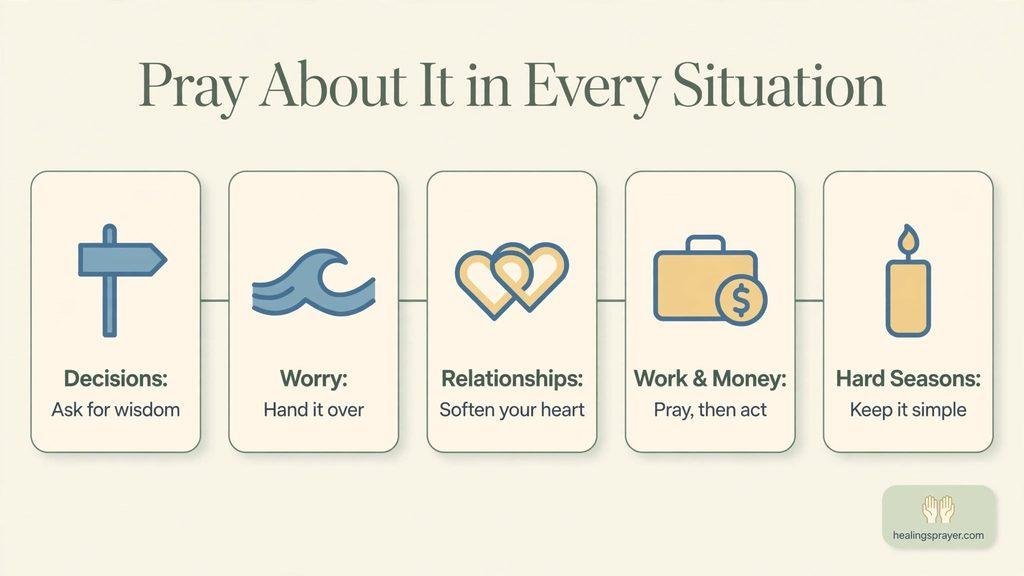
The same seven steps apply everywhere, but the focus changes with what you face. Below are five common situations, each with six sample prayers. Read them as starting points and change the words so they sound like you. These examples show how to pray about it in real life, not just in theory.
Pray About a Big Decision

When a choice will affect your future, slow down. Pray consistently over several days instead of once, and ask for wisdom before you ask for a specific answer. This is how to pray about a decision in a steady, practical way.
Sample prayers:
- “God, I need wisdom for this decision. Show me the path that fits Your plan, and help me see clearly.”
- “Lord, I want to choose well. Close the doors that are wrong and open the ones that are right.”
- “Father, quiet my fear of choosing wrong. Help me trust that You guide those who ask.”
- “God, give me patience to wait for clarity instead of rushing to an answer.”
- “Lord, whatever I decide, keep my heart humble and open to Your correction.”
- “Father, surround me with wise people and give me the courage to listen to them.”
A good routine is to pray about it each morning, write down any thoughts, and review your notes after a week.
Pray About Worry and Anxiety

Anxiety often repeats the same thought again and again. Prayer gives that thought somewhere to go. If you want to know how to pray about anxiety, name the worry specifically, hand it over, and thank God for something real before you stop.
Sample prayers:
- “God, I give You this worry. I can’t carry it anymore, and I trust You to hold it.”
- “Lord, replace my racing thoughts with Your peace, the kind I can’t explain.”
- “Father, I thank You for what You have already done. Remind me that You are still working.”
- “God, help me take today one step at a time and leave tomorrow in Your hands.”
- “Lord, guard my heart and mind as You promised. I need that peace right now.”
- “Father, calm my body and slow my breathing. Help me rest in knowing You are near.”
When you pray about it during an anxious moment, pair your prayer with slow breathing. Breathe in for four counts and out for six. The prayer steadies your heart while the breathing steadies your body.
Pray About a Relationship or Conflict
Before a hard conversation, pray about your own heart first. Ask for humility, patience, and the right words. Then pray for the other person with real goodwill, even if it feels difficult.
Sample prayers:
- “God, soften my heart toward this person. Help me listen before I respond.”
- “Lord, give me the right words and the right timing for this conversation.”
- “Father, show me my own part in this conflict and give me courage to own it.”
- “God, help me forgive, even if I don’t feel ready yet. Work in me where I am stuck.”
- “Lord, bring peace and healing between us in the way only You can.”
- “Father, protect this relationship from pride, and help us both speak with kindness.”
If you pray about it before a tough talk, you often enter the conversation calmer and more willing to listen.
Pray About Work and Money
Job stress and money worries are two of the most common reasons people turn to prayer. Ask for wisdom, honesty, and contentment, and pair your prayers with practical steps such as budgeting, learning a skill, or applying for roles.
Sample prayers:
- “God, I ask for direction in my work. Show me where to use my skills well.”
- “Lord, provide what I need, and teach me to be wise with what I already have.”
- “Father, help me work with honesty and care, even when no one is watching.”
- “God, ease my fear about money. Help me plan carefully and trust You at the same time.”
- “Lord, give me contentment today, and open the right opportunities in Your timing.”
- “Father, bless the work of my hands and keep me from comparing myself to others.”
Use a simple rule here: pray about it, then act. If you prayed about a job, update your resume. If you prayed about debt, write a budget.
Pray About Health, Grief, and Hard Seasons
In painful seasons, words may run out. That is fine. A short sentence like “God, help me” is a complete prayer. Be gentle with yourself, and lean on trusted people as well. These short prayers for hard days can help when you are not sure what to say.
Sample prayers:
- “God, I am tired and hurting. Please be near to me today.”
- “Lord, bring healing in body, mind, and heart, in the way You see best.”
- “Father, I don’t have the words. Hear what my heart is trying to say.”
- “God, comfort those who are grieving, including me. Remind me I am not alone.”
- “Lord, give me strength for the next hour. That is all I can ask right now.”
- “Father, help me rest, and send people who can walk beside me.”
Even a single line counts when you pray about it during grief. You don’t have to explain yourself or feel strong.
What to Do After You Pray About It

Many people stop at “amen” and then wonder what comes next. Prayer is the beginning of the process, not the end of it. Here is how to move forward after you pray about it.
Take the Next Wise Step
Do what you can with what you know. If you prayed about a job, update your resume. If you prayed about a conflict, schedule the conversation.
Faith and action work together. God often guides people as they move, not while they stand still. A good habit is to pray about it, then write down one small action for the day.
Watch for Peace, Not Just Signs
People often look for dramatic signs. A steadier indicator is deep, lasting peace about a direction, especially after you have prayed over time.
Peace doesn’t mean zero fear. It means a settled sense underneath the nervousness that says, “This is right.” After you pray about it, notice which option brings steady calm and which brings constant unease.
Check Your Answer With Scripture and Counsel
Test what you sense against three things:
- Scripture. Does your direction agree with the teachings of the Bible?
- Wise counsel. Do mature, trusted people see it the same way?
- Circumstances. Are doors opening or closing in a consistent way?
When all three line up, you can move forward with more confidence. When they conflict, pause and pray about it again.
What If You Don’t Get an Answer?
Silence can feel discouraging. If you have prayed and nothing seems to happen, you are not alone. Many believers describe long seasons of waiting.
Here is what to do:
- Remember that “wait” and “no” are also answers. An unanswered request is not always an ignored one.
- Keep praying. Scripture encourages persistence, and many believers pray about it for weeks or months.
- Check your heart. Are you open to whatever answer God gives, or only the one you want?
- Review your journal. Past entries often show answers you didn’t notice at the time.
- Talk to someone. A pastor or trusted believer can pray with you and offer perspective.
- Take care of the basics. Sleep, food, and rest affect how clearly you think and feel.
Feeling unheard does not mean you are not heard. Often clarity comes later, when you look back. Keep choosing to pray about it, even when the answer is slow.
Also Read : Faith Over Fear: Quotes, Verses & Ways to Find Peace
How to Recognize God’s Guidance After You Pray About It
A common question is, “How do I know when God is guiding me?” There is no single method, but several signs tend to appear together.
- A steady inner peace. It stays with you over days, not just a passing mood.
- A verse or thought that keeps returning. It fits your situation and matches Scripture.
- Consistent advice from wise people. Several trusted voices point the same way.
- Open doors that need little forcing. The way forward feels clear, even if it is challenging.
- Growing humility and love. Guidance from God tends to make you kinder, not more anxious or prideful.
Be careful with dramatic expectations. Most people don’t hear an audible voice. They notice a deepening conviction over time. If you pray about it daily and stay open, patterns usually become clear.
Common Mistakes When You Pray About It
Even sincere people fall into habits that make prayer feel empty. Avoid these mistakes:
1. Waiting for perfect words. God is not grading your vocabulary. Plain, honest speech is enough.
2. Praying once and never again. Big decisions often need steady prayer over days or weeks. Return and pray about it consistently.
3. Only asking, never thanking. A prayer made only of requests can feel like a shopping list. Add gratitude.
4. Expecting a specific answer. If you have already decided what God must say, you are not really asking for guidance.
5. Skipping action. Prayer without any practical step can become avoidance. Pray, then act wisely.
6. Praying only in a crisis. Daily prayer builds trust, so crisis prayer feels more natural.
7. Comparing your prayer life to others. Your pace and style are your own.
8. Ignoring Scripture and counsel. Feelings alone can mislead. Test your sense of direction.
9. Giving up after silence. Delay is not denial. Stay patient.
10. Treating prayer as a replacement for professional help. Prayer and medical or counseling support can work together.
Fixing even two or three of these will change how you pray about it.
How to Make Your Prayer Habit Personal and Consistent
A habit grows when it fits your real life. Use these practical ideas to make it easier to pray about it every day.
- Anchor it to an existing routine. Pray right after brushing your teeth, making coffee, or turning off the lights.
- Start small. Two minutes daily beats thirty minutes once a month.
- Use a short template. Thanks, honesty, request, trust. That is enough.
- Keep a visible reminder. Place your journal or Bible where you will see it.
- Try different styles. Some people pray aloud, some write, some walk, and some sing.
- Use a prayer list. Write names and needs so you don’t forget them.
- Set a weekly review. Once a week, read your journal and note any changes.
- Pray with someone. A friend, spouse, or small group adds accountability and warmth.
Personalizing also means using your own words. The sample prayers in this guide are a starting point. As you grow comfortable, you will pray about it in a voice that is unmistakably yours.
A simple weekly plan:
| Day | Focus | Short Prayer Idea |
|---|---|---|
| Monday | Direction for the week | “Lord, guide my steps today.” |
| Tuesday | Gratitude | “Father, thank You for what I have.” |
| Wednesday | Relationships | “God, help me love well.” |
| Thursday | Work and provision | “Lord, give me wisdom in my work.” |
| Friday | Peace and rest | “Father, calm my mind.” |
| Saturday | Others in need | “God, help the people I care about.” |
| Sunday | Reflection | “Lord, show me what I learned this week.” |
When Prayer Needs Extra Support
Prayer is powerful, but it is not meant to be your only support. If anxiety, sadness, or grief stays heavy for weeks, or if it affects your sleep, appetite, or daily life, please speak with a doctor or licensed counselor as well.
Seeking help is not a lack of faith. Many believers find that prayer and professional care work well together. If you ever feel unsafe or think about harming yourself, contact local emergency services or a crisis line right away. You can still pray about it, and you deserve real-world help at the same time.
Comparison Table: Pray About It in Different Situations
| Situation | Main Focus When You Pray About It | Best First Step | Example Line |
|---|---|---|---|
| Big decision | Wisdom and clarity | Pray daily for several days | “God, show me the right path.” |
| Worry and anxiety | Peace and trust | Name the worry, then hand it over | “I give You this worry today.” |
| Relationship or conflict | Humility and forgiveness | Pray for your own heart first | “Soften my heart toward them.” |
| Work and money | Provision and contentment | Pair prayer with one practical step | “Give me wisdom with what I have.” |
| Health and grief | Comfort and strength | Use short, honest prayers | “God, be near me today.” |
Frequently Asked Questions
What does it mean to pray about it?
It means taking a situation, decision, or worry to God, asking for His guidance and help, and trusting Him with the result. You don’t need special words. Honest, simple speech is enough.
How do I pray about something?
Find a quiet place, be honest with God, give thanks, ask clearly, hand over the outcome, listen, and write it down. These seven steps work for almost any situation.
How do I pray about a decision?
Pray consistently over several days, ask for wisdom, read Scripture, and seek wise counsel. Then watch for steady peace and take a thoughtful next step.
How long should I pray about it before deciding?
There is no fixed time. Pray until you have clarity or settled peace, while gathering advice and facts. If a deadline exists, pray daily until then and decide with what you know.
Does God answer every prayer?
Believers hold that God hears every prayer, though answers may be yes, no, or wait. Answers don’t always arrive in the form or timing we expect.
Why do we need to pray if God already knows everything?
Prayer is about relationship, not information. It aligns your heart with God’s, brings peace, and builds trust.
Is it okay to pray about small things?
Yes. Philippians 4:6-7 encourages bringing everything to God. Nothing is too small to matter to Him.
What if I can’t feel anything when I pray?
Feelings come and go. Prayer is built on faith, not emotion. Keep showing up, and trust that God hears you.
Can I pray about it in my own words?
Yes. Your own words are often the most sincere. Sample prayers are only a starting point.
What is the best time to pray about it?
The best time is one you can keep consistently. Many people choose early morning or before bed, but any quiet moment works.
Can prayer help with anxiety?
Many people find that prayer brings calm, especially when combined with slow breathing and gratitude. If anxiety is severe or lasting, seek professional support as well.
Final Thoughts: Pray About It and Keep Moving Forward
To pray about it is simply to invite God into your situation. It turns worry into trust, confusion into wisdom, and fear into peace. You don’t need perfect words or perfect faith, only a willing heart.
Start small today. Choose one worry or decision, use the seven steps, borrow one of the sample prayers, and write down what you notice. When you pray about it regularly, you build a steady habit that supports you in every season.
The next time you feel stressed, uncertain, or overwhelmed, pause and talk to God first. Worry about nothing, pray about everything, and let His peace guard your heart.

Welcome to Healings Prayer!
Healings Prayer is a faith-based platform created to offer comfort, hope, and encouragement through prayer and Scripture. Our mission is to help people find peace in difficult moments and draw closer to God through heartfelt prayers and Bible verses.
1 thought on “Pray About It: What It Really Means and How to Do It (With 30 Sample Prayers)”