
Giving works best when you understand it, and tithes and offering are easier to understand than most people expect.
Few topics in church life raise as many questions as money. Readers want to know what tithes and offering mean, how the two differ, what the Bible says, and how much they should give.
This guide answers each question in plain language. You will find clear definitions, a fair look at the Old and New Testaments, 16 Bible verses with explanations, short offering messages, prayers, and a practical giving plan. All verses are from the King James Version (KJV).
What Are Tithes and Offering?
Tithes and offering are two forms of giving in the Christian faith: a tithe is a set portion of income, traditionally one tenth, given to God through the church, while an offering is any gift given freely beyond the tithe. The word “tithe” literally means “tenth.”
Tithes and offering work together. The tithe gives a steady, planned base for the work of the church. The offering gives room for generosity that goes beyond a fixed percentage.
When people search for tithes and offering, they usually want one of three things:
- A clear definition of each term
- Bible verses with a simple explanation
- Guidance on how to give wisely and with the right attitude
This article covers all three. If you only need a quick answer, the table near the end summarizes the main points, and the FAQ answers the most common questions in one or two sentences.
Why Tithes and Offering Matter in the Christian Life
Giving is more than church finance. In Scripture, tithes and offering are tied to worship, trust, and care for other people. Here is why they matter.
1. They are an act of worship. Psalm 96:8 invites people to bring an offering and come into God’s courts. Giving is one way of saying that God, not money, has first place in your life.
2. They build trust. Setting aside a portion before you spend the rest is a practical way of relying on God for your needs. It shifts your focus from “what is left” to “what comes first.”
3. They support the church’s mission. Pastors, buildings, outreach, youth programs, and mission work all depend on the tithes and offering of members. A church that is well supported can serve its community more fully.
4. They care for the poor. Both the Old and New Testaments connect giving with help for widows, orphans, and people in need. A good share of church offerings goes to benevolence and local aid.
5. They shape the heart. Jesus said that where your treasure is, there your heart will be also (Matthew 6:21). Regular giving trains your heart toward generosity and loosens the hold of greed.
6. They create order and accountability. When members give in a planned way, churches can budget responsibly and report openly. Healthy churches share how funds are used.
Giving tithes and offering is not a way to buy God’s favor. Scripture teaches that God’s love is a gift, not a purchase. The purpose of tithes and offering is to respond to what God has already done, with a willing heart.
Tithe vs Offering: The Difference Explained
Searches for “tithe vs offering” and “difference between tithe and offering” are among the most common on this topic. The difference is simple once you see the two side by side.
What a Tithe Is
A tithe is a fixed, regular portion of your income, traditionally ten percent. In the Old Testament it was commanded as part of Israel’s law. Many churches today teach it as the standard starting point for giving.
Your tithes and offering are usually given to your local church, often called the “storehouse” based on Malachi 3:10.
What an Offering Is
An offering is a freely chosen gift above and beyond the tithe. It has no set amount. You decide what to give based on your heart and your ability.
Offerings can be given for many purposes: a special project, missions, a building fund, a family in need, or simply as thanks to God.
Where the Two Overlap
Both parts of tithes and offering are gifts to God. Both should be given with a willing and thankful attitude. In practice, people often give their tithes and offering together, using the same envelope, website, or service.
The key difference is this: a tithe is a measured amount, while an offering is a free-will amount. A tithe asks “how much is the first portion?” An offering asks “how much more can I give with joy?”
Is Tithing Required? The Old Testament and the New Testament
Christians do not all agree on whether tithing is required today. A fair article should explain the main positions. Here is what Scripture says, and then how believers differ.
What the Old Testament Teaches
The tithe appears early. Abraham gave a tenth to the priest Melchizedek (Genesis 14:20), and Jacob promised a tenth to God (Genesis 28:22). Both happened before the Law of Moses.
Under the Law, the tithe became an instruction for Israel. Leviticus 27:30 calls the tithe holy to the LORD, and Numbers 18 explains that it supported the Levites who served in the tabernacle. Deuteronomy 14 adds a tithe connected with festivals and care for the poor.
What Jesus Said
Jesus did not cancel the tithe. In Matthew 23:23, He told the religious leaders they were right to tithe, but wrong to ignore justice, mercy, and faith. His point was that tithes and offering should never replace a faithful heart.
What the Apostles Taught
The New Testament letters focus on generous, willing, regular giving rather than a fixed percentage. Paul told the Corinthian church to set aside gifts weekly, “as God hath prospered him” (1 Corinthians 16:2). He also wrote that each person should give as he has decided in his heart, “not grudgingly, or of necessity” (2 Corinthians 9:7).
How Christians Differ
Believers hold three main views:
- The tithe is still the standard. Ten percent remains the baseline for giving, and offerings go above it.
- The tithe is a starting point. Ten percent is a helpful guide, but New Testament giving is meant to be generous and Spirit-led.
- The tithe belonged to Israel’s law. Christians are not bound to a percentage, but are called to give freely and sacrificially.
All three agree on one thing: giving should be regular, generous, and willing. If you are unsure where you stand, speak with your pastor and study the passages above for yourself. The honest answer is that thoughtful Christians have reached different conclusions.
Also Read : 50+ Powerful Christmas Bible Verses About Jesus’ Birth, Peace, and Hope
Tithes and Offering in the Early Church and Today
The first Christians gave in ways that went beyond a percentage. Acts 2:44-45 says believers shared what they had, and Acts 4:34-35 describes goods being sold and distributed to anyone in need. Giving was tied directly to care for people.
Later, Paul organized a collection for the struggling church in Jerusalem. In 2 Corinthians 8 and 9 he explains how the churches in Macedonia gave out of their poverty with great joy. Their example shows that tithes and offering are about willingness, not wealth.
What this means for you today:
- Giving is communal. Your tithes and offering join with others to do what one person cannot.
- Giving is practical. Church funds pay for ministry, buildings, and aid, so regular gifts have real effects.
- Giving is flexible. Early Christians gave in response to need, which is why many churches ask for special offerings alongside the regular tithe.
- Giving is joyful. The Macedonian churches begged for the chance to give. That attitude is the goal.
Modern tithes and offering often move through online platforms, direct deposits, and envelopes. The method has changed, but the principle has not: give regularly, give willingly, and give with an understanding of what the gift supports.
8 Bible Verses About Tithes and Offering: The Tithe
These eight passages are the main Bible verses on the tithe. Each comes with a short explanation, so you can see how the verse relates to tithes and offering today.
Genesis 14:20: The First Tithe
“And blessed be the most high God, which hath delivered thine enemies into thy hand. And he gave him tithes of all.”
This is the first mention of a tithe in the Bible. Abraham gave a tenth to Melchizedek after a victory. The giving came from gratitude, before any law required it.
How to apply: Give a portion when God answers a prayer, as a way of saying thank you.
Genesis 28:22: A Promise to Give a Tenth
“And this stone, which I have set for a pillar, shall be God’s house: and of all that thou shalt give me I will surely give the tenth unto thee.”
Jacob made this promise after meeting God at Bethel. It shows a person choosing to give a tenth as a response to God’s presence and care.
How to apply: Decide your giving plan in advance, so it is a commitment and not a mood.
Leviticus 27:30: The Tithe Is Holy
“And all the tithe of the land, whether of the seed of the land, or of the fruit of the tree, is the LORD’S: it is holy unto the LORD.”
This verse sets the tithe apart as holy. In Israel’s farming economy, the tithe came from crops and fruit. It reminded people that everything they harvested came from God.
How to apply: Treat the first portion of income as set apart, not as an extra left over.
Numbers 18:21: Supporting the Ministry
“And, behold, I have given the children of Levi all the tenth in Israel for an inheritance, for their service which they serve, even the service of the tabernacle of the congregation.”
The Levites had no land of their own, so the tithe supported them while they served in worship. This is the root of the idea that tithes and offering support those who serve the church.
How to apply: Learn how your church uses its funds, so you give with understanding.
Deuteronomy 14:22: Tithe the Increase
“Thou shalt truly tithe all the increase of thy seed, that the field bringeth forth year by year.”
The word “truly” signals sincerity. The tithe was to be given every year, from what the field produced. Regular giving, not occasional giving, is the pattern for tithes and offering.
How to apply: Give on a schedule, such as every payday, so it becomes a habit.
Proverbs 3:9: Honour God With the First
“Honour the LORD with thy substance, and with the firstfruits of all thine increase.”
“Firstfruits” means the first and best, not the leftovers. This verse links giving with honor. The order matters: God is honored first, and then the rest is used.
How to apply: Give your tithes and offering at the start of the month, before other spending.
Malachi 3:10: The Storehouse
“Bring ye all the tithes into the storehouse, that there may be meat in mine house, and prove me now herewith, saith the LORD of hosts, if I will not open you the windows of heaven, and pour you out a blessing, that there shall not be room enough to receive it.”
This is the most quoted verse about the tithe. The “storehouse” was the temple storeroom, and many churches apply it to the local church today. The promise of blessing is real, but it is not a formula for wealth. God’s blessing takes many forms, and giving should never be treated as a purchase.
How to apply: Give your tithes and offering out of trust, and avoid expecting a particular financial return.
Matthew 23:23: Do Not Neglect the Heart
“Woe unto you, scribes and Pharisees, hypocrites! for ye pay tithe of mint and anise and cummin, and have omitted the weightier matters of the law, judgment, mercy, and faith: these ought ye to have done, and not to leave the other undone.”
Jesus affirms tithing but warns against giving without justice, mercy, and faith. Tithes and offering are meant to go hand in hand with a life of love toward others.
How to apply: Pair your giving with practical kindness, such as helping a neighbor or serving at church.
8 Offering Verses and Scriptures on Giving
Offering verses focus on the heart behind the gift. These eight scriptures show what a willing, joyful offering looks like.
Exodus 25:2: A Willing Heart
“Speak unto the children of Israel, that they bring me an offering: of every man that giveth it willingly with his heart ye shall take my offering.”
God asked only for gifts that were given willingly. Pressure and guilt were never the goal. This sets the tone for all tithes and offering after it.
How to apply: Give only when you can do it with a willing heart, and adjust your plan so that is possible.
1 Chronicles 29:14: Everything Comes From God
“But who am I, and what is my people, that we should be able to offer so willingly after this sort? for all things come of thee, and of thine own have we given thee.”
David said this after the people gave generously for the temple. His humility is the key: we give back only what God first gave us.
How to apply: Before you give, say, “All of this is Yours, Lord.”
Psalm 96:8: Bring an Offering and Come
“Give unto the LORD the glory due unto his name: bring an offering, and come into his courts.”
An offering is linked here with worship. It is part of coming to God, not a separate transaction.
How to apply: Think of the offering as part of the service, not an interruption.
Proverbs 19:17: Giving to the Poor
“He that hath pity upon the poor lendeth unto the LORD; and that which he hath given will he pay him again.”
Caring for the poor is treated as a gift to God Himself. A good offering often reaches beyond the church walls.
How to apply: Set aside part of your offering for people in need nearby.
Mark 12:43-44: The Widow’s Gift
“And he called unto him his disciples, and saith unto them, Verily I say unto you, That this poor widow hath cast more in, than all they which have cast into the treasury: For all they did cast in of their abundance; but she of her want did cast in all that she had, even all her living.”
Jesus measured her gift by sacrifice and sincerity, not by size. It shows that a small offering given with a full heart matters to God.
How to apply: Never feel embarrassed by a small gift. Give what you can with sincerity.
Acts 20:35: More Blessed to Give
“I have shewed you all things, how that so labouring ye ought to support the weak, and to remember the words of the Lord Jesus, how he said, It is more blessed to give than to receive.”
Paul quotes a saying of Jesus that does not appear in the Gospels. It reminds believers that giving brings its own joy and benefit.
How to apply: Look for one small way to give this week, beyond your regular church giving.
2 Corinthians 9:7: A Cheerful Giver
“Every man according as he purposeth in his heart, so let him give; not grudgingly, or of necessity: for God loveth a cheerful giver.”
This is one of the clearest offering verses in the New Testament. It teaches planning (“purposeth in his heart”), freedom (not “of necessity”), and joy.
How to apply: Decide your amount ahead of time, so you can give calmly and gladly.
2 Corinthians 8:12: According to What You Have
“For if there be first a willing mind, it is accepted according to that a man hath, and not according to that he hath not.”
God does not expect you to give what you do not have. A willing mind comes first, and the gift is measured by your actual means.
How to apply: Make a realistic plan, and avoid giving in a way that puts you in debt.
Also Read : 40+ Powerful Prayers for Nightmares with Bible Verses for Peaceful Sleep
8 Short Offering Messages for Church Giving
Searches for “short offering message” and “giving talks” show that pastors, ushers, and worship leaders often need brief words to introduce the offering. These eight messages are written in our own words and take under thirty seconds to read.
- Gratitude: “Everything we have is a gift from God. Let us give back with thankful hearts.”
- Willing heart: “God asks for a willing heart, not a perfect amount. Give as you have decided in your heart.”
- First place: “We honor God by giving Him the first part of what we receive. Let our tithes and offering be an act of worship.”
- Trust: “Giving is how we show that we trust God to provide. Let us give in faith.”
- Mission: “Your gift today helps feed the hungry, teach the young, and share good news. Thank you for giving.”
- Joy: “God loves a cheerful giver. Give with joy and without pressure.”
- Community: “We give together, and together we do what no one could do alone.”
- Humility: “We cannot out-give God, and we do not need to. We simply respond to what He has done.”
Tips for delivering offering messages:
- Keep the message short and calm.
- Avoid guilt, pressure, or promises of wealth.
- Use a Bible verse in the message when you can.
- Thank the congregation after the offering is received.
8 Prayers to Say Over Your Tithes and Offering
A short prayer before you give turns a routine act into worship. These eight prayers are written in our own words, and each fits a different moment.
- Before giving: “Lord, all that I have is from You. Accept this gift as an act of thanks. Amen.”
- For a grateful heart: “Father, thank You for providing what I need. Let my giving come from joy and not duty. Amen.”
- For wisdom: “God, help me give wisely and plan well. Teach me to use what You have given with care. Amen.”
- For trust: “Lord, when I am afraid of lack, remind me that You provide. I trust You with my finances. Amen.”
- For the church: “Father, bless the church that receives this gift. Let it be used for Your glory and for the good of people. Amen.”
- For a small gift: “God, I give little, but I give sincerely. Please accept this as You accepted the widow’s gift. Amen.”
- For the needy: “Lord, let this offering reach someone who needs it. Open my eyes to the needs around me. Amen.”
- After giving: “Thank You, Father, for the privilege of giving. Help me live generously every day. Amen.”
Pray one of these before you place your tithes and offering, or write it on the envelope. A short prayer helps you give with intention and keeps the act from becoming mechanical.
Tithes and Offering for Beginners
If you are new to church or new to giving, the topic of tithes and offering can feel intimidating. You do not need to understand every detail before you start. These five steps keep it simple.
- Start with a small, regular gift. A modest amount given faithfully is better than a large amount given once.
- Learn the two terms. Remember that the tithe is a planned portion and the offering is a freewill extra.
- Read two verses. Begin with Proverbs 3:9 and 2 Corinthians 9:7. Together they cover first place and cheerful giving.
- Ask your church. Most churches explain how their tithes and offering are used and how to give. Do not be afraid to ask.
- Grow slowly. Increase your giving as your understanding and income grow, without pressure.
There is no shame in beginning small. The widow in Mark 12 gave two small coins and received praise. What matters most about tithes and offering is the willingness behind them.
How to Give Tithes and Offering: A Practical Guide
Knowing what the Bible says is the first step. The second step is building a plan that works in real life. The guide below turns tithes and offering into a simple routine.
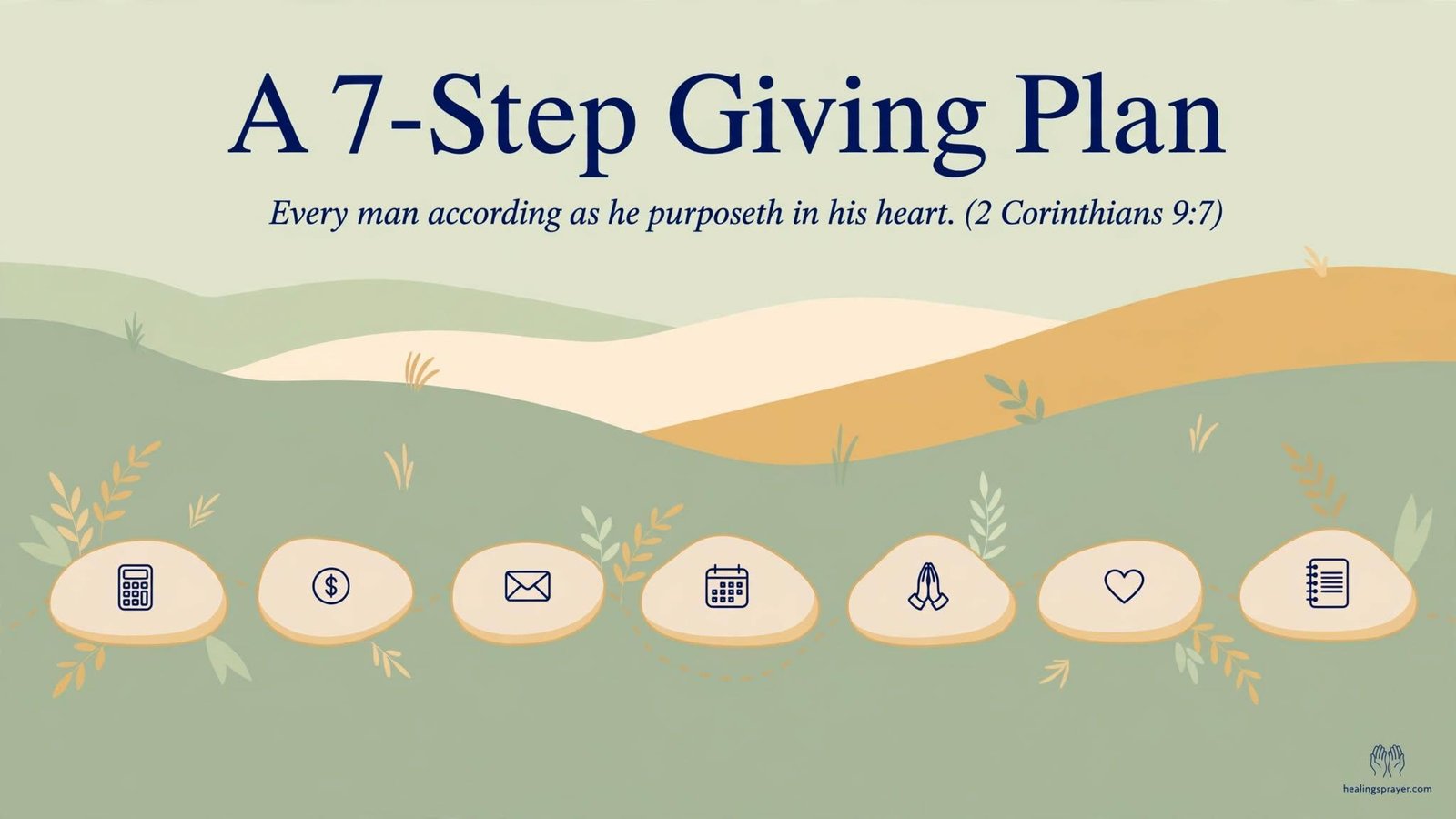
A 7-Step Giving Plan
- Decide your starting amount. Many people begin with ten percent of income for the tithe. Others begin lower and increase over time. Choose a number you can sustain.
- Calculate it from your income. If you earn 2,000 a month, ten percent is 200. Decide whether you base it on gross or net income, and stay consistent.
- Give first. Set the gift aside as soon as you are paid, before bills and spending.
- Set up a routine. Use an envelope, a bank transfer, or your church’s online giving. Automatic giving removes the need to decide every time.
- Add an offering. Choose an extra amount for missions, special projects, or people in need, even if it is small.
- Pray before you give. Use one of the prayers above to keep your heart in the right place.
- Review every few months. Adjust your plan when your income, expenses, or season of life change.
How Much to Give
There is no single answer that every Christian agrees on. Here is a fair framework:
- If you hold the view that ten percent is the standard, give the tithe first, then add an offering.
- If you see ten percent as a starting point, begin there and grow as you are able.
- If you are in financial hardship, give what you honestly can, in line with 2 Corinthians 8:12, and talk to your pastor if you need guidance or help.
If you carry debt, ask your pastor or a trusted financial counselor how to balance giving with your obligations. Giving tithes and offering should be generous, but it should not push your household into crisis. This article is not financial advice, so please consult a qualified professional for your personal situation.
Ways to Give Besides Money
Tithes and offering are most often money, but Scripture also honors other gifts:
- Time: serving in children’s ministry, setup, or hospitality.
- Skills: using your abilities in music, design, building, or teaching.
- Food and goods: supporting a church pantry or clothing drive.
- Encouragement: visiting the sick and lonely.
These gifts do not replace financial giving where it is possible, but they add real value to your church and community.
How Churches Should Handle Tithes and Offering
Giving is an act of trust, so the church receiving it carries a responsibility. Givers can reasonably expect clear and honest handling of tithes and offering. Here is what a healthy church usually does.
- Shares a budget or report. Members should be able to see, in general terms, where gifts go.
- Uses more than one person to count. Two or more people counting and recording offerings protects everyone.
- Provides receipts. Many churches give year-end statements for tax purposes.
- Separates funds clearly. General funds, missions, and special projects are tracked separately.
- Welcomes questions. Leaders who are open to questions build trust.
Paul modeled this standard. In 2 Corinthians 8:20-21 he explained that he handled the collection carefully, “providing for honest things, not only in the sight of the Lord, but also in the sight of men.” Honest handling of tithes and offering has been part of Christian life from the beginning.
If you have concerns about how a church uses its funds, begin with a respectful conversation with a pastor or treasurer. Giving should come from confidence, not doubt.
Common Mistakes With Tithes and Offering
Even sincere givers can fall into habits that weaken the purpose of giving. Here are eight common mistakes and how to avoid them.
1. Giving out of guilt or pressure. Scripture asks for a willing, cheerful gift. If you feel only pressure, step back and pray before you give.
2. Treating giving as a way to buy blessings. Tithes and offering are a response to God, not a transaction. Avoid any teaching that promises guaranteed wealth in return for a gift.
3. Giving only what is left over. Proverbs 3:9 speaks of firstfruits. Plan your gift first, then budget the rest.
4. Ignoring your own budget. Generous giving is good, but giving beyond your means can harm your household. Build a realistic plan.
5. Not knowing how the church uses funds. A healthy church is open about its finances. Ask for a report or attend a members’ meeting.
6. Giving without prayer. A gift given mechanically loses its meaning. A short prayer takes seconds and changes the attitude.
7. Comparing your gift to someone else’s. The widow’s two small coins show that God looks at the heart. Give what you can without comparing.
8. Using giving to replace mercy. Matthew 23:23 warns against paying tithes while ignoring justice and mercy. Let your giving go hand in hand with kindness.
Tithes and Offering at a Glance (Comparison Table)
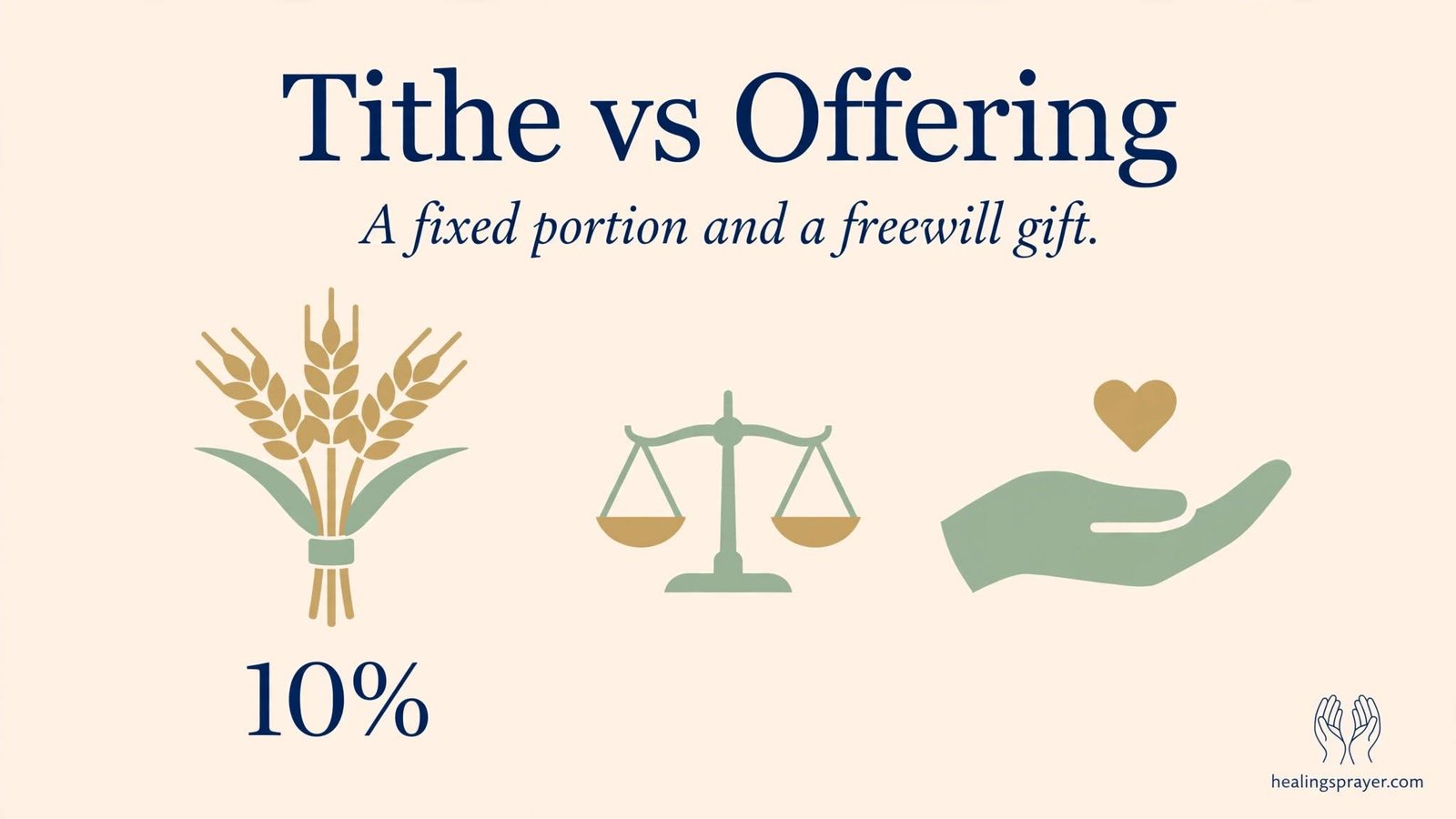
This table compares tithes and offering side by side, with one example for each row.
| Feature | Tithe | Offering | Example |
|---|---|---|---|
| Meaning | A set portion, traditionally one tenth | A freewill gift above the tithe | Tithe: 10% of pay. Offering: an extra gift for missions |
| Amount | Fixed percentage | Chosen by the giver | Tithe: 200 from 2,000. Offering: any amount you decide |
| Frequency | Regular, such as every payday | Occasional or regular | Tithe: monthly. Offering: during a special appeal |
| Key verse | Malachi 3:10 | 2 Corinthians 9:7 | Read the verse before giving |
| Purpose | Support the church and its ministry | Extra needs, projects, and the poor | Tithe for the budget. Offering for a food drive |
| Attitude | Faithful and trusting | Cheerful and willing | Pray before you give |
| Where given | Local church, often the “storehouse” | Church, missions, or people in need | Place in the offering plate or give online |
Key Takeaways on Tithes and Offering
If you remember only a few points from this guide, make them these eight. They summarize what the Bible and church practice teach about tithes and offering.
- A tithe is a tenth. It is a planned, regular portion given to God through the church.
- An offering is freewill. It is any gift above the tithe, chosen with a willing heart.
- The heart matters most. Jesus and Paul both stress attitude: mercy, faith, and cheerfulness.
- Christians differ on the requirement. Faithful believers hold different views, so study the verses and speak with your pastor.
- Plan ahead. Deciding your gift in advance, as 2 Corinthians 9:7 suggests, makes giving calm and consistent.
- Give first. Proverbs 3:9 points to firstfruits, so set your tithes and offering aside before other spending.
- Stay realistic. God accepts a gift according to what you have, so build a plan that fits your budget.
- Pray and stay accountable. Pray before you give, and choose a church that handles tithes and offering with openness.
Frequently Asked Questions
What are tithes and offering?
Tithes and offering are the two main ways Christians give: the tithe is a set portion of income, traditionally ten percent, and the offering is a freewill gift above it. Both are given to God, usually through the local church.
What is the difference between a tithe and an offering?
A tithe is a fixed amount, usually ten percent, while an offering is any extra amount you choose to give freely. The tithe is measured, and the offering is generous and voluntary.
What does Malachi 3:10 say about tithes and offering?
Malachi 3:10 tells God’s people to bring all the tithes into the storehouse and promises that God will pour out a blessing. Many Christians apply the “storehouse” to the local church, and the blessing is understood as God’s care, not a guaranteed financial return.
Is tithing required for Christians today?
Christians differ on this question. Some believe the tithe remains the standard, others see it as a helpful starting point, and others teach that the New Testament calls for free and generous giving instead of a fixed percentage.
How much should I give in tithes and offering?
Many Christians begin with ten percent of income for the tithe and add an offering as they are able. If money is tight, 2 Corinthians 8:12 teaches that God accepts a willing gift according to what you actually have.
Should I tithe on gross or net income?
There is no single rule, so choose one method and stay consistent. Some give on gross income as an act of first-fruits, while others give on net income for practical reasons. Your pastor can advise you.
What are good Bible verses about tithes and offering?
Malachi 3:10, Proverbs 3:9, and 2 Corinthians 9:7 are among the most widely used. The sections above list eight verses on the tithe and eight on the offering, each with an explanation.
Can I give tithes and offering online?
Yes, most churches now accept online giving. It is a convenient way to give regularly, and it helps you stay consistent. Confirm that you are using your church’s official giving page.
Are there Bible verses about tithes and offering in Tagalog?
Yes, the verses in this article can be read in Tagalog Bibles such as Ang Dating Biblia and the Magandang Balita Biblia. Look up the same references, such as Malachi 3:10 or 2 Corinthians 9:7, in the Tagalog translation you prefer.
Does giving tithes and offering guarantee blessings?
No, the Bible does not teach that giving guarantees wealth. God does promise to care for those who trust Him, but giving is a response to His love, not a way to purchase a result.
Final Thoughts on Tithes and Offering
Tithes and offering are more than a church routine. They are a way of saying that God comes first, that everything we have is a gift, and that we want to care for the people and the work He loves.
Start where you are. Learn what the Bible says, choose a giving plan you can keep, pray before you give, and watch your attitude. Whether you hold that the tithe is a firm standard or a helpful starting point, the heart of tithes and offering stays the same: a willing, cheerful, and trusting response to God.
Take one step this week. Read one of the verses above, pray one of the prayers, and make a plan for your next gift. Giving that comes from understanding and joy is the kind that lasts.

Welcome to Healings Prayer!
Healings Prayer is a faith-based platform created to offer comfort, hope, and encouragement through prayer and Scripture. Our mission is to help people find peace in difficult moments and draw closer to God through heartfelt prayers and Bible verses.