

Four short lines, learned at bedtime, remembered for a lifetime.
The now I lay me down to sleep prayer is one of the most familiar children’s prayers in the English-speaking world. Many adults can still recite it from memory, even decades after they first heard it at the edge of a bed.
This guide gives you the full text, the meaning of every line, the history, a clear way to handle the “die before I wake” line, and 8 versions you can choose from. You will also find blessings, kids night prayers, and a simple routine for teaching it.
What Is the Now I Lay Me Down to Sleep Prayer?
The now I lay me down to sleep prayer is a short, traditional English bedtime prayer in which a person asks God to protect their soul through the night. It is usually taught to young children as their first prayer, and it has been said by families for roughly three centuries.
The prayer is written in four rhyming lines. The first two lines settle the person into bed and ask for God’s care. The last two lines face the unknown of the night and place the person’s life in God’s hands.
People search for the now i lay me down to sleep prayer for different reasons. Parents want a simple prayer for a child. Grandparents want the words they remember. Others want to understand why the prayer mentions death, or whether there is a gentler version.
Because the prayer is so short, it is easy to memorize. A child can learn it in a few nights, and that is a large part of why it has lasted so long.
Why the Now I Lay Me Down to Sleep Prayer Still Matters
Many bedtime habits fade as children grow, yet the now i lay me down to sleep prayer stays with people for life. There are clear reasons for that, and they are worth understanding before you decide how to use it.
1. It marks the end of the day. Children need a clear signal that activity is over. Saying the now i lay me down to sleep prayer at the same point each night gives the day a quiet ending, which helps a restless mind let go.
2. It builds a sense of safety. Night is when many children feel small. A prayer that asks for protection gives them words for that feeling and a calm answer to it.
3. It supports a steady routine. The American Academy of Pediatrics and the National Sleep Foundation both encourage consistent bedtime routines, because predictable steps help children fall asleep more easily. A short prayer is easy to keep in that routine.
4. It passes faith from one generation to the next. Few things are shared so directly as a prayer spoken at a bedside. Parents and grandparents often say the exact words they learned as children, which links the family across time.
5. It teaches trust. The central idea of the now i lay me down to sleep prayer is that we do not control everything, and that God can be trusted with what we cannot. Researchers who study religious coping, such as Kenneth Pargament, describe how prayer helps many people handle stress and uncertainty. A child who learns this early carries it into adulthood.
6. It is easy to remember when life is hard. Because it is short and rhymed, adults can recall it during illness, grief, or a sleepless night, even when other prayers feel out of reach.
None of this means the prayer must be used in only one way. It is a flexible tool for rest and trust, and the sections below show how to shape it for your home.
Now I Lay Me Down to Sleep Prayer: The Full Traditional Text
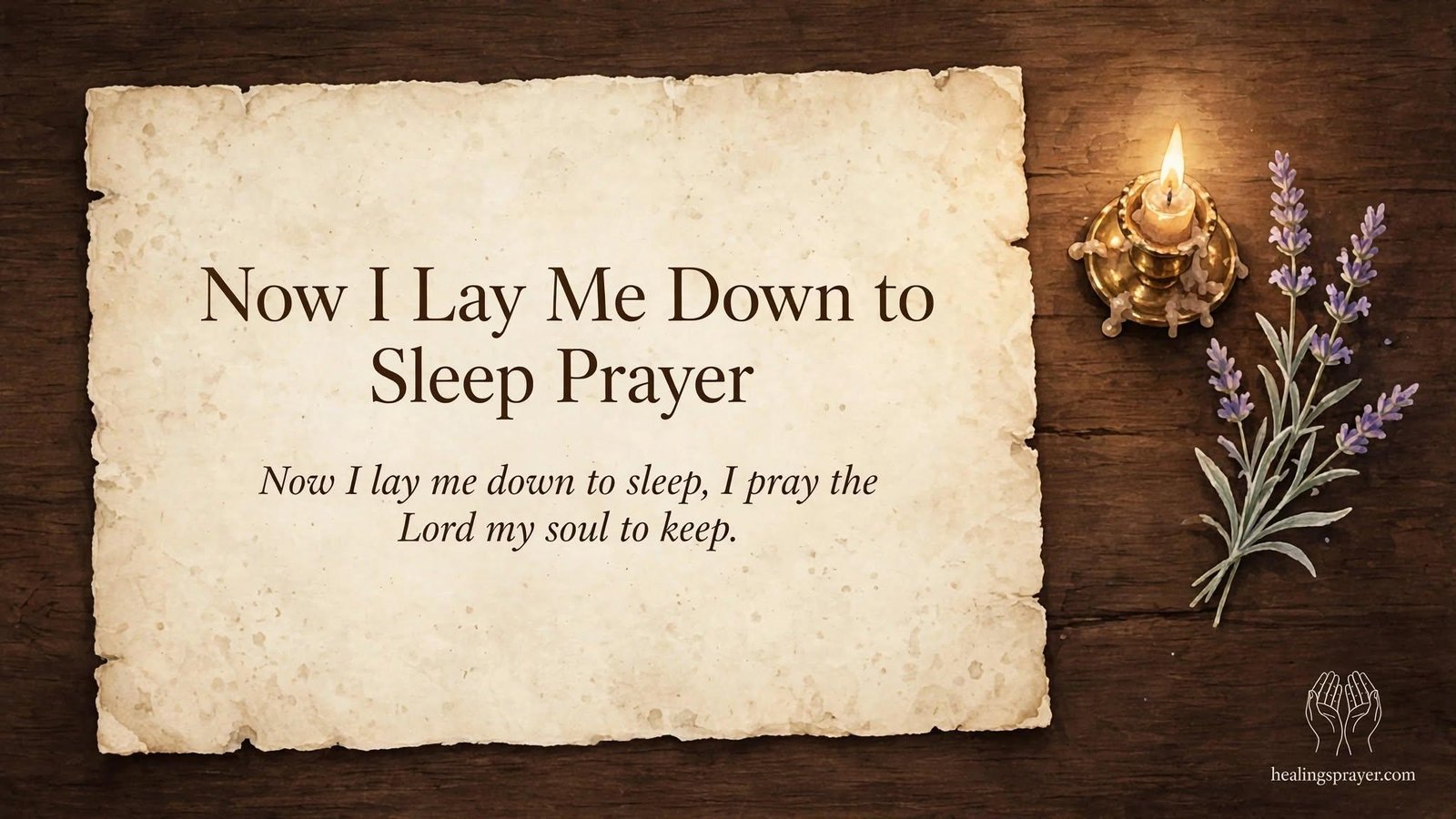
Here is the full traditional now i lay me down to sleep prayer in its best-known form:
Now I lay me down to sleep, I pray the Lord my soul to keep; If I should die before I wake, I pray the Lord my soul to take.
Some families add a closing line such as “Amen.” Others add a blessing for family members, which you will find later in this guide.
You may also see the opening written as “Now lay me down to sleep” or “Lay me down to sleep.” These shortened forms are very common in search and conversation, but the now i lay me down to sleep prayer is most often printed with the opening shown above.
Quick facts about the traditional text:
- Lines: 4
- Rhyme: sleep/keep and wake/take
- Meter: short, steady lines that suit a quiet voice
- Time to say it: about 10 seconds
- Best age to begin: around ages 2 to 3, when children start copying words
The rhythm is part of the reason the now i lay me down to sleep prayer works as a first prayer. Children enjoy rhyme, and rhyme makes memory easier.
Now I Lay Me Down to Sleep Prayer Meaning, Line by Line
Understanding the words helps you say the prayer with intention instead of by habit. Here is what each line of the now i lay me down to sleep prayer means.
Line 1: “Now I lay me down to sleep”
This line describes the simple act of going to bed. “Lay me down” is older English for “I lie down.” It sets a calm scene and tells the child that sleep is about to begin.
Takeaway: the prayer starts with a quiet action, which signals the body to slow down.
Line 2: “I pray the Lord my soul to keep”
To “keep” something means to guard it. The speaker asks God to protect their soul, meaning their whole self, while they cannot protect themselves.
This is the line that gives the i pray the lord my soul to keep prayer its popular name in search. Many people remember this second line first because it carries the heart of the request.
Takeaway: sleep is a time of vulnerability, and the prayer hands that care to God.
Line 3: “If I should die before I wake”
This line admits that no one is promised another morning. It is not a prediction. It is an honest acknowledgment of how fragile life is, spoken in a gentle rhythm.
Many parents pause at this line, and that is understandable. A full section below explains how to handle it for children.
Takeaway: the prayer faces the unknown without panic.
Line 4: “I pray the Lord my soul to take”
The final line trusts God with the worst outcome. If death were to come in the night, the speaker asks to be received by God.
For a believer, this line is an expression of trust, not fear. It says that whatever the night brings, the person belongs to God.
Takeaway: the prayer ends with surrender and peace, which is why many people find it settling.
Taken together, the four lines move from bedtime to protection to honesty to trust. That progression is what makes the now i lay me down to sleep prayer more than a nursery rhyme.
Origin and History of the Now I Lay Me Down to Sleep Prayer
The exact author of the now i lay me down to sleep prayer is unknown. It developed over time and appears in several early forms, which is common for oral prayers passed from parent to child.
Here is what historians and hymn scholars generally agree on:
- Early 1700s: Versions of a bedtime verse with similar wording appear in English printed material.
- The New England Primer: This widely used colonial schoolbook helped spread the prayer to children across America. It is commonly cited as an early printed home for the verse, with a well-known appearance in an edition from the 1700s.
- 19th century: The prayer became a standard part of Christian home life in both Britain and America.
- 20th century: It moved into songs, books, films, and greeting cards, which kept it in public memory.
Because the prayer was spoken far more than it was printed, small differences in wording appeared from region to region. This is why you will see variants today.
The now i lay me down to sleep prayer also reflects the way people thought about sleep and death at the time. In earlier centuries, childhood illness was common, and families were more openly aware of how quickly life could change. A bedtime prayer that mentioned death was not shocking. It was realistic.
Modern parents often feel differently, which explains why gentler versions have become popular. Both the traditional and the softened forms have a place, and you can choose the one that fits your family.
Also Read : 250+ Powerful Night Prayers with Bible Verses for Protection, Peace, and Rest
“If I Should Die Before I Wake”: How to Explain the Line to Children
The most common question about the now i lay me down to sleep prayer is how to handle the line “If I should die before I wake.” Searches for the if i die before i wake prayer show how many parents are looking for this answer.
The goal is to be honest without frightening a child. Children interpret words literally, so a vague or fearful explanation can cause worry at bedtime.
What to Say by Age
Ages 2 to 4: Keep the explanation very short. You can say, “This prayer asks God to take care of us while we sleep.” At this age, children focus on the comfort, not the meaning of death.
Ages 5 to 7: Children start asking direct questions. A good answer is, “We almost always wake up in the morning, and that is what we expect. The prayer just says that even if something unexpected happened, God would still take care of us.”
Ages 8 to 11: Children can handle a fuller explanation. You can say, “People in the past knew life could change quickly, so they asked God to care for them in every situation. The prayer is a way of trusting God completely.”
Ages 12 and up: Teens can discuss the line as a statement of faith and humility. You can talk about trust, mortality, and what the prayer meant historically.
Helpful reminders:
- Answer the question that was asked, and no more.
- Use a calm, steady voice.
- Reassure the child that they are safe tonight.
- If the child seems anxious, switch to a gentler version for a while.
Gentle Alternatives to the Line
If the original wording troubles your child, you can replace the third and fourth lines. Here are options that keep the rhythm:
- “If I should live for other days, I pray the Lord to guide my ways.”
- “Guard me, Lord, through the night, and wake me with the morning light.”
- “Thy love guard me through the night, and wake me in the morning light.”
- “Watch me, Lord, till morning’s here, and keep me safe when You are near.”
- “Keep me safe till morning’s light, and bless me, Lord, throughout the night.”
- “Stay beside me through the dark, and hold me close, a gentle spark.”
- “Let angels guard me as I rest, and fill my dreams with what is best.”
- “Wrap me in Your love tonight, and bring me to the morning’s light.”
Using one of these does not make the now i lay me down to sleep prayer less sincere. Families have adapted the ending for generations, and the first two lines still carry the same heart.
If your child asks why the words changed, you can say, “This version asks God to keep us safe all night and wake us up happy.”
8 Versions of the Now I Lay Me Down to Sleep Prayer
Here are eight versions of the now i lay me down to sleep prayer. Versions 1 to 3 are traditional forms. Versions 4 to 8 are written in our own words for different needs.
1. The Traditional Version
Now I lay me down to sleep, I pray the Lord my soul to keep; If I should die before I wake, I pray the Lord my soul to take.
Best for: families who want the classic wording, older children, and adults.
2. The “Guide Me” Version
Now I lay me down to sleep, I pray the Lord my soul to keep; Thy love guard me through the night, And wake me with the morning light.
Best for: children who are sensitive to the word “die.”
3. The “Other Days” Version
Now I lay me down to sleep, I pray the Lord my soul to keep; If I should live for other days, I pray the Lord to guide my ways.
Best for: children who like hopeful, forward-looking prayers.
4. The Two-Line Toddler Version
Now I lay me down to sleep, God, please keep me safe and warm.
Best for: ages 2 to 3, who learn best with very short phrases.
5. The Gratitude Version
Now I lay me down to sleep, Thank You, God, for all I keep: My family, my home, my friends, And Your love that never ends.
Best for: families who want the now i lay me down to sleep prayer to include thanksgiving.
6. The Family Blessing Version
Now I lay me down to sleep, I pray the Lord my soul to keep; Bless my family, big and small, Keep us safe, Lord, one and all.
Best for: siblings who pray together at bedtime.
7. The Angel Version
Now I lay me down to sleep, Your gentle angels watch me keep; Quiet hearts and peaceful rest, Lord, I know that I am blessed.
Best for: children who find comfort in the idea of guardian angels.
8. The Adult Sleepless-Night Version
Now I lay me down to sleep, Lord, quiet every worry deep; Let my mind be calm and still, And rest me in Your holy will.
Best for: adults who use the now i lay me down to sleep prayer to settle racing thoughts.
You can rotate between versions. A child may enjoy a different one each week, then return to the traditional text once the meaning feels comfortable.
The Catholic Now I Lay Me Down to Sleep Prayer
Searches for the catholic now i lay me down to sleep prayer are common because many Catholic families grow up with this verse alongside other devotions.
The traditional now i lay me down to sleep prayer is not a formal liturgical prayer of the Catholic Church. It is a popular family prayer shared across many Christian traditions, and Catholic families use it freely at home.

Catholic families often pair the now i lay me down to sleep prayer with other night devotions. A common bedtime sequence looks like this:
- Sign of the Cross to begin.
- The Guardian Angel prayer (“Angel of God, my guardian dear…”).
- The now i lay me down to sleep prayer.
- One Hail Mary or Our Father.
- A short list of people to pray for.
The Catholic Church teaches a faith in God’s care over every night and day, so the sentiments in the now i lay me down to sleep prayer fit comfortably within Catholic belief. Parents who want a more specifically Catholic wording can use this version in our own words:
Now I lay me down to sleep, Guardian angel, watch me keep; Mary, mother, hear my prayer, Hold me close in Jesus’ care.
If you follow a parish catechism program, ask your priest or religious education teacher which night prayers your community uses.
Now I Lay Me Down to Sleep Prayer With Blessings (8 Lines to Add)
Many families extend the now i lay me down to sleep prayer with a “God bless” list. This turns a short prayer into a warm, personal routine and helps children name the people they love.
Here are eight blessing lines you can add after the prayer. Each can be changed to match your family:
- “God bless Mommy and Daddy, and keep them safe tonight.”
- “God bless my brothers and sisters, and help us be kind.”
- “God bless Grandma and Grandpa, and give them peaceful rest.”
- “God bless my friends and my teachers.”
- “God bless our pets, and help me care for them.”
- “God bless the people who are sick, and bring them healing.”
- “God bless everyone who is lonely or sad tonight.”
- “God, thank You for today. Amen.”

Tips for using blessings:
- Let the child choose who to bless each night.
- Keep the list short on tired evenings.
- Add a name when someone is sick or struggling.
- Use the same closing word each night, such as “Amen,” so the child knows the prayer is finished.
Blessing lists also teach empathy. A child who prays for a sick friend learns to notice other people’s needs, and the now i lay me down to sleep prayer becomes a doorway to gratitude and care.
8 Bible Verses That Match the Now I Lay Me Down to Sleep Prayer
The now i lay me down to sleep prayer is not a verse from Scripture, but its themes of rest, protection, and trust appear throughout the Bible. These eight KJV verses pair well with it, and each shows where the prayer’s ideas come from.
1. Psalm 4:8: “I will both lay me down in peace, and sleep: for thou, LORD, only makest me dwell in safety.” Why it fits: This is the closest Bible parallel to the first two lines of the now i lay me down to sleep prayer. Safety comes from God, not from controlling the night.
2. Psalm 3:5: “I laid me down and slept; I awaked; for the LORD sustained me.” Why it fits: It speaks of waking up in the morning and gives the credit to God, which gently answers the worry in “before I wake.”
3. Psalm 127:2: “…for so he giveth his beloved sleep.” Why it fits: Sleep is called a gift. This helps a child see bedtime as something good, not something to fear.
4. Proverbs 3:24: “When thou liest down, thou shalt not be afraid: yea, thou shalt lie down, and thy sleep shall be sweet.” Why it fits: It is a direct promise for children who struggle with night fears.
5. Psalm 121:3: “He will not suffer thy foot to be moved: he that keepeth thee will not slumber.” Why it fits: The word “keepeth” matches “my soul to keep.” God stays awake while you sleep.
6. Psalm 91:1: “He that dwelleth in the secret place of the most High shall abide under the shadow of the Almighty.” Why it fits: It paints a picture of shelter, which suits the protection the prayer asks for.
7. Psalm 31:5: “Into thine hand I commit my spirit: thou hast redeemed me, O LORD God of truth.” Why it fits: This is the theme of the last line, “my soul to take.” Jesus echoed these words at the end of His life, which shows the trust behind them.
8. Isaiah 26:3: “Thou wilt keep him in perfect peace, whose mind is stayed on thee: because he trusteth in thee.” Why it fits: It connects a calm mind with trust, which is what the now i lay me down to sleep prayer helps build.
How to use them: read one verse before the prayer, or say it right after. Rotating through the eight gives you a week-plus of fresh bedtime readings that all point to the same idea.
Also Read : 40+ Powerful Prayers for Nightmares with Bible Verses for Peaceful Sleep
Using the Now I Lay Me Down to Sleep Prayer in Seasons of Grief or Worry
This prayer is not only for children. Adults often return to the now i lay me down to sleep prayer during hard seasons, because its simple words are easy to hold when the mind is tired.
When you are grieving. Nights can be the hardest part of loss. Saying the now i lay me down to sleep prayer slowly can give you a gentle way to place your loved one, and yourself, in God’s care. You may pause after the third line and add a personal sentence, such as “Lord, keep the ones I miss.”
When you are anxious. Racing thoughts tend to grow at night. Try this approach: breathe in on the first line, breathe out on the second, and repeat the prayer two or three times without hurrying. Pairing the words with slow breathing can help your body settle.
When you are ill. The prayer works well as a short, low-effort act of trust on days when longer prayers feel like too much.
When you cannot sleep. Do not force yourself to stay in bed worrying. Say the now i lay me down to sleep prayer, add one worry you want to hand over, and let it go. If sleep problems last for weeks, speak with a doctor, because prayer and medical care work well together.
If your grief or sadness feels overwhelming, please reach out to a counselor, pastor, or trusted friend as well. Faith is a source of strength, and support from other people is part of that strength.
8 Kids Night Prayers to Say After the Now I Lay Me Down to Sleep Prayer
Searches for kids night prayer and nightly prayer for kids show that many families want more than four lines. These eight short night prayers are written in our own words, and each works well after the now i lay me down to sleep prayer.
- For fear of the dark: “Dear God, the dark can feel big, but You are bigger. Stay close to me tonight. Amen.”
- For a hard day: “God, today was tough. Please take my worries and give me rest. Amen.”
- For thankfulness: “Thank You, God, for my food, my home, and my family. Help me remember Your goodness. Amen.”
- For forgiveness: “Lord, I am sorry for the times I was unkind. Help me do better tomorrow. Amen.”
- For a sick child: “God, my body feels tired and sore. Please help me heal and sleep well. Amen.”
- For a new school year: “Lord, tomorrow is new and a little scary. Go with me and help me be brave. Amen.”
- For missing someone: “God, I miss someone I love. Please hold them in Your care and comfort my heart. Amen.”
- For peaceful dreams: “Father, fill my dreams with peace and my heart with joy. I rest in You. Amen.”
Choose the one that matches how your child feels that night. Matching the prayer to the emotion teaches children that God cares about their real feelings, not just their routine.
For more ideas that follow the same pattern, see the Bible verses in our guide on calming scriptures.
How to Teach the Now I Lay Me Down to Sleep Prayer to a Child
Children learn the now i lay me down to sleep prayer best through repetition in a calm setting. The same time, place, and tone each night matters more than perfect wording.
Research on children’s sleep supports the value of routine. The American Academy of Pediatrics and the National Sleep Foundation both recommend consistent bedtime routines for children, because predictable steps help the body prepare for sleep. A short prayer fits naturally into that routine.
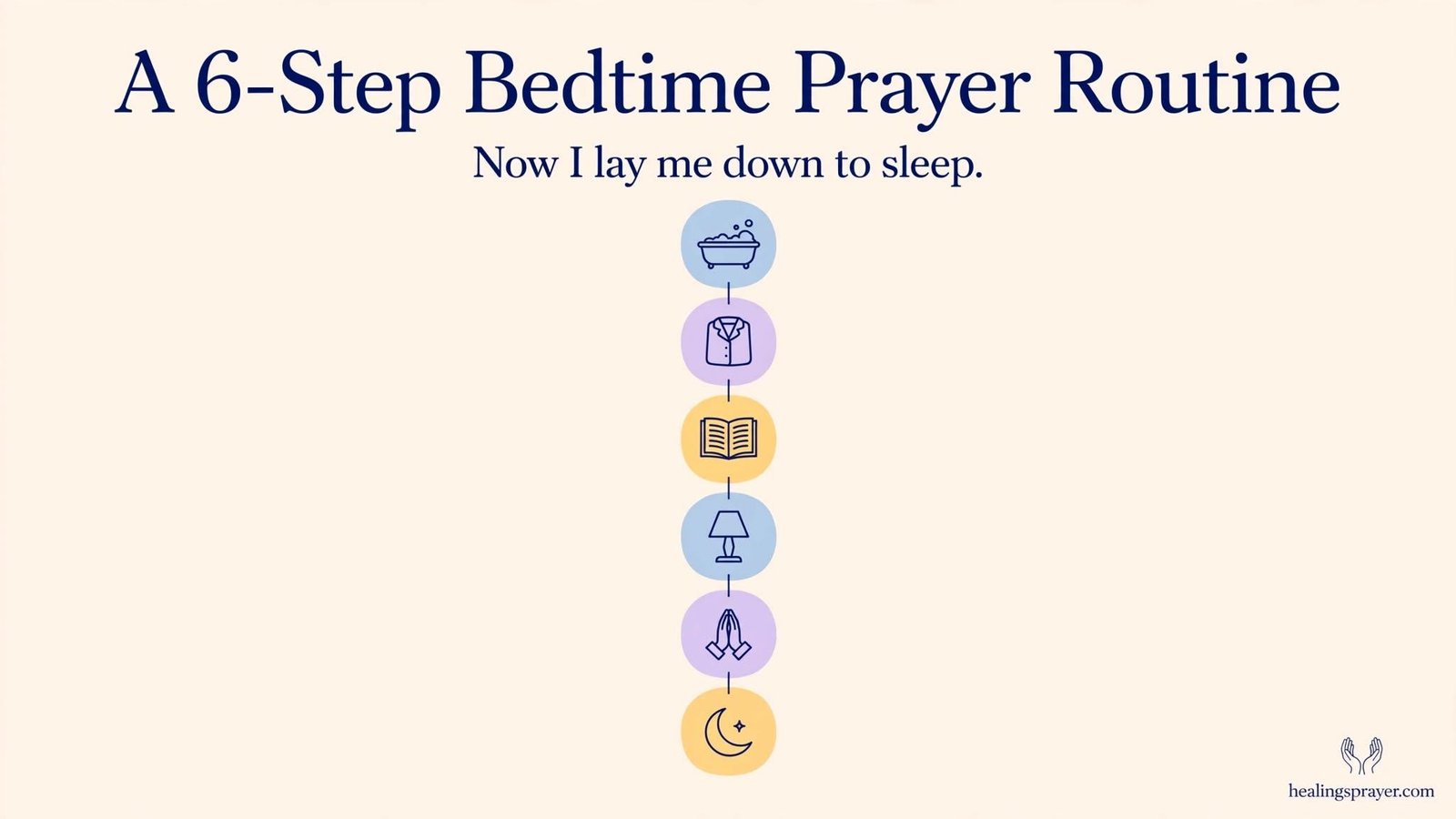
A 6-Step Bedtime Routine
- Start at the same time each night. A fixed time tells the body that sleep is coming.
- Dim the lights. Lower light helps children relax and get ready to listen.
- Say the prayer slowly. Speak one line at a time and let your child repeat it.
- Use hand gestures. Fold your hands on “pray,” lay a hand on your heart on “keep,” and rest your head on “sleep.”
- Add one blessing. Let your child name one person to pray for.
- End with a quiet closing. Say “Amen,” give a hug, and say goodnight softly.
How long it takes to learn: most children memorize the now i lay me down to sleep prayer within one to two weeks of nightly practice. Younger children may learn only the first two lines at first, and that is perfectly fine.
Ways to make it stick:
- Pair the prayer with a picture book that shows the words.
- Record yourself reading it so your child can listen on their own.
- Write the prayer on a small card by the bed.
- Let an older sibling lead the prayer sometimes.
- Keep a consistent tone. A calm voice matters more than correct pronunciation.
If your child resists, do not turn the prayer into a battle. Return to it on another night with a shorter version. The goal is comfort, not performance.
How to Personalize the Now I Lay Me Down to Sleep Prayer for Your Family
The now i lay me down to sleep prayer works best when it feels like your family’s own. Small changes make it more personal without losing the heart of the words. Here are eight practical ways to adapt it.
1. Change the ending to fit your child. Keep the first two lines and choose a closing that suits their age. A worried child may prefer “wake me with the morning light,” while an older child may want the traditional wording.
2. Add your child’s name. Say, “Now I lay me down to sleep, Lord, please watch over (name).” Hearing their own name helps younger children feel seen.
3. Add a gratitude line. Before the prayer, ask, “What was one good thing today?” Then let the answer lead into the now i lay me down to sleep prayer. This turns bedtime into a moment of thankfulness.
4. Use gestures. Folded hands on “pray,” a hand on the heart on “keep,” and a slow breath on “sleep” give restless children something to do and help them remember the words.
5. Use your home language. Families who speak more than one language can say the prayer in both. Hearing the same prayer in a first language builds comfort and cultural connection.
6. Add quiet music. A soft, slow lullaby after the prayer can help children relax. Keep the volume low and choose the same tune each night.
7. Adapt it for anxious or sensitive children. Use a gentle ending, speak slowly, and add a reassurance such as, “You are safe, and I am right here.” For children who struggle with fear at night, a short prayer repeated calmly is often more helpful than a long one.
8. Make it a family moment. Let each person say one line, or let the youngest lead. When the whole household joins the now i lay me down to sleep prayer, children see that prayer is something the family does together.
Quick personalization checklist:
- Does the ending match my child’s comfort level?
- Have I included something to be thankful for?
- Is the tone calm and unhurried?
- Can my child say at least part of it without help?
If you can answer yes to most of these, the now i lay me down to sleep prayer is working as it should. Review the choice every few months, because a prayer that fits a four-year-old may need a small change for an eight-year-old.
Common Mistakes With the Now I Lay Me Down to Sleep Prayer
Even a simple prayer can be used in ways that miss its purpose. Here are the most common problems and how to avoid them.
1. Ignoring a child’s fear of the “die” line. If your child looks worried, pause and explain, or switch to a gentler version of the now i lay me down to sleep prayer.
2. Rushing through the words. A hurried prayer becomes a chant. Slow down so each line has space.
3. Using the prayer as a threat or a tool for obedience. Never say, “Say your prayers or God will be upset.” The prayer should feel safe.
4. Expecting a child to understand everything at once. Meaning grows with age. Begin with comfort and add explanation over time.
5. Skipping the routine on busy nights. Even a thirty-second version keeps the habit alive.
6. Copying a version without checking the wording. Some online versions change lines in ways that do not match the traditional text. Read each version before teaching it.
7. Making the child perform for guests. Prayer is personal. Let your child pray quietly without being put on display.
8. Forgetting your own voice. Children remember tone more than text. A warm, steady voice is the most important part of the now i lay me down to sleep prayer.
Now I Lay Me Down to Sleep Prayer Versions at a Glance (Table)
This table summarizes the main forms of the now i lay me down to sleep prayer and when each works best.
| Version | Key Feature | Best For | Sample Line |
|---|---|---|---|
| Traditional | Classic four lines | Older children, adults | “If I should die before I wake” |
| “Guide Me” | Gentler ending | Sensitive children | “Thy love guard me through the night” |
| “Other Days” | Hopeful ending | Ages 4 to 8 | “If I should live for other days” |
| Toddler | Two short lines | Ages 2 to 3 | “God, please keep me safe and warm” |
| Gratitude | Adds thanks | Daily routine | “Thank You, God, for all I keep” |
| Family Blessing | Names loved ones | Siblings | “Bless my family, big and small” |
| Catholic | Adds angel and Mary | Catholic homes | “Guardian angel, watch me keep” |
| Adult | Calms worry | Sleepless nights | “Lord, quiet every worry deep” |
Frequently Asked Questions
What is the full now I lay me down to sleep prayer?
The full traditional now I lay me down to sleep prayer has four lines: “Now I lay me down to sleep, I pray the Lord my soul to keep; If I should die before I wake, I pray the Lord my soul to take.” Many families add “Amen” and a blessing for loved ones.
Who wrote the now I lay me down to sleep prayer?
The author of the now I lay me down to sleep prayer is unknown. The verse developed over time, and early versions appear in English printed material from the 1700s, including colonial schoolbooks such as the New England Primer.
What does the now I lay me down to sleep prayer mean?
The now I lay me down to sleep prayer asks God to protect a person’s soul during sleep and to receive them if they die in the night. It expresses trust in God during the most vulnerable hours of the day.
Is the now I lay me down to sleep prayer too scary for children?
It can feel scary to some children because of the line about dying, but gentler versions are widely used. You can keep the first two lines and replace the ending with “Thy love guard me through the night, and wake me with the morning light.”
Is the now I lay me down to sleep prayer Catholic?
It is a popular Christian family prayer, not an official Catholic liturgical prayer, but many Catholic families use it. It is often said together with the Guardian Angel prayer or a Hail Mary.
What is the “I pray the Lord my soul to keep” prayer?
“I pray the Lord my soul to keep” is the second line of the now I lay me down to sleep prayer. Many people use the line as the nickname for the whole prayer.
What is a good short bedtime prayer for kids?
A good short bedtime prayer is the two-line toddler version: “Now I lay me down to sleep, God, please keep me safe and warm.” It is easy for young children to learn and repeat.
At what age should a child learn the now I lay me down to sleep prayer?
Most children can begin learning the now I lay me down to sleep prayer around ages 2 to 3. Start with the first two lines and add the rest as the child grows.
Can adults say the now I lay me down to sleep prayer?
Yes, adults can say it at any time, and many do on nights when they feel anxious. The adult version above is written for calm and sleep.
Is it okay to change the words of the now I lay me down to sleep prayer?
Yes, it is fine to change the words, and families have done so for generations. Keep the heart of the prayer, which is trust in God’s care, and adjust the ending to suit your child’s age and comfort.
Is the now I lay me down to sleep prayer in the Bible?
The prayer itself is not in the Bible, but its ideas come from Scripture. Psalm 4:8, Psalm 3:5, and Psalm 31:5 carry the same themes of peaceful sleep and trusting God with your life.
Final Thoughts on the Now I Lay Me Down to Sleep Prayer
The now i lay me down to sleep prayer has lasted for centuries because it does something simple and difficult at once: it helps a person end the day by trusting God with the night. Its four lines offer protection, honesty, and peace in a form even a toddler can learn.
Whether you choose the traditional text, a gentler ending, a Catholic version, or one of the kids night prayers above, the most important part is the warm, steady presence of the person saying it with the child. A calm voice and a regular routine do more than perfect words.
Pick one version tonight, say it slowly, and add one blessing. Over time, the now i lay me down to sleep prayer becomes more than a bedtime habit. It becomes a memory of safety that a child carries into adulthood.
Sleep well, and may every night end in peace.

Welcome to Healings Prayer!
Healings Prayer is a faith-based platform created to offer comfort, hope, and encouragement through prayer and Scripture. Our mission is to help people find peace in difficult moments and draw closer to God through heartfelt prayers and Bible verses.