

What Is a Prayer Journal?
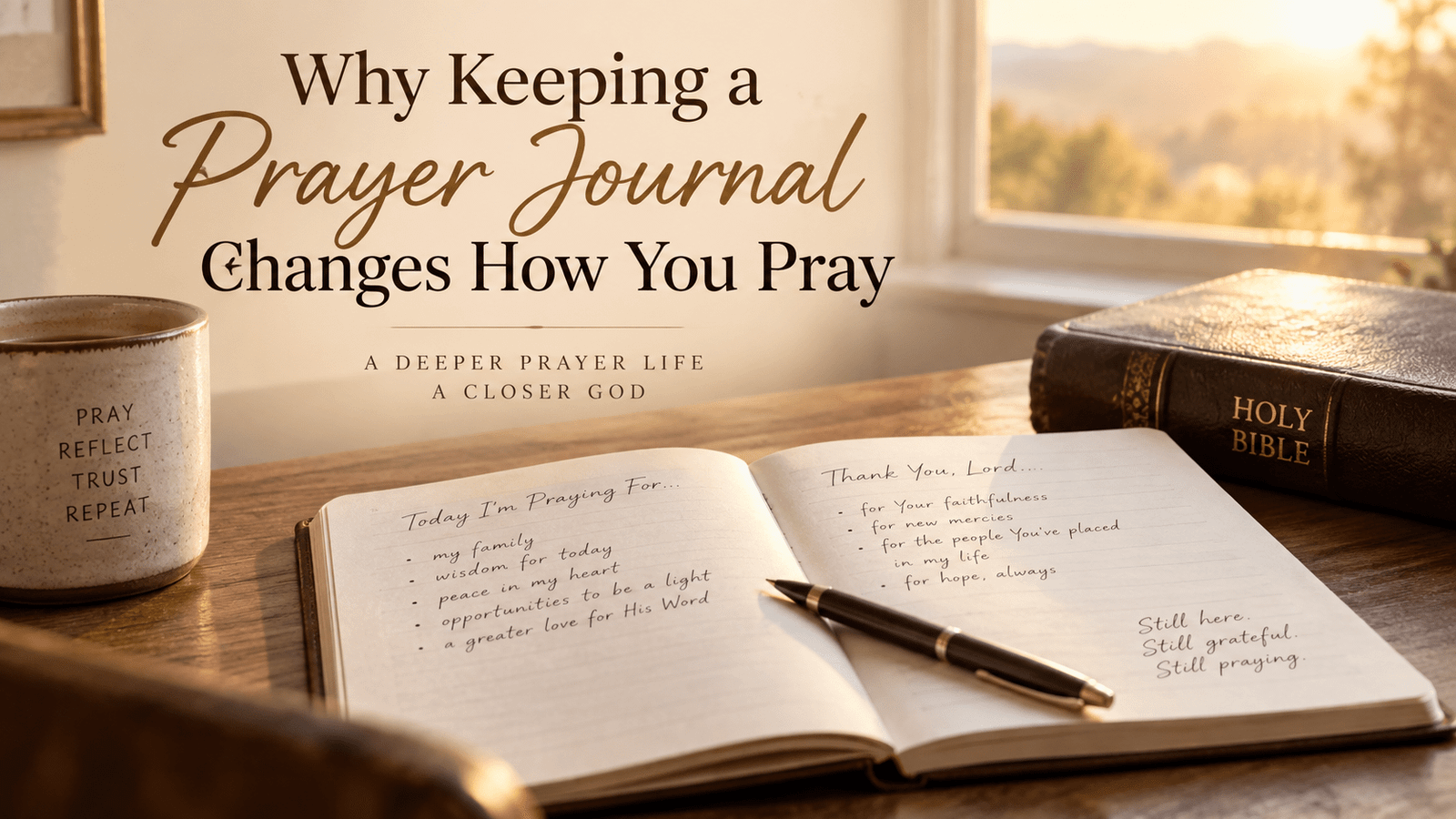
A prayer journal is a dedicated notebook where you write down your prayers, reflections, and the things you’re bringing to God, so you can track what you’re praying for and see how those prayers unfold over time.
Unlike a general diary, a prayer journal has a specific purpose: it’s a conversation record, not just a log of your day. It captures what you’re grateful for, what you’re struggling with, what you’re asking for, and what scripture or insight you’re sitting with — all in one place you return to again and again.
What makes it different from simply “praying in your head” is permanence. A spoken prayer disappears the moment it’s finished. A written one stays — which means you can revisit it, notice how your wording changes over months, and catch the exact moment a request quietly turned into an answer.
The value isn’t the notebook itself. It’s what happens when you flip back three months later and see the exact request you wrote down, now answered, sitting right there in your own handwriting — proof, in ink, that you weren’t just talking into the void.
Why Keeping a Prayer Journal Changes How You Pray
Most people’s prayer life is scattered — a few minutes in the car, a quick thought before bed, easily forgotten by morning. Writing changes that in four concrete ways.
It slows you down. You can’t write as fast as your mind wanders, so putting prayer on paper forces you to actually finish a thought instead of drifting to the next worry mid-sentence.
It creates evidence. Memory is unreliable, especially for things that resolved quietly. A written record of “I prayed for this on March 3rd” and “this was answered on April 20th” builds a kind of proof that’s easy to lose when prayer only lives in passing thoughts.
It makes patterns visible. When you write regularly, you start noticing what you actually pray about most — anxiety, a specific relationship, a recurring fear — patterns that are nearly impossible to spot when prayer only lives in your head.
It turns waiting into something active. Prayers that haven’t been answered yet can feel like dead weight when they only exist as vague worry. Writing them down gives the waiting a shape — you’re not just hoping, you’re tracking, which makes the in-between feel less passive.
The Core Elements of an Effective Prayer Journal
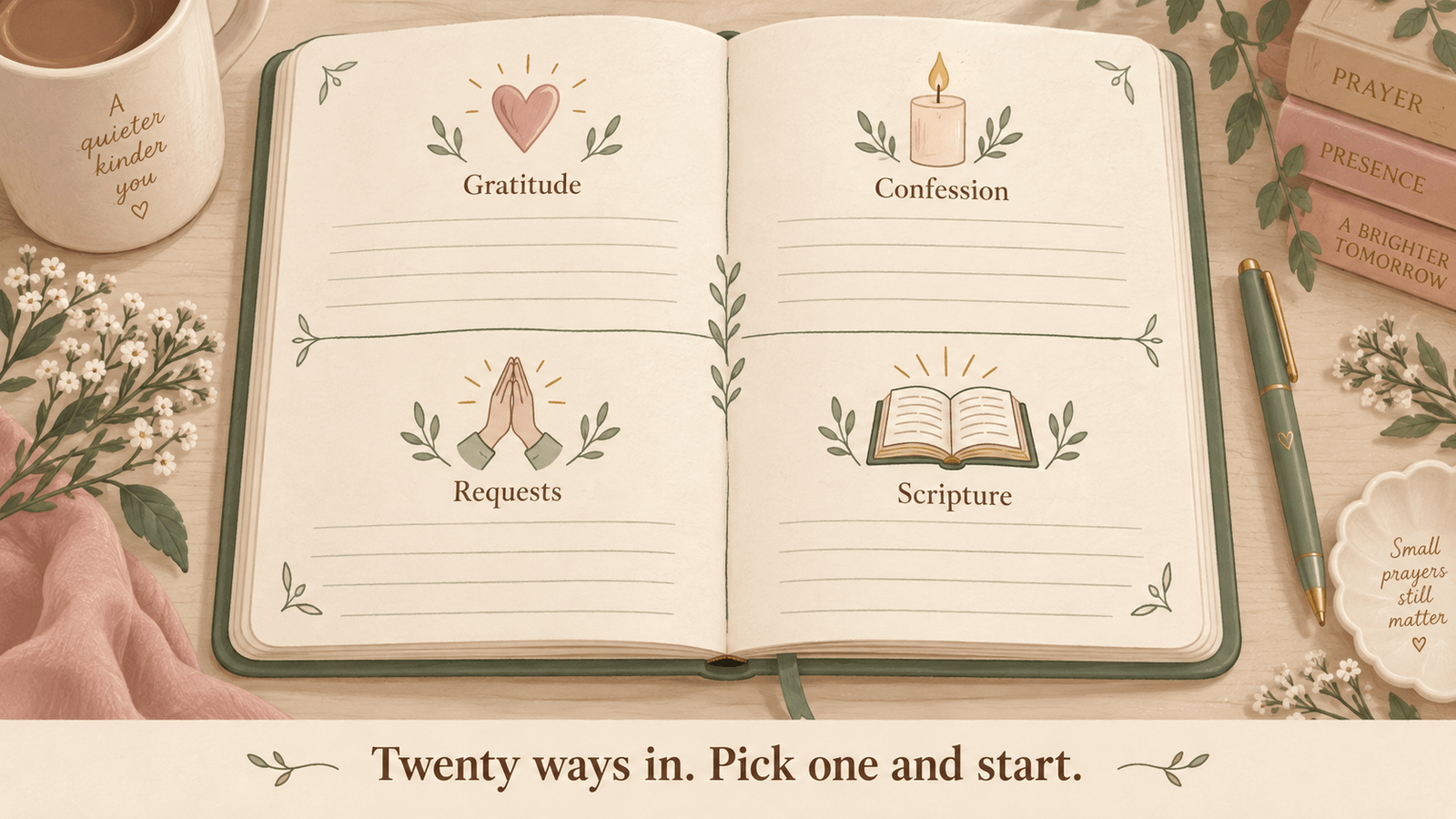
A prayer journal doesn’t need to be complicated, but it works best when it consistently covers these five areas instead of becoming a random collection of scattered thoughts.
Praise and Gratitude
Start with what you’re thankful for, even briefly. This shifts your posture before you move into requests or struggles — you’re entering the page already anchored in something good rather than starting from a place of need. Gratitude journaling, a well-documented practice in positive psychology, is consistently linked to improved mood and lower stress, and folding it into a prayer journal gives that benefit a spiritual dimension too.
Confession
A short, honest section for where you fell short — not to dwell in guilt, but to name it plainly and move forward. This doesn’t need elaboration or self-punishment; one honest sentence is enough to keep this section from becoming something you dread writing.
Also Read: Mindset Monday Quotes to Reset Your Thoughts
Requests and Intercession
What you’re asking for yourself and for others. Be specific. “Help my finances” is vague and hard to track; “help me pay off the $400 medical bill by June” is something you can actually check back on and later confirm as answered — specificity is what makes the answered-prayers section meaningful later.
Scripture and Reflection
A verse you read that day and one honest sentence on what it actually meant to you — not a sermon, not a summary, just your real, unfiltered reaction to it.
Answered Prayers
The most overlooked section and, quietly, the most important one. Without this, you’ll write requests forever and never circle back to notice what actually changed — which is the single biggest reason people describe prayer journaling as feeling “pointless” after a few months.
Also Read: Prayers for Marriage Restoration with Bible Verses for Healing
Ready-to-Use Prayer Journal Prompts You Can Start With Today
If you’re staring at a blank page, use any of these to get started right now. Pick one, write for five minutes, and stop overthinking the format — the goal is honesty, not eloquence.
Gratitude prompts:
- What’s one thing today that I almost didn’t notice, but I’m thankful for?
- Who showed me kindness recently that I haven’t thanked God for yet?
- What’s a prayer from months ago that’s already been answered, even quietly?
- What part of my body, health, or daily routine am I taking for granted?
Confession prompts:
5. Where did I react out of fear or frustration today instead of patience?
6. What am I avoiding admitting, even to myself?
7. Who do I need to forgive, including myself?
Request prompts:
8. What’s the specific outcome I’m hoping for in [situation], stated plainly?
9. What am I afraid to ask for because it feels too big or too selfish?
10. Who in my life needs prayer today that I haven’t named in weeks?
Scripture reflection prompts:
11. What verse stopped me today, and why did it stop me specifically?
12. Where do I see this passage showing up in my actual life this week?
13. What would it look like to actually live out what I just read, starting tomorrow?
Season and identity prompts:
14. What season of life do I feel like I’m in right now — waiting, building, healing, celebrating?
15. What’s one lie about myself I keep believing that I want to bring into the light?
16. What would change today if I actually believed this specific prayer would be answered?
Closing and reflection prompts:
17. What’s the one thing from today I want to remember a year from now?
18. Where did I feel closest to God this week, even briefly?
19. What’s something I need to let go of before I can move forward honestly?
20. If this were the last entry I ever wrote, what would I want it to say?
What to Do When You Don’t Feel Like Writing
Almost every guide skips this, but it’s the actual reason most prayer journals get abandoned by week three — not lack of interest, but lack of a plan for the days motivation disappears.
Give yourself a one-line minimum. On days you have nothing, write one honest sentence: “I don’t have words today, but I’m here.” That counts as a full entry. Consistency matters more than length, and a one-line day still keeps the habit alive.
Separate the habit from the mood. You don’t need to feel spiritual to journal — the writing itself is often what creates the feeling, not the other way around. Waiting to “feel ready” is usually what causes the gap to grow from one missed day into a month.
Keep a dedicated “dry season” page. Set aside one page specifically for seasons when prayer feels flat or distant. Writing “this feels empty right now” is still an honest, valid entry, and rereading it later often shows you it wasn’t permanent — which is its own kind of encouragement.
Lower the bar on formatting. Skip the prompts, skip the five-part structure, and just write three things you’re carrying today. A messy, three-line entry beats a beautifully formatted one you never got around to writing.
How to Make Your Prayer Journal Your Own
Once the basic habit is in place, personalize it so it actually fits your life instead of feeling like a rigid template you’re forcing yourself into.
- Match the format to your personality. If you’re a list person, use bullet points instead of full sentences. If you process best through writing, let entries run longer and more narrative.
- Pick a consistent time, not a perfect one. Right after coffee, during a lunch break, or right before bed — the specific time matters less than anchoring it to something you already do daily.
- Use color or symbols for quick scanning. A small star next to answered prayers, or a different ink color for requests versus gratitude, makes it dramatically faster to flip back and spot patterns months later.
- Revisit old entries on a schedule. Once a month, reread the last four weeks specifically looking for answered prayers you might have missed in the moment.
- Let it evolve with your season. A format that worked during a season of crisis might feel too heavy during a season of routine — adjust the structure as your life changes instead of forcing the same template forever, even if it stops fitting.
Also Read: Lovely Prayers for Relationships Strengthening with Bible Verses for Love
Common Prayer Journaling Mistakes to Avoid
Most people quit for one of these reasons, and each one has a simple, practical fix.
- Treating it like a performance. Writing what you think a “good” prayer sounds like instead of what’s actually true creates distance instead of connection. Write the real thing, even when it’s messy, repetitive, or angry.
- Skipping the answered-prayers section. Without this, journaling becomes an endless list of asking with no sense of resolution, which quietly drains motivation over weeks without you noticing why.
- Aiming for daily perfection. Missing two days doesn’t mean starting over — it means picking the notebook back up tomorrow. All-or-nothing thinking is the single biggest reason people abandon the habit within the first month.
- Making it too long to sustain. A journal that requires 20 minutes every day will get skipped on busy days and eventually resented. Five honest minutes, done consistently, outperforms a long entry done rarely.
- Never rereading past entries. The real value compounds only when you look back. A journal you never revisit is just a diary with extra steps and none of the payoff.
- Copying someone else’s format exactly. A structure that works for one person’s personality and season can feel forced and unsustainable for another — adapt it, don’t just replicate it wholesale.

Prayer Journal Methods Compared
| Method | Best For | Time Commitment | Real Example |
|---|---|---|---|
| Five-Part Structured (Praise, Confession, Request, Scripture, Answered) | People who want a repeatable daily system | 10–15 min | “Grateful for: sleep last night. Confession: snapped at my sister. Request: peace before Monday’s meeting.” |
| One-Line Minimum | Busy seasons or low-motivation days | Under 2 min | “Tired today, but thank you for getting me through it.” |
| Letter Format | People who process best through full sentences | 10–20 min | An entry written as “Dear God, today I’m struggling with…” continuing as an open letter. |
| Prompt-Based | Beginners who don’t know where to start | 5–10 min | Answering prompt #14 above: naming what season of life you’re currently in. |
| Answered Prayers Log Only | Supplementing an existing prayer habit | 2–5 min | A dated list: “March 3 — prayed for the interview. April 1 — got the job.” |
FAQ
Do I need to write in my prayer journal every day?
No — consistency matters more than daily perfection. Three to five entries a week, even short ones, builds the habit without the pressure that causes most people to quit within a month.
What’s the difference between a prayer journal and a gratitude journal?
A gratitude journal focuses only on thankfulness, while a prayer journal includes gratitude alongside confession, requests, and scripture reflection as part of one ongoing conversation.
Should I write my prayers as if I’m talking to God directly?
Either works — some people write in direct second person (“God, I’m asking for…”) and others write in reflective third person about their day. Use whichever feels most natural and honest to you personally.
What if I run out of things to write?
Use a prompt instead of starting from a blank page, and remember that a single honest sentence is a complete entry — you never need to fill the whole page to make it count.
Is a physical notebook better than a digital prayer journal app?
Physical notebooks tend to slow you down and reduce distraction, but a digital format works just as well if it’s the one you’ll actually use consistently — the right format is whichever one you genuinely keep returning to.
Also Read: Powerful Fasting Prayers with Bible Verses for Breakthrough
Your Next Step
Don’t wait for the “right” notebook or the perfect first entry — open to a blank page right now, pick one prompt from this list, and write for five minutes. That single entry is the whole habit starting.

Welcome to Healings Prayer!
Healings Prayer is a faith-based platform created to offer comfort, hope, and encouragement through prayer and Scripture. Our mission is to help people find peace in difficult moments and draw closer to God through heartfelt prayers and Bible verses.